Bolivia Canned Tuna Market Top 5 Importing Countries and Market Competition (HHI) Analysis
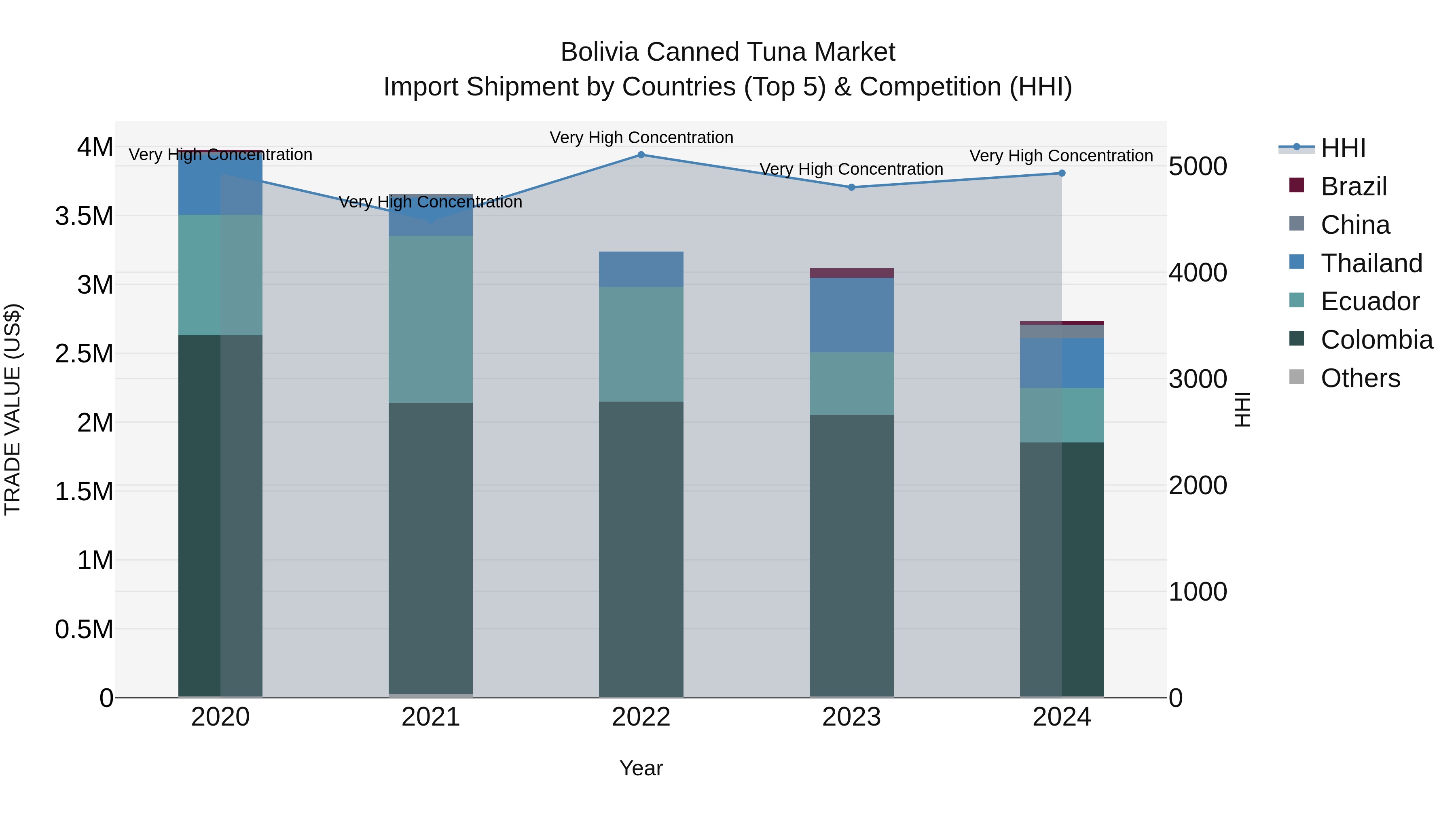
In 2024, Bolivia continued to heavily rely on imports of canned tuna, with top suppliers including Colombia, Ecuador, Thailand, China, and Brazil. The high Herfindahl-Hirschman Index (HHI) indicates a market dominated by a small number of major players. The compound annual growth rate (CAGR) from 2020 to 2024 was negative at -8.94%, with a significant decline in growth rate from 2023 to 2024 at -12.41%. These trends suggest a challenging market environment for canned tuna imports in Bolivia, potentially impacted by various economic factors and market dynamics.
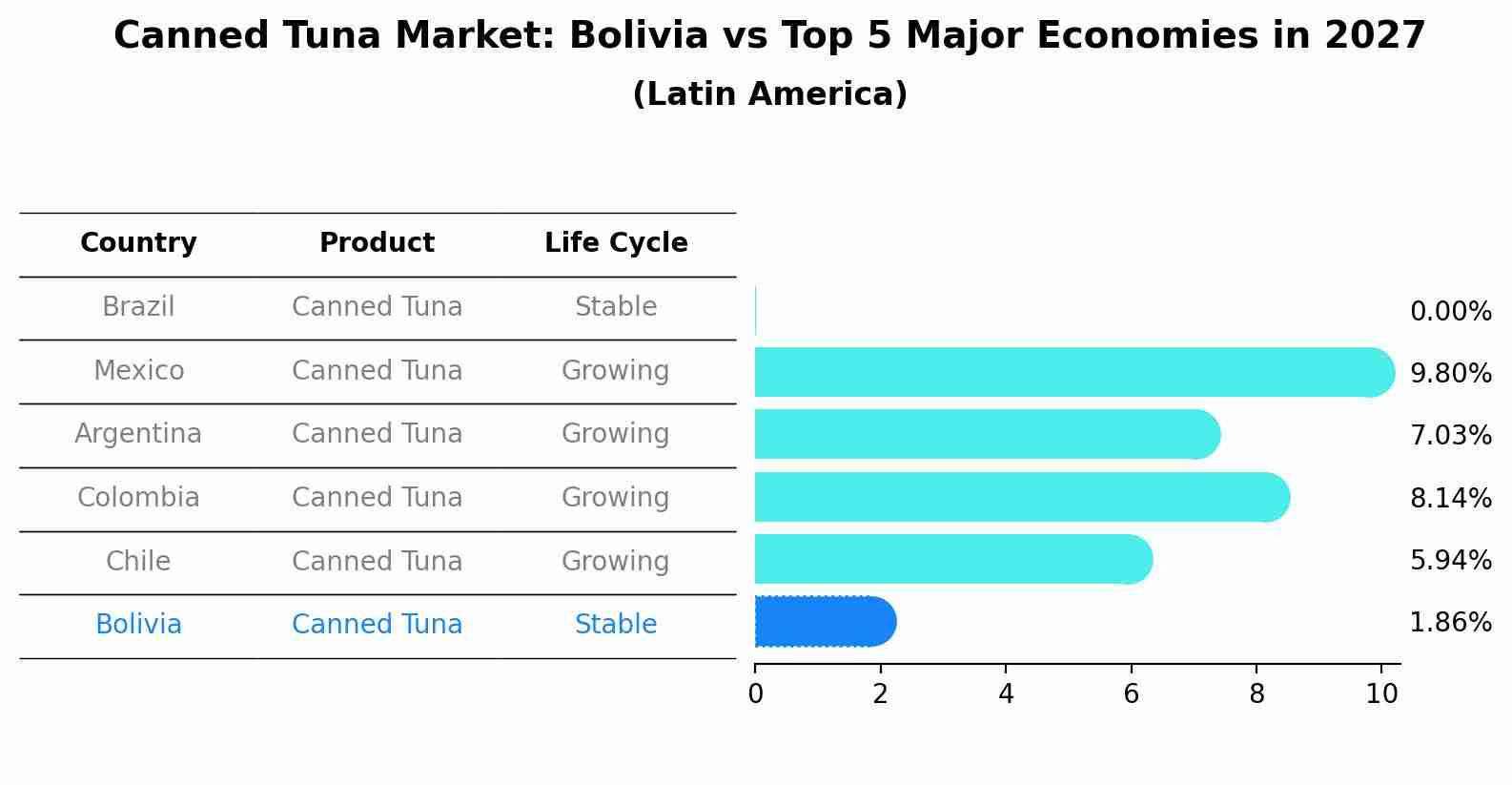
Canned Tuna Market: Bolivia vs Top 5 Major Economies in 2027 (Latin America)
The Canned Tuna market in Bolivia is projected to grow at a stable growth rate of 1.86% by 2027, within the Latin America region led by Brazil, along with other countries like Mexico, Argentina, Colombia and Chile, collectively shaping a dynamic and evolving market environment driven by innovation and increasing adoption of emerging technologies.
Bolivia Canned Tuna Market Overview
Bolivia`s canned tuna market is stable, with tuna being a popular choice for its taste, nutrition, and convenience. The market is driven by both local consumption and the import of canned tuna from international suppliers.
Drivers of the market
The Bolivia canned tuna market is driven by the increasing consumption of tuna as a rich source of protein and omega-3 fatty acids. The demand for convenient and ready-to-eat tuna products, coupled with the growing health consciousness among consumers, supports market growth.
Challenges of the market
The canned tuna market in Bolivia encounters challenges related to fluctuating raw material prices and the need for effective quality control and packaging solutions. Canned tuna is a widely consumed product, but the market must navigate issues related to ingredient costs and competition from alternative seafood products.
Government Policy of the market
The Bolivian government is encouraging the development of the canned tuna market as part of its broader strategy to support the food processing industry. Policies include tax breaks for tuna processors and subsidies for companies that invest in sustainable fishing practices. The government also promotes the consumption of canned tuna in domestic markets through public health campaigns that highlight its nutritional benefits.
Key Highlights of the Report:
- Bolivia Canned Tuna Market Outlook
- Market Size of Bolivia Canned Tuna Market, 2024
- Forecast of Bolivia Canned Tuna Market, 2031
- Historical Data and Forecast of Bolivia Canned Tuna Revenues & Volume for the Period 2021-2031
- Bolivia Canned Tuna Market Trend Evolution
- Bolivia Canned Tuna Market Drivers and Challenges
- Bolivia Canned Tuna Price Trends
- Bolivia Canned Tuna Porter`s Five Forces
- Bolivia Canned Tuna Industry Life Cycle
- Historical Data and Forecast of Bolivia Canned Tuna Market Revenues & Volume By Product for the Period 2021-2031
- Historical Data and Forecast of Bolivia Canned Tuna Market Revenues & Volume By Skipjack for the Period 2021-2031
- Historical Data and Forecast of Bolivia Canned Tuna Market Revenues & Volume By Yellowfin for the Period 2021-2031
- Historical Data and Forecast of Bolivia Canned Tuna Market Revenues & Volume By Others for the Period 2021-2031
- Historical Data and Forecast of Bolivia Canned Tuna Market Revenues & Volume By Distribution Channel for the Period 2021-2031
- Historical Data and Forecast of Bolivia Canned Tuna Market Revenues & Volume By Hypermarket & Supermarket for the Period 2021-2031
- Historical Data and Forecast of Bolivia Canned Tuna Market Revenues & Volume By Specialty Stores for the Period 2021-2031
- Historical Data and Forecast of Bolivia Canned Tuna Market Revenues & Volume By Online for the Period 2021-2031
- Bolivia Canned Tuna Import Export Trade Statistics
- Market Opportunity Assessment By Product
- Market Opportunity Assessment By Distribution Channel
- Bolivia Canned Tuna Top Companies Market Share
- Bolivia Canned Tuna Competitive Benchmarking By Technical and Operational Parameters
- Bolivia Canned Tuna Company Profiles
- Bolivia Canned Tuna Key Strategic Recommendations






































