Bolivia Commercial Aircraft Market Top 5 Importing Countries and Market Competition (HHI) Analysis
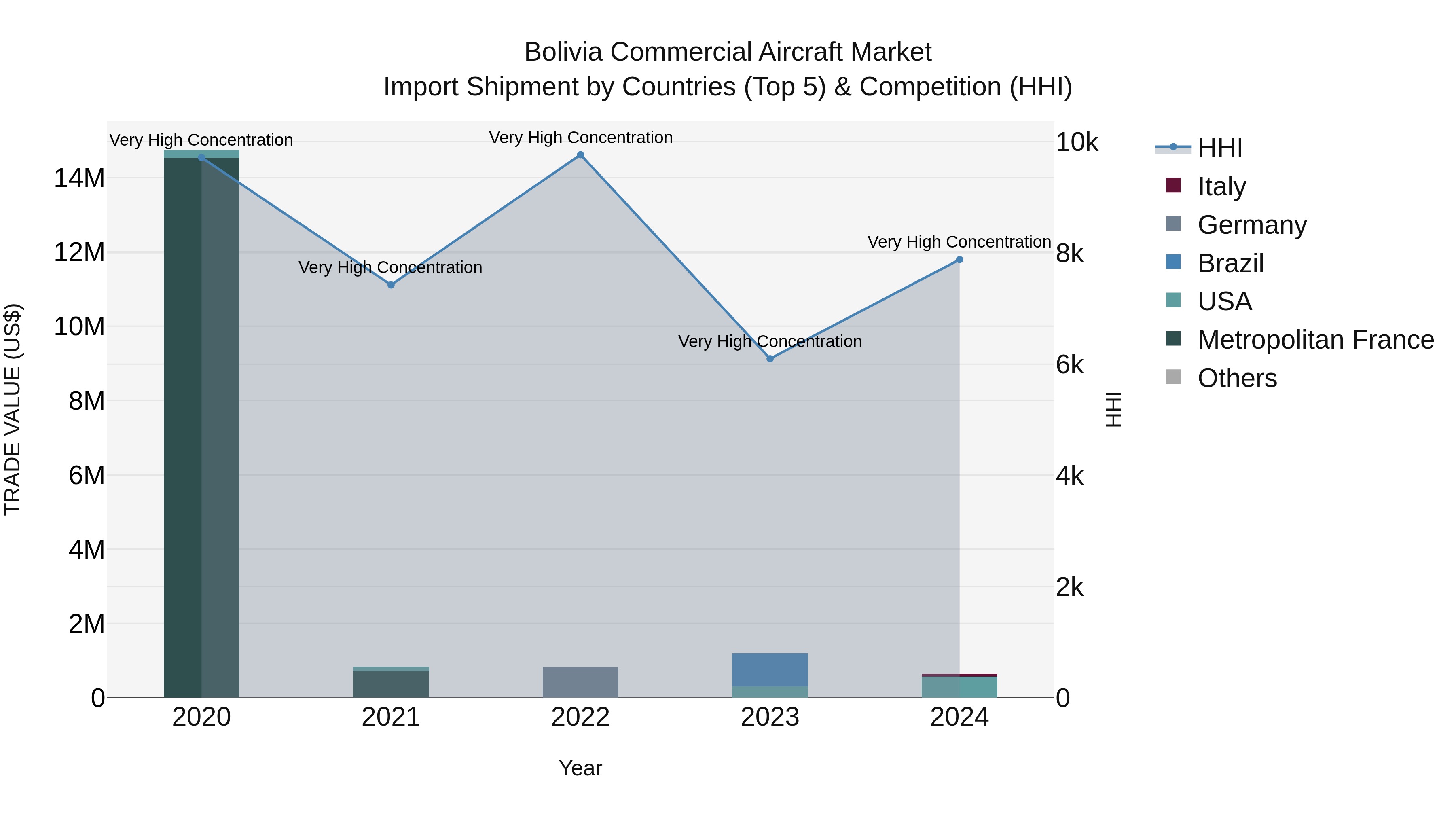
In 2024, Bolivia continued to rely on imports of commercial aircraft, with top exporters being the USA, Italy, Brazil, Germany, and Metropolitan France. Despite a high Herfindahl-Hirschman Index (HHI) indicating market concentration, the industry experienced a significant decline in CAGR of -54.37% from 2020 to 2024. The negative growth rate of -46.5% from 2023 to 2024 suggests ongoing challenges in the sector. Bolivia reliance on these key exporting countries highlights the importance of monitoring global trends and fostering strategic partnerships to support the aviation industry`s development.
Bolivia Commercial Aircraft Market Overview
The commercial aircraft market in Bolivia is expanding with the growth of the aviation sector and increasing demand for air travel. Commercial aircraft are used for passenger and cargo transport. The market growth is supported by investments in aviation infrastructure and the rising number of air travelers.
Drivers of the market
The commercial aircraft market in Bolivia is driven by the expansion of the aviation sector and increasing travel demand. As Bolivia continues to develop its aviation infrastructure and tourism industry, the need for modern and efficient commercial aircraft grows. Investments in airport infrastructure and rising consumer travel preferences contribute to the growth of the commercial aircraft market.
Challenges of the market
The commercial aircraft market in Bolivia encounters challenges related to infrastructure and market demand. Limited infrastructure for aircraft maintenance and operations can hinder market growth, especially in regions with fewer airports or repair facilities. Additionally, fluctuations in global aviation demand and economic conditions can impact the market for new aircraft. Addressing these challenges involves improving infrastructure, expanding market access, and adapting to changing economic conditions and technological advancements in the aviation industry.
Government Policy of the market
The commercial aircraft market in Bolivia is subject to regulations that ensure the safety, performance, and environmental impact of aircraft used for passenger and cargo transport. The government imposes standards for aircraft design, manufacturing, and operation. Policies support the growth of local commercial aircraft industries and advancements in aviation technology while ensuring compliance with international safety standards.
Key Highlights of the Report:
- Bolivia Commercial Aircraft Market Outlook
- Market Size of Bolivia Commercial Aircraft Market, 2024
- Forecast of Bolivia Commercial Aircraft Market, 2031
- Historical Data and Forecast of Bolivia Commercial Aircraft Revenues & Volume for the Period 2021-2031
- Bolivia Commercial Aircraft Market Trend Evolution
- Bolivia Commercial Aircraft Market Drivers and Challenges
- Bolivia Commercial Aircraft Price Trends
- Bolivia Commercial Aircraft Porter`s Five Forces
- Bolivia Commercial Aircraft Industry Life Cycle
- Historical Data and Forecast of Bolivia Commercial Aircraft Market Revenues & Volume By Aircraft Type for the Period 2021-2031
- Historical Data and Forecast of Bolivia Commercial Aircraft Market Revenues & Volume By Narrow Body Aircrafts for the Period 2021-2031
- Historical Data and Forecast of Bolivia Commercial Aircraft Market Revenues & Volume By Wide Body Aircrafts for the Period 2021-2031
- Historical Data and Forecast of Bolivia Commercial Aircraft Market Revenues & Volume By Regional Jets for the Period 2021-2031
- Historical Data and Forecast of Bolivia Commercial Aircraft Market Revenues & Volume By Turboprop Aircrafts for the Period 2021-2031
- Bolivia Commercial Aircraft Import Export Trade Statistics
- Market Opportunity Assessment By Aircraft Type
- Bolivia Commercial Aircraft Top Companies Market Share
- Bolivia Commercial Aircraft Competitive Benchmarking By Technical and Operational Parameters
- Bolivia Commercial Aircraft Company Profiles
- Bolivia Commercial Aircraft Key Strategic Recommendations






































