Bolivia Glycerol Market Top 5 Importing Countries and Market Competition (HHI) Analysis
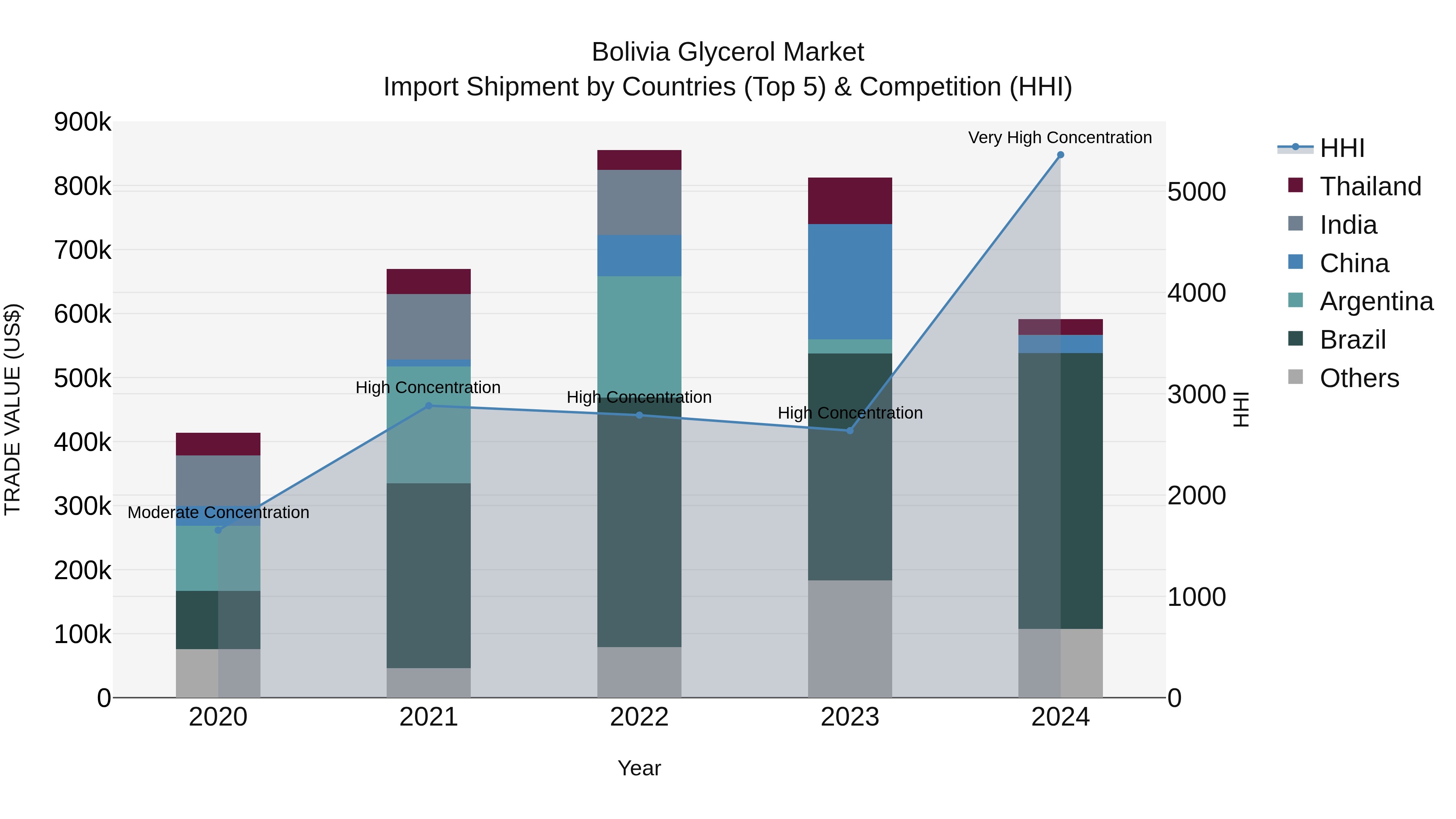
Bolivia glycerol import market saw a significant shift in 2024, with top exporters including Brazil, Netherlands, Peru, China, and Thailand. The market concentration, as measured by the HHI, reached very high levels, indicating a competitive landscape dominated by a few key players. Despite a negative growth rate in 2024, the compound annual growth rate over the past four years has been strong at 9.31%, highlighting the overall growth potential in the glycerol import sector in Bolivia. Monitoring market dynamics and competitive strategies will be crucial for stakeholders to navigate this evolving market landscape.
Glycerol Market: Bolivia vs Top 5 Major Economies in 2027 (Latin America)
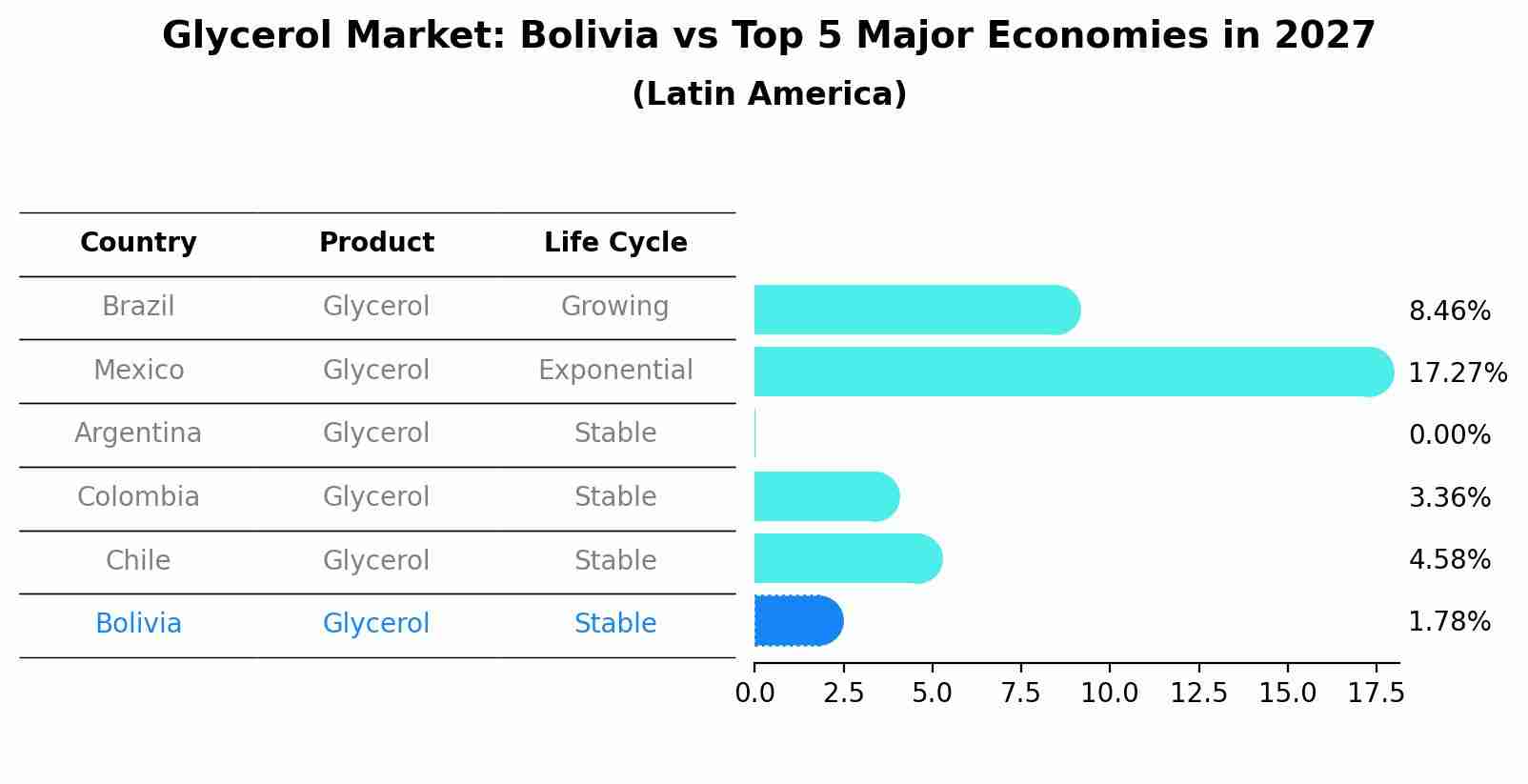
The Glycerol market in Bolivia is projected to grow at a stable growth rate of 1.78% by 2027, within the Latin America region led by Brazil, along with other countries like Mexico, Argentina, Colombia and Chile, collectively shaping a dynamic and evolving market environment driven by innovation and increasing adoption of emerging technologies.
Bolivia Glycerol Market Overview
The glycerol market in Bolivia is expanding, supported by its applications in food, cosmetics, pharmaceuticals, and industrial processes. Glycerol, a byproduct of biodiesel production, offers similar properties to glycerin, including its use as a humectant and solvent.
Drivers of the market
The Bolivia glycerol market is driven by its widespread use as a solvent, sweetener, and emollient in various applications, including food, pharmaceuticals, and cosmetics. Glycerols role in enhancing product stability and its applications in health and wellness products contribute to market expansion. The growth of the cosmetic and pharmaceutical industries supports demand.
Challenges of the market
The glycerol market in Bolivia encounters challenges such as high import costs and limited local manufacturing facilities. The market also faces difficulties related to the consistent quality and supply of glycerol products. Additionally, there is a need for better consumer education about the applications and benefits of glycerol in various industries.
Government Policy of the market
The Bolivian government oversees the glycerol market to ensure the quality and safety of this compound used in various industrial and consumer products. Policies include standards for glycerol composition, production, and environmental impact to support effective and sustainable use.
Key Highlights of the Report:
- Bolivia Glycerol Market Outlook
- Market Size of Bolivia Glycerol Market, 2024
- Forecast of Bolivia Glycerol Market, 2031
- Historical Data and Forecast of Bolivia Glycerol Revenues & Volume for the Period 2021-2031
- Bolivia Glycerol Market Trend Evolution
- Bolivia Glycerol Market Drivers and Challenges
- Bolivia Glycerol Price Trends
- Bolivia Glycerol Porter`s Five Forces
- Bolivia Glycerol Industry Life Cycle
- Historical Data and Forecast of Bolivia Glycerol Market Revenues & Volume By Source for the Period 2021-2031
- Historical Data and Forecast of Bolivia Glycerol Market Revenues & Volume By Biodiesel for the Period 2021-2031
- Historical Data and Forecast of Bolivia Glycerol Market Revenues & Volume By Fatty Alcohols for the Period 2021-2031
- Historical Data and Forecast of Bolivia Glycerol Market Revenues & Volume By Fatty Acids for the Period 2021-2031
- Historical Data and Forecast of Bolivia Glycerol Market Revenues & Volume By Soap for the Period 2021-2031
- Historical Data and Forecast of Bolivia Glycerol Market Revenues & Volume By Type for the Period 2021-2031
- Historical Data and Forecast of Bolivia Glycerol Market Revenues & Volume By Crude for the Period 2021-2031
- Historical Data and Forecast of Bolivia Glycerol Market Revenues & Volume By Refined for the Period 2021-2031
- Historical Data and Forecast of Bolivia Glycerol Market Revenues & Volume By End-use for the Period 2021-2031
- Historical Data and Forecast of Bolivia Glycerol Market Revenues & Volume By Food & Beverage for the Period 2021-2031
- Historical Data and Forecast of Bolivia Glycerol Market Revenues & Volume By Pharmaceutical for the Period 2021-2031
- Historical Data and Forecast of Bolivia Glycerol Market Revenues & Volume By Nutraceutical for the Period 2021-2031
- Historical Data and Forecast of Bolivia Glycerol Market Revenues & Volume By Personal Care & Cosmetics for the Period 2021-2031
- Historical Data and Forecast of Bolivia Glycerol Market Revenues & Volume By Industrial for the Period 2021-2031
- Historical Data and Forecast of Bolivia Glycerol Market Revenues & Volume By Others for the Period 2021-2031
- Bolivia Glycerol Import Export Trade Statistics
- Market Opportunity Assessment By Source
- Market Opportunity Assessment By Type
- Market Opportunity Assessment By End-use
- Bolivia Glycerol Top Companies Market Share
- Bolivia Glycerol Competitive Benchmarking By Technical and Operational Parameters
- Bolivia Glycerol Company Profiles
- Bolivia Glycerol Key Strategic Recommendations






































