Bolivia Insect Repellent Market Top 5 Importing Countries and Market Competition (HHI) Analysis
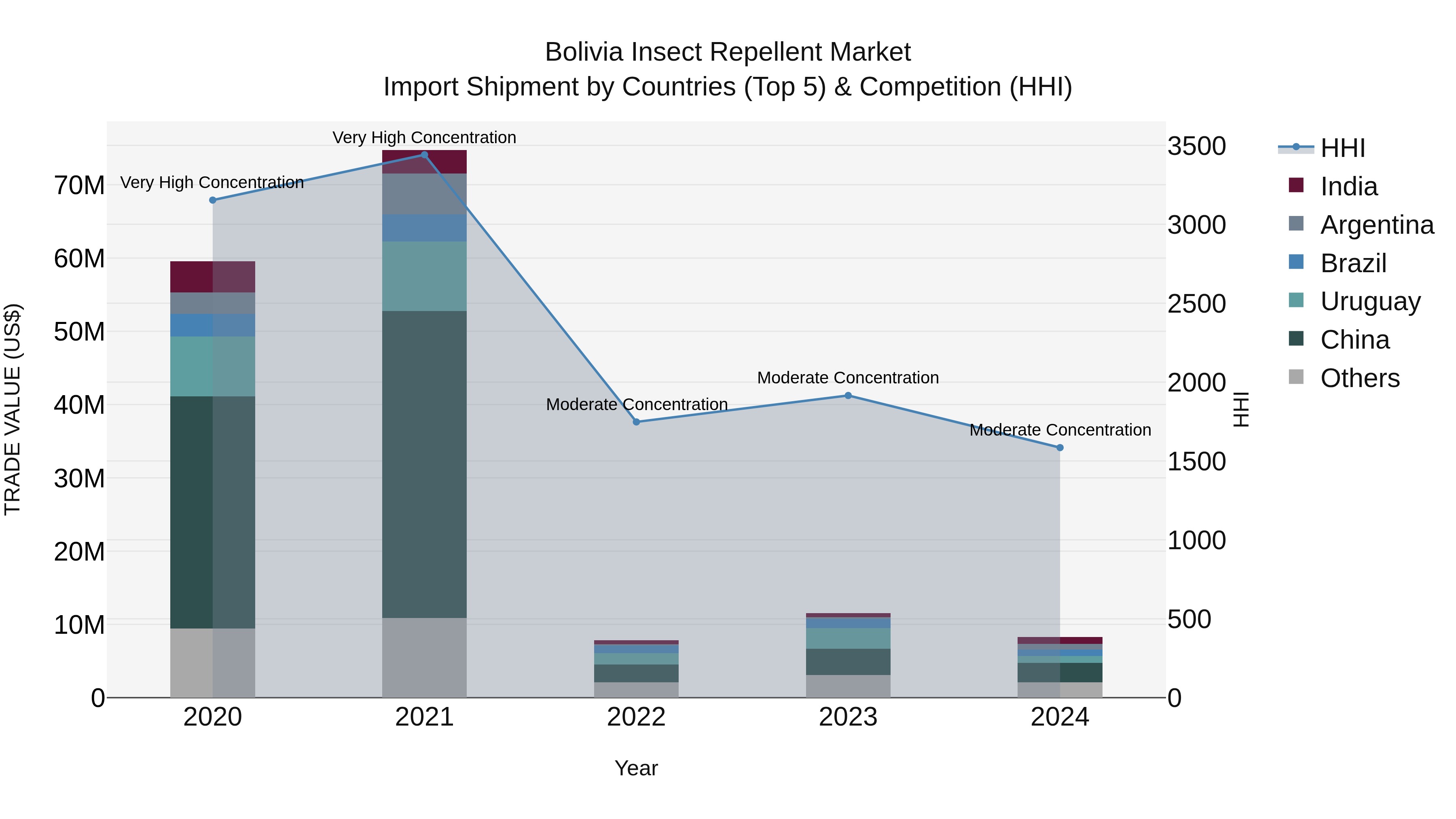
In 2024, Bolivia continued to rely on insect repellent imports from diverse sources, with China, Uruguay, India, Brazil, and Argentina leading the way. Despite a negative CAGR of -38.93% from 2020 to 2024, the market showed signs of stabilization with a growth rate of -28.14% in 2023-24. The Herfindahl-Hirschman Index (HHI) indicated moderate concentration, suggesting a competitive market landscape. This data highlights the importance of strategic sourcing and market dynamics in the Bolivian insect repellent industry.
Bolivia Insect Repellent Market Overview
The Bolivia insect repellent market is characterized by a growing demand for products that protect against mosquito-borne diseases such as dengue, Zika, and malaria. Consumers in Bolivia are increasingly aware of the importance of using insect repellents to prevent these diseases, driving the market growth. Key players in the market offer a range of products including sprays, lotions, and wearable devices infused with repellent compounds such as DEET, picaridin, and natural ingredients like citronella and eucalyptus. The market is also witnessing a trend towards eco-friendly and skin-friendly formulations to cater to the preferences of environmentally conscious consumers. Distribution channels include pharmacies, supermarkets, online retailers, and outdoor gear stores. With a focus on innovation and product differentiation, the Bolivia insect repellent market is poised for further expansion in the coming years.
Bolivia Insect Repellent Market Trends and Opportunities
In Bolivia, the insect repellent market is experiencing growth due to increasing awareness about insect-borne diseases such as dengue fever and Zika virus. Consumers are seeking natural and eco-friendly repellent options, leading to a rising demand for products containing ingredients like citronella, eucalyptus, and lemongrass. There is also a trend towards convenient and portable insect repellent solutions such as wristbands, patches, and sprays for outdoor activities. Opportunities exist for companies to innovate in packaging and formulation to cater to these preferences, as well as to expand distribution channels to reach more consumers across the country. With a focus on effective marketing strategies highlighting the benefits of natural ingredients and convenience, companies can capitalize on the growing demand for insect repellents in Bolivia.
Bolivia Insect Repellent Market Challenges
In the Bolivia Insect Repellent Market, some key challenges include the presence of traditional home remedies that compete with commercial insect repellent products, limited awareness about the importance of using insect repellents to prevent diseases like dengue and Zika virus, and price sensitivity among consumers due to the country`s economic conditions. Additionally, the market faces issues related to distribution channels in reaching remote rural areas where insect-borne diseases are prevalent. Regulatory hurdles and concerns about the safety and effectiveness of certain chemical ingredients used in insect repellents also pose challenges for companies trying to enter and expand in the Bolivia market. Overcoming these challenges will require targeted marketing efforts, education campaigns on the benefits of using insect repellents, partnerships with local health authorities, and the development of affordable yet high-quality products to cater to the diverse consumer base in Bolivia.
Bolivia Insect Repellent Market Drivers
The Bolivia Insect Repellent Market is primarily driven by factors such as increasing awareness about insect-borne diseases like dengue, Zika, and malaria, leading to a higher demand for insect repellent products. Additionally, the rise in outdoor recreational activities and travel tourism in Bolivia has further fueled the market growth as individuals seek protection against insect bites. The availability of a variety of insect repellent products catering to different preferences and needs of consumers, including natural and DEET-based formulations, also contributes to market expansion. Furthermore, the government initiatives promoting public health and safety measures against insect-borne illnesses play a significant role in driving the demand for insect repellents in Bolivia.
Bolivia Insect Repellent Market Government Policies
In Bolivia, government policies related to the insect repellent market focus on product safety and environmental protection. The Ministry of Health regulates the registration and approval of insect repellent products to ensure they meet safety standards and are effective in repelling insects. Additionally, there are policies in place to minimize the environmental impact of these products, particularly in terms of their disposal and use in sensitive ecosystems. The government also encourages the use of natural and eco-friendly insect repellents through awareness campaigns and incentives for manufacturers. Overall, Bolivia`s government policies in the insect repellent market aim to protect public health, promote sustainability, and encourage responsible use of insect repellent products.
Bolivia Insect Repellent Market Future Outlook
The Bolivia Insect Repellent Market is expected to witness steady growth in the coming years, driven by increasing awareness about insect-borne diseases and the growing preference for natural and eco-friendly products. With a rise in outdoor activities and travel, the demand for insect repellents is likely to surge among the population. Consumers are also becoming more conscious about the harmful effects of chemical-based repellents, leading to a shift towards organic and plant-based alternatives. Key players in the market are focusing on product innovation, incorporating advanced technologies for longer-lasting and more effective formulations. Overall, the market is poised for expansion, supported by changing consumer preferences and the rising need for protection against insect-borne illnesses.
Key Highlights of the Report:
- Bolivia Insect Repellent Market Outlook
- Market Size of Bolivia Insect Repellent Market, 2024
- Forecast of Bolivia Insect Repellent Market, 2031
- Historical Data and Forecast of Bolivia Insect Repellent Revenues & Volume for the Period 2021- 2031
- Bolivia Insect Repellent Market Trend Evolution
- Bolivia Insect Repellent Market Drivers and Challenges
- Bolivia Insect Repellent Price Trends
- Bolivia Insect Repellent Porter's Five Forces
- Bolivia Insect Repellent Industry Life Cycle
- Historical Data and Forecast of Bolivia Insect Repellent Market Revenues & Volume By Type for the Period 2021- 2031
- Historical Data and Forecast of Bolivia Insect Repellent Market Revenues & Volume By Mosquito Repellent for the Period 2021- 2031
- Historical Data and Forecast of Bolivia Insect Repellent Market Revenues & Volume By Bugs Repellent for the Period 2021- 2031
- Historical Data and Forecast of Bolivia Insect Repellent Market Revenues & Volume By Fly Repellent for the Period 2021- 2031
- Historical Data and Forecast of Bolivia Insect Repellent Market Revenues & Volume By Others for the Period 2021- 2031
- Historical Data and Forecast of Bolivia Insect Repellent Market Revenues & Volume By Product Type for the Period 2021- 2031
- Historical Data and Forecast of Bolivia Insect Repellent Market Revenues & Volume By Vaporizers for the Period 2021- 2031
- Historical Data and Forecast of Bolivia Insect Repellent Market Revenues & Volume By Spray for the Period 2021- 2031
- Historical Data and Forecast of Bolivia Insect Repellent Market Revenues & Volume By Cream for the Period 2021- 2031
- Historical Data and Forecast of Bolivia Insect Repellent Market Revenues & Volume By Others for the Period 2021- 2031
- Bolivia Insect Repellent Import Export Trade Statistics
- Market Opportunity Assessment By Type
- Market Opportunity Assessment By Product Type
- Bolivia Insect Repellent Top Companies Market Share
- Bolivia Insect Repellent Competitive Benchmarking By Technical and Operational Parameters
- Bolivia Insect Repellent Company Profiles
- Bolivia Insect Repellent Key Strategic Recommendations






































