Bolivia Iodine Market Top 5 Importing Countries and Market Competition (HHI) Analysis
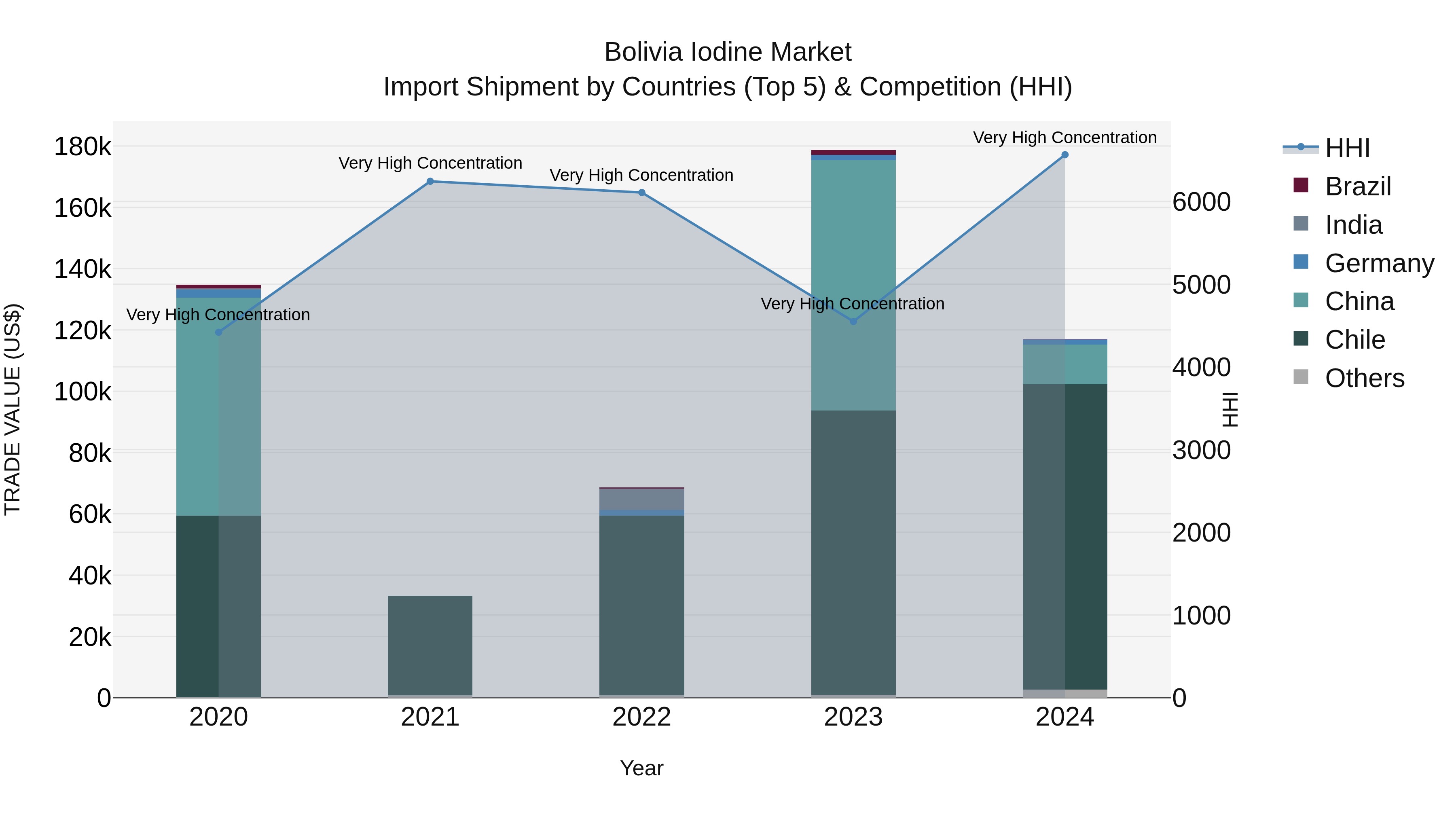
Bolivia iodine import market in 2024 saw continued dominance from top exporters Chile, China, Germany, Argentina, and Metropolitan France. The high concentration of the Herfindahl-Hirschman Index (HHI) indicates a consolidated market. However, the industry experienced a negative compound annual growth rate (CAGR) of -3.47% from 2020-2024, with a significant decline in growth rate of -34.48% from 2023-2024. This suggests a challenging landscape for iodine import shipments to Bolivia, potentially influenced by various factors affecting the global iodine market.
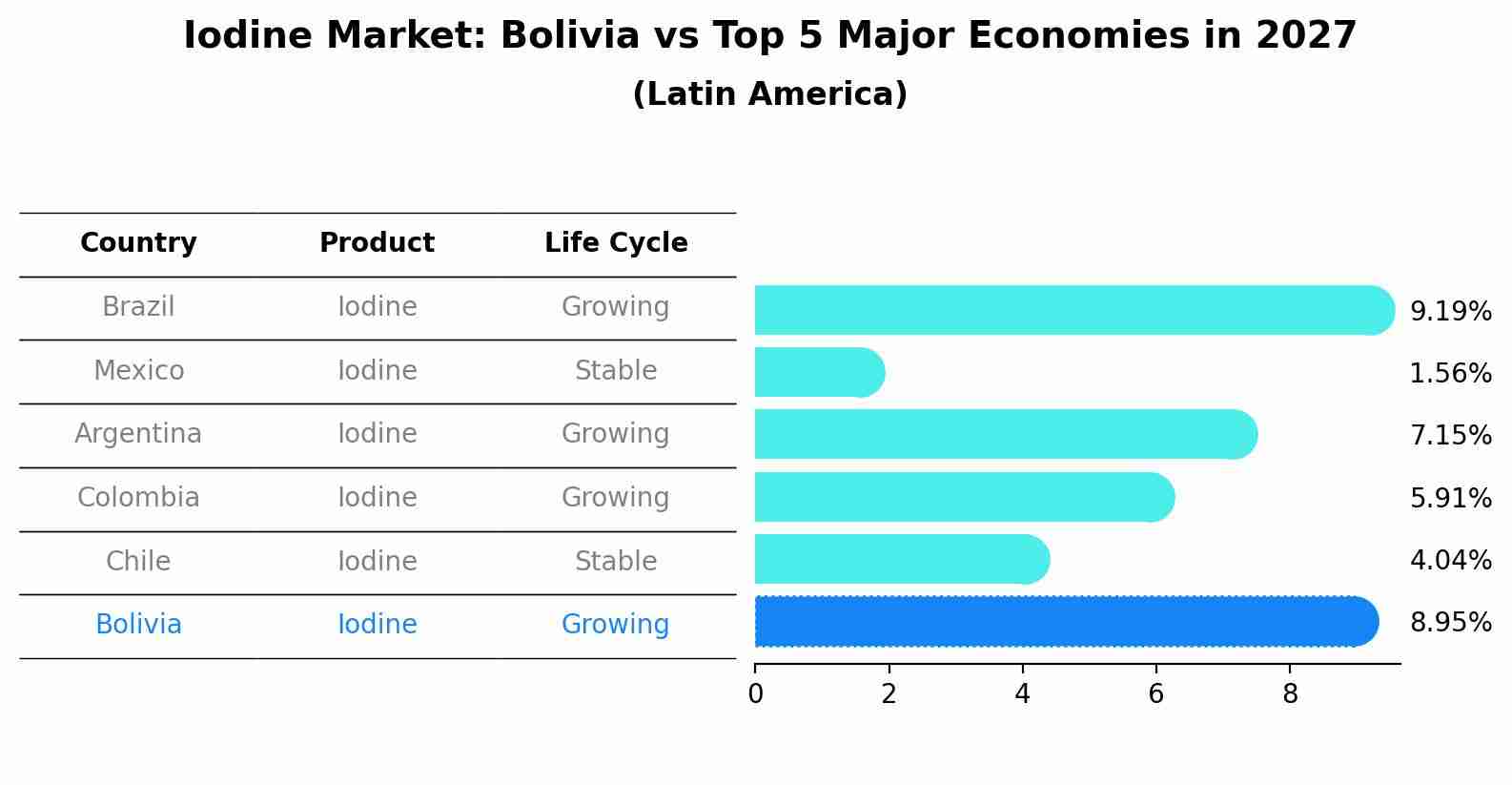
Iodine Market: Bolivia vs Top 5 Major Economies in 2027 (Latin America)
In the Latin America region, the Iodine market in Bolivia is projected to expand at a growing growth rate of 8.95% by 2027. The largest economy is Brazil, followed by Mexico, Argentina, Colombia and Chile.
Bolivia Iodine Market Overview
The iodine market in Bolivia is expanding due to its essential role in various industrial and healthcare applications. Iodine is used in the production of pharmaceuticals, disinfectants, and in the animal feed industry. Increased demand for iodine in medical treatments and the expansion of the healthcare sector are significant market drivers.
Drivers of the market
The iodine market in Bolivia is supported by the growing demand for iodine in various applications, including pharmaceuticals, disinfectants, and industrial processes. Iodine is used in medical imaging, wound care, and as a key ingredient in various chemical reactions. As Bolivia`s healthcare sector and industrial activities expand, the demand for iodine increases. Additionally, advancements in iodine extraction and production technologies and a focus on improving product applications drive market growth.
Challenges of the market
In Bolivia, the iodine market encounters challenges such as high import costs and a lack of local production capabilities. There is a need for investment in technology and infrastructure to support the development and application of iodine products. Additionally, market growth is constrained by limited awareness and technical expertise related to iodine solutions.
Government Policy of the market
In Bolivia, policies for the iodine market focus on safety, quality, and health benefits. Regulations may set standards for iodine purity, safety, and efficacy in dietary supplements and medical applications. The government may support research into iodine applications and offer incentives for companies that provide high-quality iodine products and contribute to public health.
Key Highlights of the Report:
- Bolivia Iodine Market Outlook
- Market Size of Bolivia Iodine Market, 2024
- Forecast of Bolivia Iodine Market, 2031
- Historical Data and Forecast of Bolivia Iodine Revenues & Volume for the Period 2021-2031
- Bolivia Iodine Market Trend Evolution
- Bolivia Iodine Market Drivers and Challenges
- Bolivia Iodine Price Trends
- Bolivia Iodine Porter`s Five Forces
- Bolivia Iodine Industry Life Cycle
- Historical Data and Forecast of Bolivia Iodine Market Revenues & Volume By Source for the Period 2021-2031
- Historical Data and Forecast of Bolivia Iodine Market Revenues & Volume By Caliche Ore for the Period 2021-2031
- Historical Data and Forecast of Bolivia Iodine Market Revenues & Volume By Underground Brines for the Period 2021-2031
- Historical Data and Forecast of Bolivia Iodine Market Revenues & Volume By Recycling for the Period 2021-2031
- Historical Data and Forecast of Bolivia Iodine Market Revenues & Volume By Seaweeds for the Period 2021-2031
- Historical Data and Forecast of Bolivia Iodine Market Revenues & Volume By Form for the Period 2021-2031
- Historical Data and Forecast of Bolivia Iodine Market Revenues & Volume By Organic Compounds for the Period 2021-2031
- Historical Data and Forecast of Bolivia Iodine Market Revenues & Volume By Inorganic Salts & Complexes for the Period 2021-2031
- Historical Data and Forecast of Bolivia Iodine Market Revenues & Volume By Elemental & Isotopes for the Period 2021-2031
- Historical Data and Forecast of Bolivia Iodine Market Revenues & Volume By Application for the Period 2021-2031
- Historical Data and Forecast of Bolivia Iodine Market Revenues & Volume By X-Ray Contrast Media for the Period 2021-2031
- Historical Data and Forecast of Bolivia Iodine Market Revenues & Volume By Pharmaceuticals for the Period 2021-2031
- Historical Data and Forecast of Bolivia Iodine Market Revenues & Volume By Optical Polarizing Films for the Period 2021-2031
- Historical Data and Forecast of Bolivia Iodine Market Revenues & Volume By Catalyst in Polymer Processing for the Period 2021-2031
- Historical Data and Forecast of Bolivia Iodine Market Revenues & Volume By Animal Feed for the Period 2021-2031
- Historical Data and Forecast of Bolivia Iodine Market Revenues & Volume By Fluorochemicals for the Period 2021-2031
- Historical Data and Forecast of Bolivia Iodine Market Revenues & Volume By Human Nutrition for the Period 2021-2031
- Historical Data and Forecast of Bolivia Iodine Market Revenues & Volume By Othersfor the Period 2021-2031
- Bolivia Iodine Import Export Trade Statistics
- Market Opportunity Assessment By Source
- Market Opportunity Assessment By Form
- Market Opportunity Assessment By Application
- Bolivia Iodine Top Companies Market Share
- Bolivia Iodine Competitive Benchmarking By Technical and Operational Parameters
- Bolivia Iodine Company Profiles
- Bolivia Iodine Key Strategic Recommendations






































