Bolivia Marine Hvac Market Top 5 Importing Countries and Market Competition (HHI) Analysis
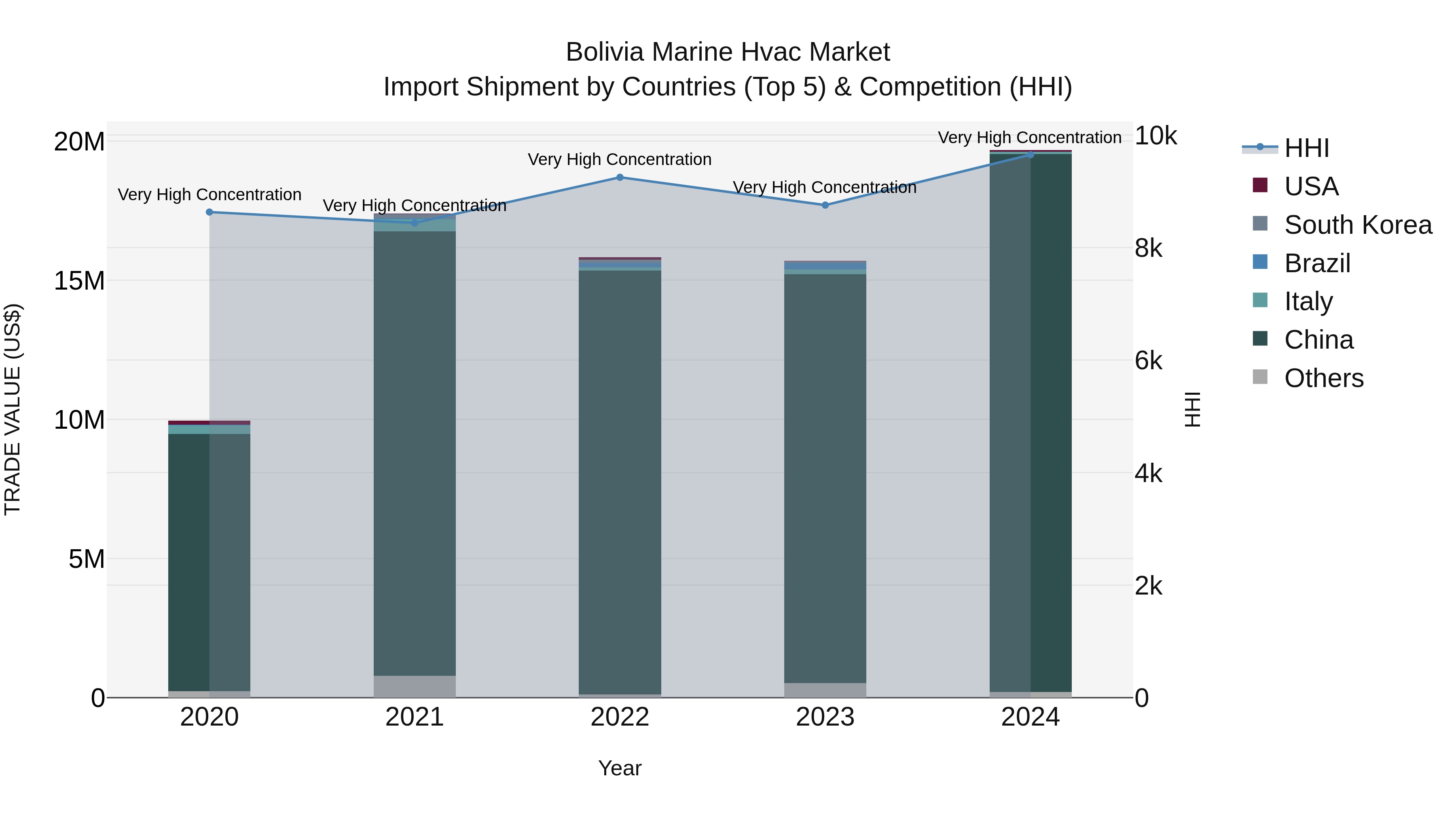
Bolivia marine HVAC import market in 2024 continued to be dominated by top exporters including China, Italy, Malaysia, USA, and Germany, reflecting a high level of concentration. The impressive Compound Annual Growth Rate (CAGR) of 18.55% from 2020 to 2024 highlights the growing demand for marine HVAC systems in Bolivia. The notable growth rate of 25.33% from 2023 to 2024 indicates a strong upward trend in import shipments, showcasing opportunities for both suppliers and market players in the marine HVAC industry.
Bolivia Marine HVAC Market Overview
The Bolivia Marine HVAC market is characterized by a growing demand for heating, ventilation, and air conditioning systems in the marine industry. The market is driven by the increasing number of cruise ships, cargo vessels, and offshore platforms requiring HVAC systems for passenger comfort and equipment maintenance. Key players in the market are focusing on developing energy-efficient and environmentally friendly HVAC solutions to comply with regulations and reduce operating costs. Factors such as the country`s extensive coastline, thriving fishing industry, and growth in maritime tourism contribute to the steady expansion of the Marine HVAC market in Bolivia. Additionally, the market is witnessing a trend towards digitalization and automation in HVAC systems to enhance control, monitoring, and efficiency on marine vessels.
Bolivia Marine HVAC Market Trends
Currently, the Bolivia Marine HVAC market is experiencing a growing demand for energy-efficient and environmentally friendly HVAC systems. This trend is driven by increasing awareness of sustainability among shipowners and operators. There is also a shift towards the adoption of advanced technologies such as variable refrigerant flow (VRF) systems and smart HVAC controls to optimize energy consumption and enhance onboard comfort. Additionally, the market is witnessing a focus on the development of compact and lightweight HVAC solutions to meet the space constraints on marine vessels. Overall, the Bolivia Marine HVAC market is evolving towards more sustainable and efficient solutions to meet the demands of the maritime industry while complying with stringent environmental regulations.
Bolivia Marine HVAC Market Challenges
In the Bolivia Marine HVAC market, one of the key challenges faced is the limited availability of skilled technicians and engineers with specialized knowledge in marine HVAC systems. This shortage can lead to delays in installation, maintenance, and repairs, impacting the overall efficiency and performance of HVAC systems on marine vessels. Additionally, the market may also face challenges related to the high costs associated with sourcing and installing marine-grade HVAC equipment, as well as the logistical complexities of operating in remote or offshore locations. Adapting to evolving environmental regulations and standards for marine emissions and energy efficiency further adds to the challenges faced by companies operating in the Bolivia Marine HVAC market.
Bolivia Marine HVAC Market Investment Opportunities
The Bolivia Marine HVAC market presents promising investment opportunities due to the country`s growing maritime industry and the increasing focus on environmental regulations. With the rise in marine transportation activities, there is a growing demand for HVAC systems in ships and vessels to ensure comfortable and safe working conditions for crew members. Additionally, the need for energy-efficient and environmentally friendly HVAC solutions is driving innovation in the market. Investors could consider opportunities in supplying advanced HVAC systems, providing maintenance and repair services, and offering energy-efficient solutions tailored to the specific needs of the marine industry in Bolivia. By tapping into this niche market segment, investors can capitalize on the growing demand for HVAC systems in the Bolivia Marine industry while contributing to sustainability efforts.
Bolivia Marine HVAC Market Government Policy
The Bolivian government has implemented policies to promote energy efficiency and environmental sustainability in the Marine HVAC market. These policies include regulations on the use of environmentally friendly refrigerants, such as hydrofluorocarbons (HFCs), and requirements for energy-efficient systems to reduce greenhouse gas emissions. Additionally, the government has set standards for the installation and maintenance of HVAC systems to ensure optimal performance and safety. These policies aim to drive the adoption of modern, efficient HVAC technologies in the marine sector, while also addressing climate change concerns and promoting sustainable development in Bolivia.
Bolivia Marine HVAC Market Future Outlook
The future outlook for the Bolivia Marine HVAC market appears positive with steady growth anticipated in the coming years. Factors such as increasing investments in the marine industry, rising demand for energy-efficient HVAC systems, and stringent regulations regarding emissions and energy efficiency are expected to drive market growth. The adoption of advanced technologies like variable refrigerant flow (VRF) systems and smart HVAC solutions are likely to further propel market expansion. Additionally, the growing focus on improving passenger comfort and safety on marine vessels is expected to create opportunities for HVAC system providers in Bolivia. Overall, the market is forecasted to experience a gradual but sustainable growth trajectory in the foreseeable future.
Key Highlights of the Report:
- Bolivia Marine HVAC Market Outlook
- Market Size of Bolivia Marine HVAC Market, 2024
- Forecast of Bolivia Marine HVAC Market, 2031
- Historical Data and Forecast of Bolivia Marine HVAC Revenues & Volume for the Period 2021- 2031
- Bolivia Marine HVAC Market Trend Evolution
- Bolivia Marine HVAC Market Drivers and Challenges
- Bolivia Marine HVAC Price Trends
- Bolivia Marine HVAC Porter's Five Forces
- Bolivia Marine HVAC Industry Life Cycle
- Historical Data and Forecast of Bolivia Marine HVAC Market Revenues & Volume By Vessel Type for the Period 2021- 2031
- Historical Data and Forecast of Bolivia Marine HVAC Market Revenues & Volume By Passenger Vessels for the Period 2021- 2031
- Historical Data and Forecast of Bolivia Marine HVAC Market Revenues & Volume By Cargo Carriers for the Period 2021- 2031
- Historical Data and Forecast of Bolivia Marine HVAC Market Revenues & Volume By Fishing Vessels for the Period 2021- 2031
- Historical Data and Forecast of Bolivia Marine HVAC Market Revenues & Volume By Technology Type for the Period 2021- 2031
- Historical Data and Forecast of Bolivia Marine HVAC Market Revenues & Volume By Marine Ventilation Systems for the Period 2021- 2031
- Historical Data and Forecast of Bolivia Marine HVAC Market Revenues & Volume By Marine Air Conditioning for the Period 2021- 2031
- Historical Data and Forecast of Bolivia Marine HVAC Market Revenues & Volume By Marine Heating Systems for the Period 2021- 2031
- Historical Data and Forecast of Bolivia Marine HVAC Market Revenues & Volume By Marine Refrigeration Systems for the Period 2021- 2031
- Historical Data and Forecast of Bolivia Marine HVAC Market Revenues & Volume By Capacity for the Period 2021- 2031
- Historical Data and Forecast of Bolivia Marine HVAC Market Revenues & Volume By Less than 20 RT for the Period 2021- 2031
- Historical Data and Forecast of Bolivia Marine HVAC Market Revenues & Volume By 20 - 90 RT for the Period 2021- 2031
- Historical Data and Forecast of Bolivia Marine HVAC Market Revenues & Volume By Above 90 RT for the Period 2021- 2031
- Historical Data and Forecast of Bolivia Marine HVAC Market Revenues & Volume By Application for the Period 2021- 2031
- Historical Data and Forecast of Bolivia Marine HVAC Market Revenues & Volume By Engine Room for the Period 2021- 2031
- Historical Data and Forecast of Bolivia Marine HVAC Market Revenues & Volume By Cargo Hold for the Period 2021- 2031
- Historical Data and Forecast of Bolivia Marine HVAC Market Revenues & Volume By Deck for the Period 2021- 2031
- Historical Data and Forecast of Bolivia Marine HVAC Market Revenues & Volume By Tender Garage for the Period 2021- 2031
- Bolivia Marine HVAC Import Export Trade Statistics
- Market Opportunity Assessment By Vessel Type
- Market Opportunity Assessment By Technology Type
- Market Opportunity Assessment By Capacity
- Market Opportunity Assessment By Application
- Bolivia Marine HVAC Top Companies Market Share
- Bolivia Marine HVAC Competitive Benchmarking By Technical and Operational Parameters
- Bolivia Marine HVAC Company Profiles
- Bolivia Marine HVAC Key Strategic Recommendations






































