Bolivia Mobility Scooter Market Top 5 Importing Countries and Market Competition (HHI) Analysis
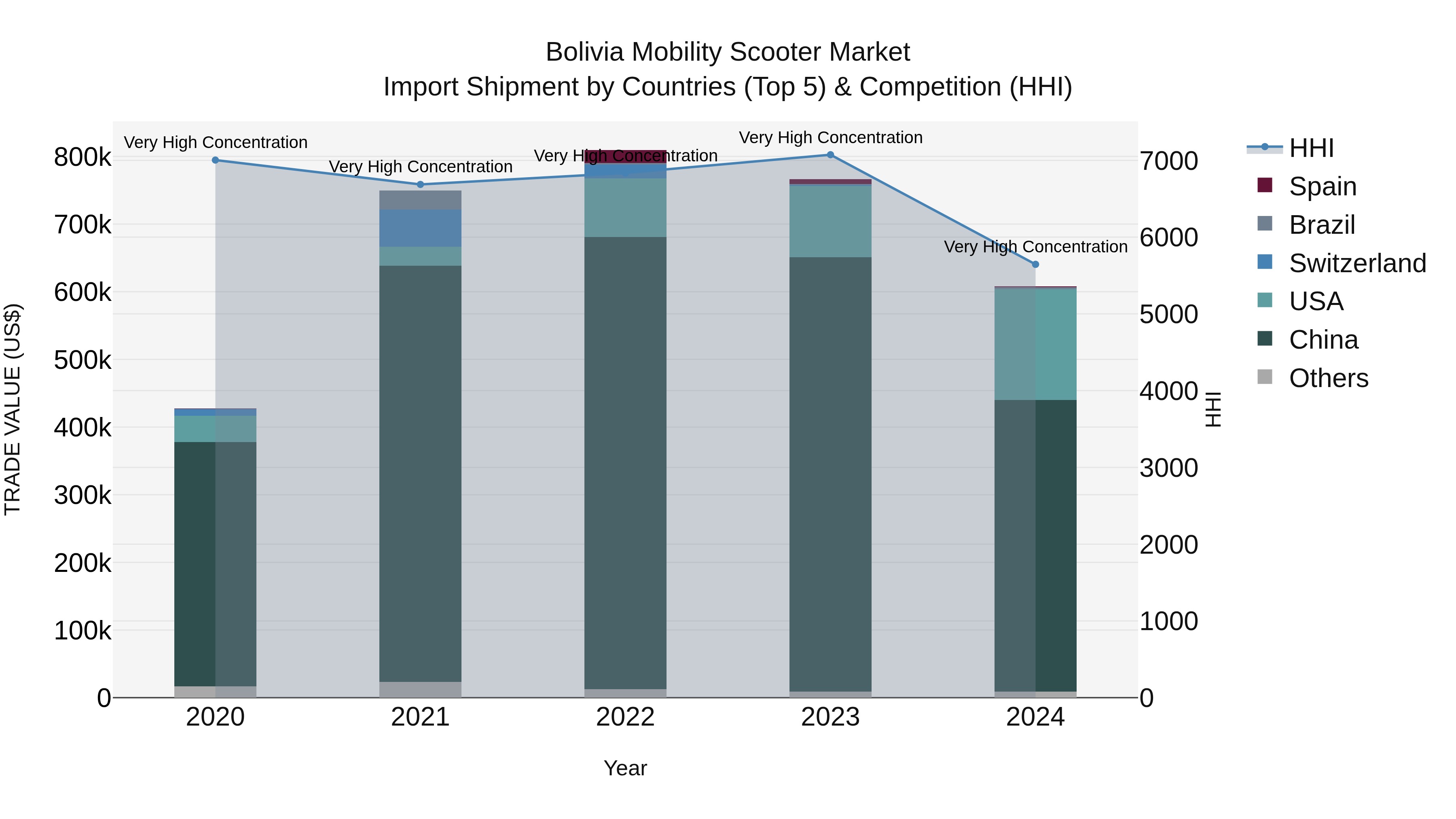
In 2024, Bolivia continued to see a high concentration of mobility scooter imports, with top exporting countries being China, USA, Japan, Germany, and Brazil. Despite a slight decline in growth rate from 2023 to 2024, the compound annual growth rate (CAGR) from 2020 to 2024 remained strong at 9.21%. This indicates sustained demand for mobility scooters in Bolivia, with key players from diverse regions contributing to the market`s growth.
Bolivia Mobility Scooter Market Overview
The Bolivia Mobility Scooter Market is witnessing steady growth due to the increasing elderly population and a rise in the number of people with mobility issues. The market is primarily driven by the growing awareness about the benefits of mobility scooters in enhancing the independence and quality of life for individuals with disabilities or limited mobility. Key players in the Bolivia Mobility Scooter Market are focusing on product innovation, such as lightweight and foldable designs, improved battery life, and enhanced safety features. Additionally, government initiatives and subsidies to promote the use of mobility aids are further boosting market growth. With a trend towards improved accessibility and inclusivity, the Bolivia Mobility Scooter Market is expected to continue expanding in the coming years.
Bolivia Mobility Scooter Market Trends
The Bolivia Mobility Scooter Market is experiencing a growing demand due to an aging population and increasing awareness about mobility aid products. There is a trend towards more lightweight and portable mobility scooters that offer greater convenience and ease of use for users. Additionally, there is a rising interest in advanced features such as longer battery life, improved comfort, and enhanced maneuverability. The market is also witnessing a shift towards eco-friendly options with the introduction of electric mobility scooters. Manufacturers are focusing on innovative designs and customization options to cater to the diverse needs of consumers. Overall, the Bolivia Mobility Scooter Market is expected to continue expanding as the population ages and the demand for mobility solutions increases.
Bolivia Mobility Scooter Market Challenges
In the Bolivia Mobility Scooter Market, some challenges that are faced include limited awareness and acceptance of mobility scooters among the general population, lack of infrastructure to support easy mobility for individuals using scooters, high import taxes on mobility scooters which can drive up prices and make them less accessible to potential buyers, and limited availability of specialized retailers or service providers for maintenance and repairs. Additionally, cultural attitudes towards disability and mobility aids may also impact the market as some individuals may feel stigmatized or hesitant to use mobility scooters in public spaces. Overcoming these challenges would require efforts to increase education and awareness, improve infrastructure for accessibility, address pricing concerns, and work towards creating a more inclusive and supportive environment for individuals using mobility scooters in Bolivia.
Bolivia Mobility Scooter Market Investment Opportunities
The Bolivia Mobility Scooter Market presents significant investment opportunities due to the growing aging population and increasing awareness about mobility solutions for the elderly and disabled individuals. With a rising demand for assistive devices and improved accessibility in urban areas, there is a growing market for mobility scooters in Bolivia. Investors can capitalize on this trend by partnering with local distributors, manufacturers, or retailers to tap into the expanding market. Additionally, there is potential for introducing innovative and technologically advanced mobility scooter models to cater to different consumer segments. As the government focuses on improving infrastructure and inclusivity, investing in the Bolivia Mobility Scooter Market can provide long-term growth prospects and a chance to contribute to enhancing the quality of life for individuals with mobility challenges.
Bolivia Mobility Scooter Market Government Policy
In Bolivia, there are no specific government policies that directly address mobility scooters. However, general regulations related to transportation and accessibility may impact the mobility scooter market. The government has made efforts to improve infrastructure and accessibility for persons with disabilities, which can indirectly benefit the mobility scooter market by creating a more inclusive environment for users. Additionally, import regulations and tariffs on medical devices may influence the availability and pricing of mobility scooters in the market. Keeping track of any changes in government policies related to transportation, accessibility, and import regulations will be essential for businesses operating in the Bolivia mobility scooter market to stay compliant and competitive.
Bolivia Mobility Scooter Market Future Outlook
The Bolivia Mobility Scooter Market is poised for steady growth in the coming years due to several factors, including an aging population, increasing awareness about mobility aids, and rising disposable income levels. With a growing emphasis on accessibility and inclusivity, demand for mobility scooters is expected to rise among seniors and individuals with mobility issues. Additionally, advancements in technology, such as improved battery life and enhanced features, are likely to drive market expansion. Government initiatives to promote the use of mobility aids and improve infrastructure for disabled individuals will also contribute to market growth. Overall, the Bolivia Mobility Scooter Market is anticipated to experience a positive outlook, with opportunities for manufacturers and retailers to capture a larger share of the market.
Key Highlights of the Report:
- Bolivia Mobility Scooter Market Outlook
- Market Size of Bolivia Mobility Scooter Market, 2024
- Forecast of Bolivia Mobility Scooter Market, 2031
- Historical Data and Forecast of Bolivia Mobility Scooter Revenues & Volume for the Period 2021- 2031
- Bolivia Mobility Scooter Market Trend Evolution
- Bolivia Mobility Scooter Market Drivers and Challenges
- Bolivia Mobility Scooter Price Trends
- Bolivia Mobility Scooter Porter's Five Forces
- Bolivia Mobility Scooter Industry Life Cycle
- Historical Data and Forecast of Bolivia Mobility Scooter Market Revenues & Volume By Type for the Period 2021- 2031
- Historical Data and Forecast of Bolivia Mobility Scooter Market Revenues & Volume By Small (Less than 110cm) for the Period 2021- 2031
- Historical Data and Forecast of Bolivia Mobility Scooter Market Revenues & Volume By Medium (110-150cm) for the Period 2021- 2031
- Historical Data and Forecast of Bolivia Mobility Scooter Market Revenues & Volume By Large (More than 150cm) for the Period 2021- 2031
- Historical Data and Forecast of Bolivia Mobility Scooter Market Revenues & Volume By Application for the Period 2021- 2031
- Historical Data and Forecast of Bolivia Mobility Scooter Market Revenues & Volume By In-House for the Period 2021- 2031
- Historical Data and Forecast of Bolivia Mobility Scooter Market Revenues & Volume By Outdoor for the Period 2021- 2031
- Historical Data and Forecast of Bolivia Mobility Scooter Market Revenues & Volume By Off-Road for the Period 2021- 2031
- Historical Data and Forecast of Bolivia Mobility Scooter Market Revenues & Volume By Number of Wheels for the Period 2021- 2031
- Historical Data and Forecast of Bolivia Mobility Scooter Market Revenues & Volume By Three Wheels for the Period 2021- 2031
- Historical Data and Forecast of Bolivia Mobility Scooter Market Revenues & Volume By Four Wheels for the Period 2021- 2031
- Historical Data and Forecast of Bolivia Mobility Scooter Market Revenues & Volume By Others for the Period 2021- 2031
- Historical Data and Forecast of Bolivia Mobility Scooter Market Revenues & Volume By Battery Range for the Period 2021- 2031
- Historical Data and Forecast of Bolivia Mobility Scooter Market Revenues & Volume By Less than 10 Miles for the Period 2021- 2031
- Historical Data and Forecast of Bolivia Mobility Scooter Market Revenues & Volume By 10-20 Miles for the Period 2021- 2031
- Historical Data and Forecast of Bolivia Mobility Scooter Market Revenues & Volume By More than 20 Miles for the Period 2021- 2031
- Historical Data and Forecast of Bolivia Mobility Scooter Market Revenues & Volume By End use for the Period 2021- 2031
- Historical Data and Forecast of Bolivia Mobility Scooter Market Revenues & Volume By Personal Use for the Period 2021- 2031
- Historical Data and Forecast of Bolivia Mobility Scooter Market Revenues & Volume By Institutional Use for the Period 2021- 2031
- Bolivia Mobility Scooter Import Export Trade Statistics
- Market Opportunity Assessment By Type
- Market Opportunity Assessment By Application
- Market Opportunity Assessment By Number of Wheels
- Market Opportunity Assessment By Battery Range
- Market Opportunity Assessment By End use
- Bolivia Mobility Scooter Top Companies Market Share
- Bolivia Mobility Scooter Competitive Benchmarking By Technical and Operational Parameters
- Bolivia Mobility Scooter Company Profiles
- Bolivia Mobility Scooter Key Strategic Recommendations






































