Bolivia Photochromic Lenses Market Top 5 Importing Countries and Market Competition (HHI) Analysis
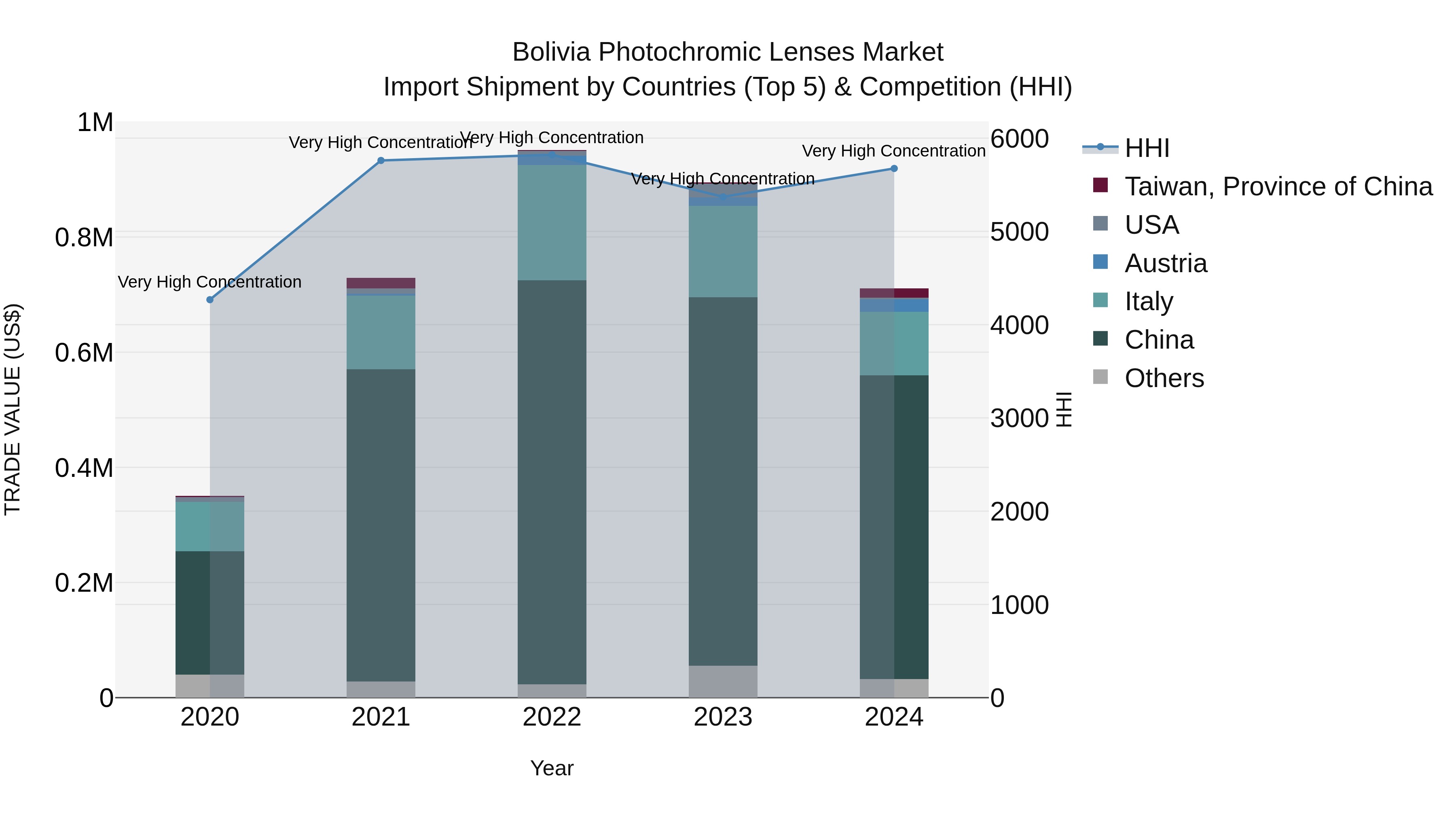
Bolivia import shipments of photochromic lenses saw a significant increase in 2024, with top exporting countries being China, Italy, Austria, Taiwan, and Chile. The market remained highly concentrated, indicating limited diversification among suppliers. Despite the strong compound annual growth rate (CAGR) of 19.3% from 2020 to 2024, there was a notable decline in the growth rate from 2023 to 2024 at -20.62%. This suggests a potential shift or stabilization in the market dynamics for photochromic lenses in Bolivia.
Bolivia Photochromic Lenses Market Synopsis
The Bolivia Photochromic Lenses Market is experiencing steady growth due to increasing awareness about the benefits of photochromic lenses among consumers. These lenses are designed to automatically adjust to changes in lighting conditions, providing convenience and eye protection. The market is driven by factors such as the rising prevalence of eye-related disorders, growing demand for UV protection, and a shift towards fashionable eyewear. Key players in the market are focusing on product innovation, technological advancements, and strategic partnerships to gain a competitive edge. With a growing emphasis on eye health and aesthetics, the Bolivia Photochromic Lenses Market is expected to continue its positive trajectory in the foreseeable future.
Bolivia Photochromic Lenses Market Trends
The Bolivia Photochromic Lenses Market is experiencing growth due to increasing awareness about UV protection and the rising demand for eyewear that offers both vision correction and protection from harmful rays. The market is witnessing a trend towards innovative photochromic lens technologies that provide faster transition times and enhanced clarity. Opportunities exist for market players to expand their product offerings to cater to specific consumer needs, such as lenses designed for outdoor sports or driving. Additionally, the growing preference for eyewear as a fashion accessory presents a market opportunity for stylish and customizable photochromic lenses. Collaborations with optometrists and eyewear retailers to educate consumers about the benefits of photochromic lenses can further drive market growth in Bolivia.
Bolivia Photochromic Lenses Market Challenges
In the Bolivia photochromic lenses market, one of the main challenges faced is the lack of awareness among consumers regarding the benefits and technology of photochromic lenses. This results in a slower adoption rate of these lenses compared to traditional eyewear options. Additionally, the relatively higher cost of photochromic lenses compared to regular lenses can be a barrier for price-sensitive consumers. Another challenge is the limited availability of a wide range of options and styles in photochromic lenses in the Bolivian market, leading to less variety for consumers to choose from. Furthermore, the presence of counterfeit or low-quality photochromic lenses in the market can create confusion and distrust among consumers, affecting the overall reputation and growth of the photochromic lenses market in Bolivia.
Bolivia Photochromic Lenses Market Investment Opportunities
The Bolivia Photochromic Lenses market is being driven by several key factors. Firstly, increasing awareness about the importance of eye health and the benefits of photochromic lenses in protecting the eyes from harmful UV rays is driving market growth. Additionally, the growing trend of outdoor activities and sports among the population is fueling the demand for photochromic lenses that provide both vision correction and UV protection. Furthermore, technological advancements in lens materials and coatings are enhancing the performance and durability of photochromic lenses, attracting more consumers. Moreover, the rising disposable income levels and changing lifestyles are also contributing to the growth of the market as consumers are willing to invest in high-quality eyewear products for better vision and eye protection.
Bolivia Photochromic Lenses Market Government Polices
Government policies related to the Bolivia Photochromic Lenses Market primarily focus on consumer protection and quality standards. The Bolivian government has implemented regulations to ensure that photochromic lenses meet specific safety and performance requirements, including UV protection levels and impact resistance. Additionally, there are guidelines in place to monitor the marketing and advertising practices of photochromic lens manufacturers and distributors to prevent false claims and misleading information. Import and export regulations also play a role in governing the market, ensuring that products entering the country comply with established standards. Overall, the government aims to promote a competitive and transparent market environment while safeguarding the interests of consumers and maintaining product quality in the Bolivia Photochromic Lenses Market.
Bolivia Photochromic Lenses Market Future Outlook
The Bolivia Photochromic Lenses Market is expected to see steady growth in the coming years, driven by increasing awareness about eye health and the growing demand for convenience in eyewear. Factors such as rising disposable income, changing lifestyles, and a growing aging population are also contributing to the market`s growth. Additionally, technological advancements in lens materials and coatings are expected to enhance the performance and durability of photochromic lenses, further boosting their popularity among consumers. As more individuals prioritize eye protection and comfort, the market for photochromic lenses in Bolivia is likely to expand, presenting opportunities for both local and international eyewear manufacturers to capitalize on this growing trend.
Key Highlights of the Report:
- Bolivia Photochromic Lenses Market Outlook
- Market Size of Bolivia Photochromic Lenses Market, 2024
- Forecast of Bolivia Photochromic Lenses Market, 2031
- Historical Data and Forecast of Bolivia Photochromic Lenses Revenues & Volume for the Period 2021- 2031
- Bolivia Photochromic Lenses Market Trend Evolution
- Bolivia Photochromic Lenses Market Drivers and Challenges
- Bolivia Photochromic Lenses Price Trends
- Bolivia Photochromic Lenses Porter's Five Forces
- Bolivia Photochromic Lenses Industry Life Cycle
- Historical Data and Forecast of Bolivia Photochromic Lenses Market Revenues & Volume By Product for the Period 2021- 2031
- Historical Data and Forecast of Bolivia Photochromic Lenses Market Revenues & Volume By Glass for the Period 2021- 2031
- Historical Data and Forecast of Bolivia Photochromic Lenses Market Revenues & Volume By Polycarbonate for the Period 2021- 2031
- Historical Data and Forecast of Bolivia Photochromic Lenses Market Revenues & Volume By Plastic for the Period 2021- 2031
- Historical Data and Forecast of Bolivia Photochromic Lenses Market Revenues & Volume By Technology Type for the Period 2021- 2031
- Historical Data and Forecast of Bolivia Photochromic Lenses Market Revenues & Volume By In-mass for the Period 2021- 2031
- Historical Data and Forecast of Bolivia Photochromic Lenses Market Revenues & Volume By Imbibing & Trans-bonding for the Period 2021- 2031
- Historical Data and Forecast of Bolivia Photochromic Lenses Market Revenues & Volume By UV & Visible Light for the Period 2021- 2031
- Historical Data and Forecast of Bolivia Photochromic Lenses Market Revenues & Volume By Others for the Period 2021- 2031
- Historical Data and Forecast of Bolivia Photochromic Lenses Market Revenues & Volume By Distribution Channel for the Period 2021- 2031
- Historical Data and Forecast of Bolivia Photochromic Lenses Market Revenues & Volume By Online for the Period 2021- 2031
- Historical Data and Forecast of Bolivia Photochromic Lenses Market Revenues & Volume By Optical Chains for the Period 2021- 2031
- Historical Data and Forecast of Bolivia Photochromic Lenses Market Revenues & Volume By Independent Eye Care Professionals (ECPs) for the Period 2021- 2031
- Bolivia Photochromic Lenses Import Export Trade Statistics
- Market Opportunity Assessment By Product
- Market Opportunity Assessment By Technology Type
- Market Opportunity Assessment By Distribution Channel
- Bolivia Photochromic Lenses Top Companies Market Share
- Bolivia Photochromic Lenses Competitive Benchmarking By Technical and Operational Parameters
- Bolivia Photochromic Lenses Company Profiles
- Bolivia Photochromic Lenses Key Strategic Recommendations






































