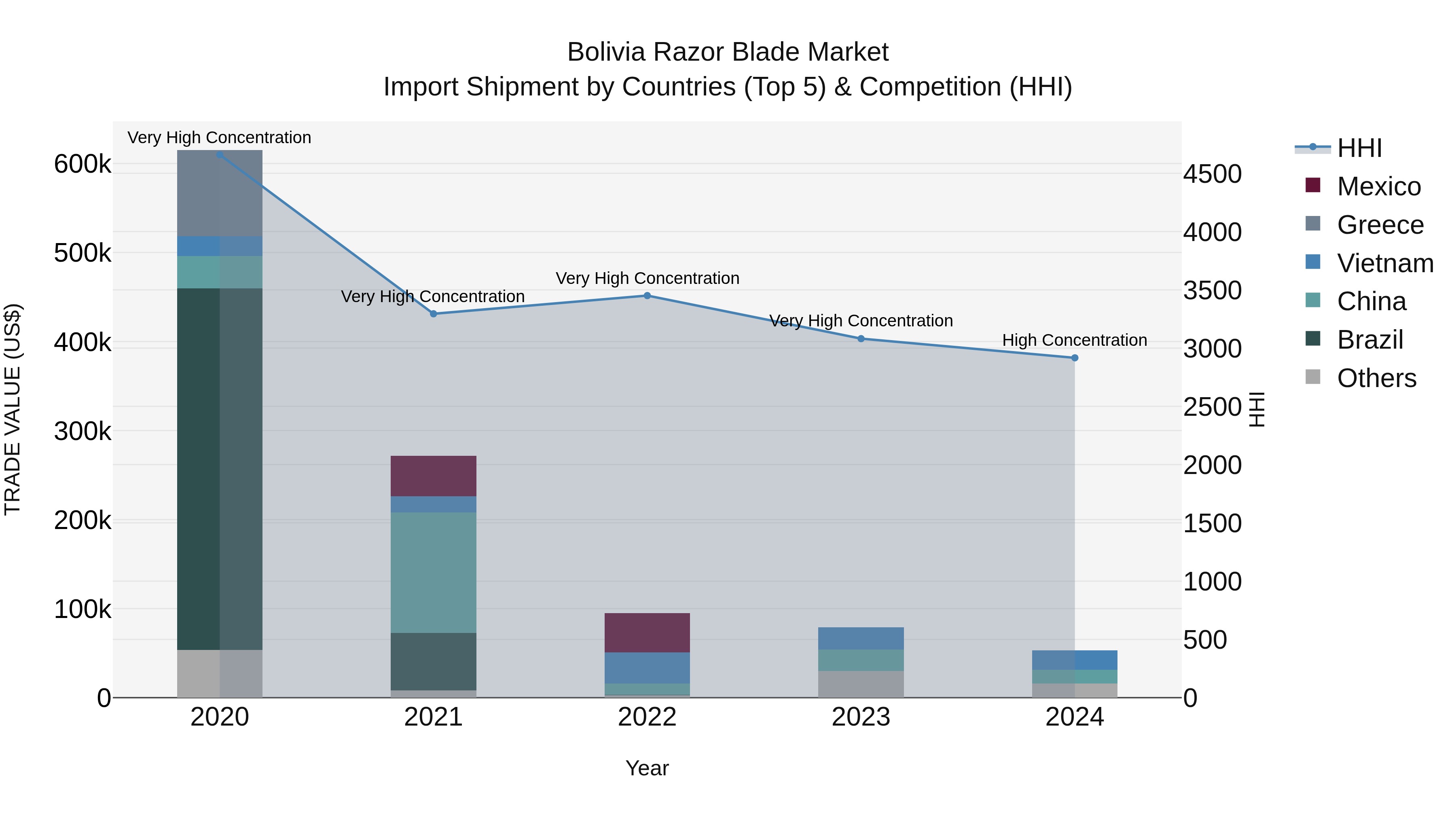
Bolivia Razor Blade Market Top 5 Importing Countries and Market Competition (HHI) Analysis
Despite a steep decline in the CAGR and growth rate for razor blade imports in Bolivia, the market remains heavily concentrated, with top exporting countries like Vietnam, China, and Pakistan dominating the sector. The high Herfindahl-Hirschman Index (HHI) in 2024 indicates a significant level of market concentration. While the negative growth trend is concerning, the presence of established exporters like the USA and Peru suggests ongoing demand for razor blades in Bolivia, albeit at a reduced rate. Monitoring market dynamics and potential shifts in consumer preferences will be crucial for stakeholders in the industry.
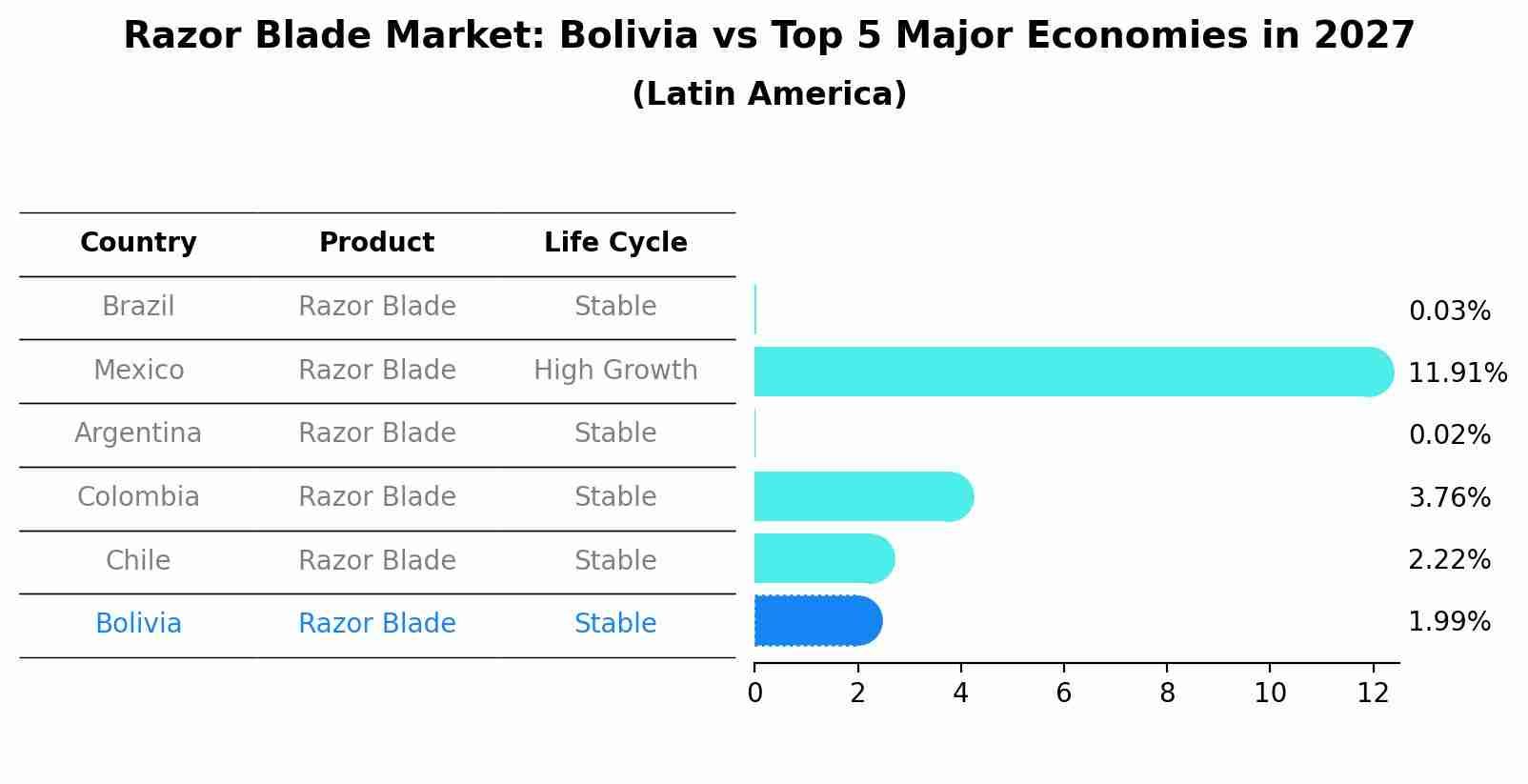
Razor Blade Market: Bolivia vs Top 5 Major Economies in 2027 (Latin America)
The Razor Blade market in Bolivia is projected to grow at a stable growth rate of 1.99% by 2027, highlighting the country's increasing focus on advanced technologies within the Latin America region, where Brazil holds the dominant position, followed closely by Mexico, Argentina, Colombia and Chile, shaping overall regional demand.
Bolivia Razor Blade Market Overview
The razor blade market in Bolivia is growing as the demand for personal grooming products increases. Razor blades are used in disposable and reusable razors for shaving and grooming. The market growth is driven by the increasing focus on personal care, the demand for high-quality grooming products, and the introduction of advanced blade technologies.
Drivers of the market
The razor blade market in Bolivia is growing due to the increasing demand for personal grooming products and the need for high-quality shaving solutions. Razor blades are essential components of shaving systems, providing a close and comfortable shave. The market is driven by factors such as the rising awareness of personal grooming, the growth of the men`s grooming industry, and advancements in razor blade technology. Additionally, the focus on product innovation and improving shaving performance supports market growth.
Challenges of the market
The razor blade market in Bolivia is constrained by high production costs, limited local manufacturing capabilities, and competition from disposable razors and electric shavers. The production of razor blades involves precision engineering and high-quality materials, leading to high costs. Limited local manufacturing capabilities restrict the ability to produce razor blades domestically. The market also faces competition from disposable razors and electric shavers, which offer convenience and cost-effectiveness to consumers.
Government Policy of the market
Government policies impacting the Razor Blade Market in Bolivia include regulations related to manufacturing and consumer safety. The Bolivian government supports the production and use of razor blades through regulatory frameworks that ensure safety and quality standards. Policies promoting investments in manufacturing technologies and improving product safety drive market growth. Additionally, regulations aimed at ensuring the performance and safety of razor blades contribute to market expansion.
Key Highlights of the Report:
- Bolivia Razor Blade Market Outlook
- Market Size of Bolivia Razor Blade Market, 2024
- Forecast of Bolivia Razor Blade Market, 2031
- Historical Data and Forecast of Bolivia Razor Blade Revenues & Volume for the Period 2021-2031
- Bolivia Razor Blade Market Trend Evolution
- Bolivia Razor Blade Market Drivers and Challenges
- Bolivia Razor Blade Price Trends
- Bolivia Razor Blade Porter`s Five Forces
- Bolivia Razor Blade Industry Life Cycle
- Historical Data and Forecast of Bolivia Razor Blade Market Revenues & Volume By Type for the Period 2021-2031
- Historical Data and Forecast of Bolivia Razor Blade Market Revenues & Volume By Single Edge for the Period 2021-2031
- Historical Data and Forecast of Bolivia Razor Blade Market Revenues & Volume By Double Edge for the Period 2021-2031
- Historical Data and Forecast of Bolivia Razor Blade Market Revenues & Volume By Blade Material for the Period 2021-2031
- Historical Data and Forecast of Bolivia Razor Blade Market Revenues & Volume By Carbon Steel for the Period 2021-2031
- Historical Data and Forecast of Bolivia Razor Blade Market Revenues & Volume By Stainless Steel for the Period 2021-2031
- Historical Data and Forecast of Bolivia Razor Blade Market Revenues & Volume By End User for the Period 2021-2031
- Historical Data and Forecast of Bolivia Razor Blade Market Revenues & Volume By Men for the Period 2021-2031
- Historical Data and Forecast of Bolivia Razor Blade Market Revenues & Volume By Women for the Period 2021-2031
- Historical Data and Forecast of Bolivia Razor Blade Market Revenues & Volume By Distribution Channel for the Period 2021-2031
- Historical Data and Forecast of Bolivia Razor Blade Market Revenues & Volume By Supermarkets/Hypermarkets for the Period 2021-2031
- Historical Data and Forecast of Bolivia Razor Blade Market Revenues & Volume By Departmental Stores for the Period 2021-2031
- Historical Data and Forecast of Bolivia Razor Blade Market Revenues & Volume By Convenience Stores for the Period 2021-2031
- Historical Data and Forecast of Bolivia Razor Blade Market Revenues & Volume By Online for the Period 2021-2031
- Bolivia Razor Blade Import Export Trade Statistics
- Market Opportunity Assessment By Type
- Market Opportunity Assessment By Blade Material
- Market Opportunity Assessment By End User
- Market Opportunity Assessment By Distribution Channel
- Bolivia Razor Blade Top Companies Market Share
- Bolivia Razor Blade Competitive Benchmarking By Technical and Operational Parameters
- Bolivia Razor Blade Company Profiles
- Bolivia Razor Blade Key Strategic Recommendations






































