Bolivia Whiskey Market Top 5 Importing Countries and Market Competition (HHI) Analysis
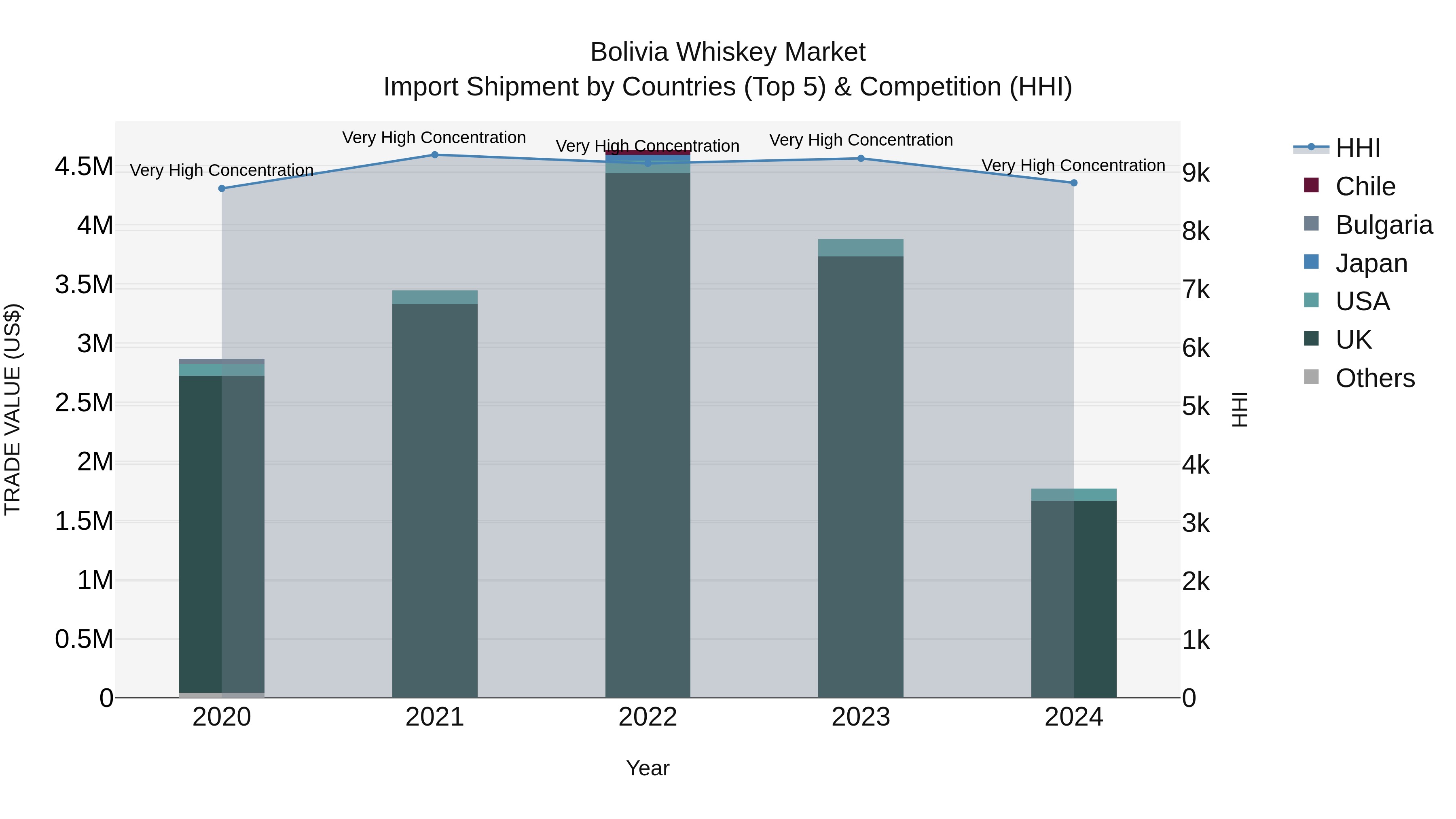
Despite a decline in growth rate from 2023 to 2024, Bolivia continues to see a high concentration of whiskey import shipments from top exporting countries such as the UK, USA, Argentina, Bulgaria, and India. The high Herfindahl-Hirschman Index (HHI) indicates significant market concentration. With a negative compound annual growth rate (CAGR) of -11.38% from 2020 to 2024, the whiskey import market in Bolivia faces challenges. The steep decline in growth rate from 2023 to 2024 at -54.44% suggests a potential shift in market dynamics or external factors impacting the industry.
Bolivia Whiskey Market Overview
The whiskey market in Bolivia is witnessing growth due to an increasing interest in premium and craft alcoholic beverages. Whiskey, with its diverse flavors and aging processes, appeals to consumers seeking high-quality and artisanal spirits. The market expansion is supported by rising disposable incomes, changing consumer preferences towards sophisticated alcoholic beverages, and the growing presence of international whiskey brands in the Bolivian market.
Drivers of the market
The whiskey market in Bolivia is growing due to the increasing popularity of premium and craft alcoholic beverages. Whiskey, known for its distinct flavors and aging process, is gaining traction among consumers seeking quality spirits. Market growth is driven by rising disposable incomes, a growing interest in artisanal and aged whiskeys, and the expansion of the beverage industry. The emphasis on producing high-quality and diverse whiskey offerings supports market development.
Challenges of the market
The whiskey market in Bolivia faces challenges including high import costs and regulatory hurdles. As a premium alcoholic beverage, whiskey often comes with a high price tag, which can limit its accessibility to a broader consumer base. The market is heavily reliant on imports, leading to increased costs due to tariffs, shipping, and supply chain complexities. Additionally, strict regulations and licensing requirements for alcoholic beverages can complicate market entry and distribution. Consumer preferences and competition from local spirits or other alcoholic beverages also impact market dynamics.
Government Policy of the market
The Whiskey Market in Bolivia is shaped by government policies related to alcohol production, taxation, and consumer protection. The Bolivian government regulates the whiskey industry through standards that ensure product quality and safety. Policies concerning the taxation of alcoholic beverages and regulations governing production practices influence market dynamics. Additionally, regulations aimed at protecting consumers and promoting responsible consumption contribute to the market`s growth and stability.
Key Highlights of the Report:
- Bolivia Whiskey Market Outlook
- Market Size of Bolivia Whiskey Market, 2024
- Forecast of Bolivia Whiskey Market, 2031
- Historical Data and Forecast of Bolivia Whiskey Revenues & Volume for the Period 2021-2031
- Bolivia Whiskey Market Trend Evolution
- Bolivia Whiskey Market Drivers and Challenges
- Bolivia Whiskey Price Trends
- Bolivia Whiskey Porter`s Five Forces
- Bolivia Whiskey Industry Life Cycle
- Historical Data and Forecast of Bolivia Whiskey Market Revenues & Volume By Product Type for the Period 2021-2031
- Historical Data and Forecast of Bolivia Whiskey Market Revenues & Volume By American Whisky for the Period 2021-2031
- Historical Data and Forecast of Bolivia Whiskey Market Revenues & Volume By Irish Whisky for the Period 2021-2031
- Historical Data and Forecast of Bolivia Whiskey Market Revenues & Volume By Scotch Whisky for the Period 2021-2031
- Historical Data and Forecast of Bolivia Whiskey Market Revenues & Volume By Canadian Whisky for the Period 2021-2031
- Historical Data and Forecast of Bolivia Whiskey Market Revenues & Volume By Others for the Period 2021-2031
- Historical Data and Forecast of Bolivia Whiskey Market Revenues & Volume By Distribution Channel for the Period 2021-2031
- Historical Data and Forecast of Bolivia Whiskey Market Revenues & Volume By On-trade for the Period 2021-2031
- Historical Data and Forecast of Bolivia Whiskey Market Revenues & Volume By Off-trade for the Period 2021-2031
- Bolivia Whiskey Import Export Trade Statistics
- Market Opportunity Assessment By Product Type
- Market Opportunity Assessment By Distribution Channel
- Bolivia Whiskey Top Companies Market Share
- Bolivia Whiskey Competitive Benchmarking By Technical and Operational Parameters
- Bolivia Whiskey Company Profiles
- Bolivia Whiskey Key Strategic Recommendations






































