Global Whiskey Market Highlights
| Market Size (2025) | USD 75.3 Billion |
| Forecast Size (2032) | USD 105.6 Billion |
| CAGR | 5.10% |
| Base Year | 2025 |
| Forecast Period | 2026-2032 |
| Largest Region | North America |
| Fastest Growing Region | Asia Pacific |
| Largest Segment | American Whisky |
| Fastest Growing Segment | Irish Whisky |
| Leading Companies | Diageo, Pernod Ricard, Brown-Forman, Beam Suntory, Bacardi |
Global Whiskey Market Size & Growth Rate (2026-2032)
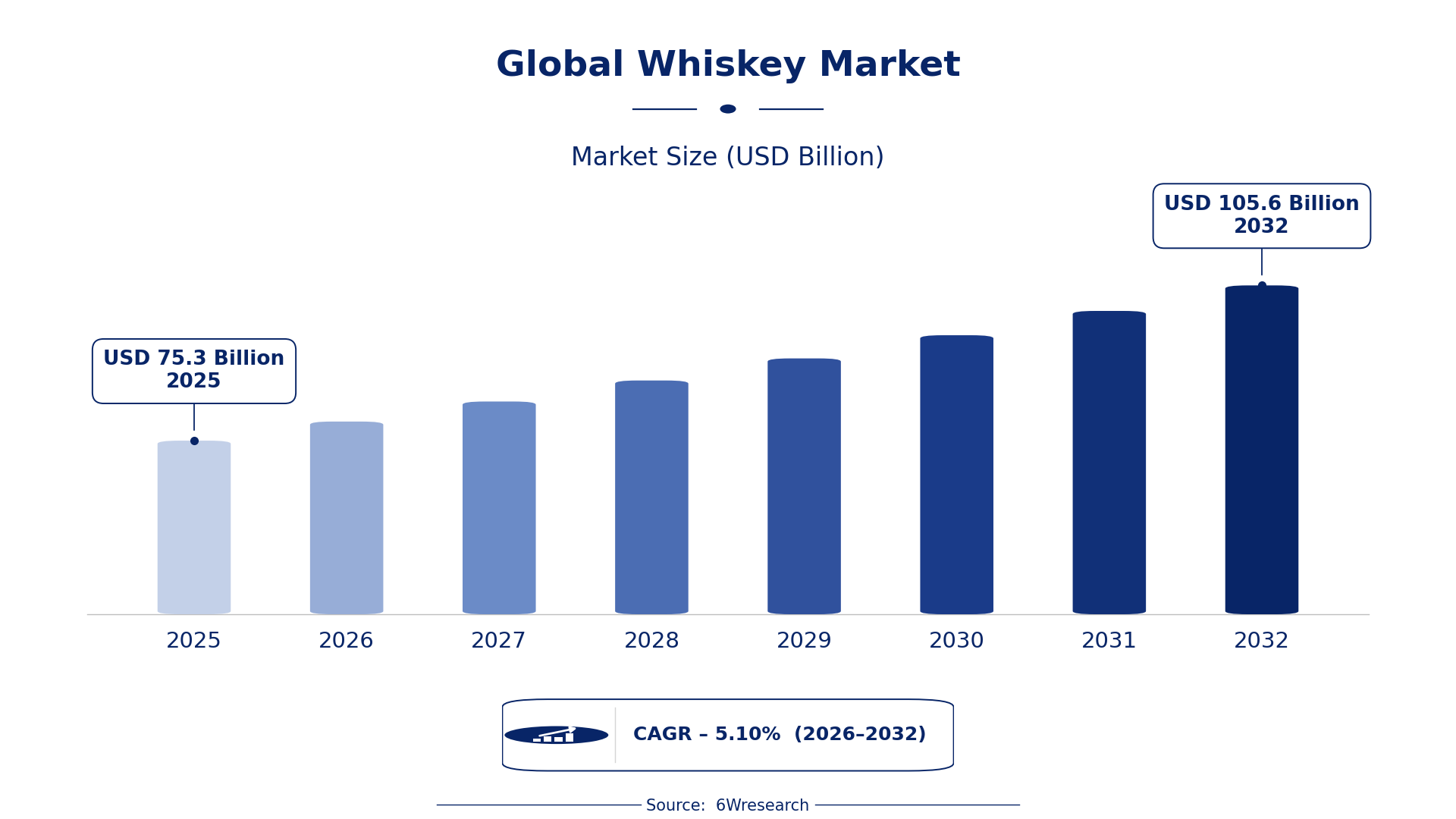
The Global Whiskey Market was estimated at USD 75.3 Billion in 2025 and is projected to reach USD 105.6 Billion by 2032, growing at a CAGR of 5.10% from 2026 to 2032.
Global Whiskey Market Synopsis
Transformative factors are currently reshaping the Global Whiskey Market, notably through an increasing consumer inclination towards higher-quality and artisanal offerings. The impact of premiumization is evident, leading distilleries to innovate in production processes and marketing strategies to cater to a more discerning palate. Furthermore, global consumer demographics are evolving, with younger consumers showing a preference for whiskey varieties that offer distinct flavors and unique production stories.
The significance of this market extends beyond mere revenue; it serves as a cultural cornerstone for various regions, reflecting heritage and local craftsmanship. The rise of whiskey-based cocktails and the burgeoning interest in whiskey tourism are also noteworthy developments. These trends indicate a market that is not only growing in size but is also becoming more complex, with clear opportunities for both established and emerging brands.
Global Whiskey Market Year-wise Growth Rate and Key Drivers
This graph illustrates the annual growth rates of the Global Whiskey Market from 2022 to 2032, highlighting a steady upward trajectory and projected expansion over the forecast period.
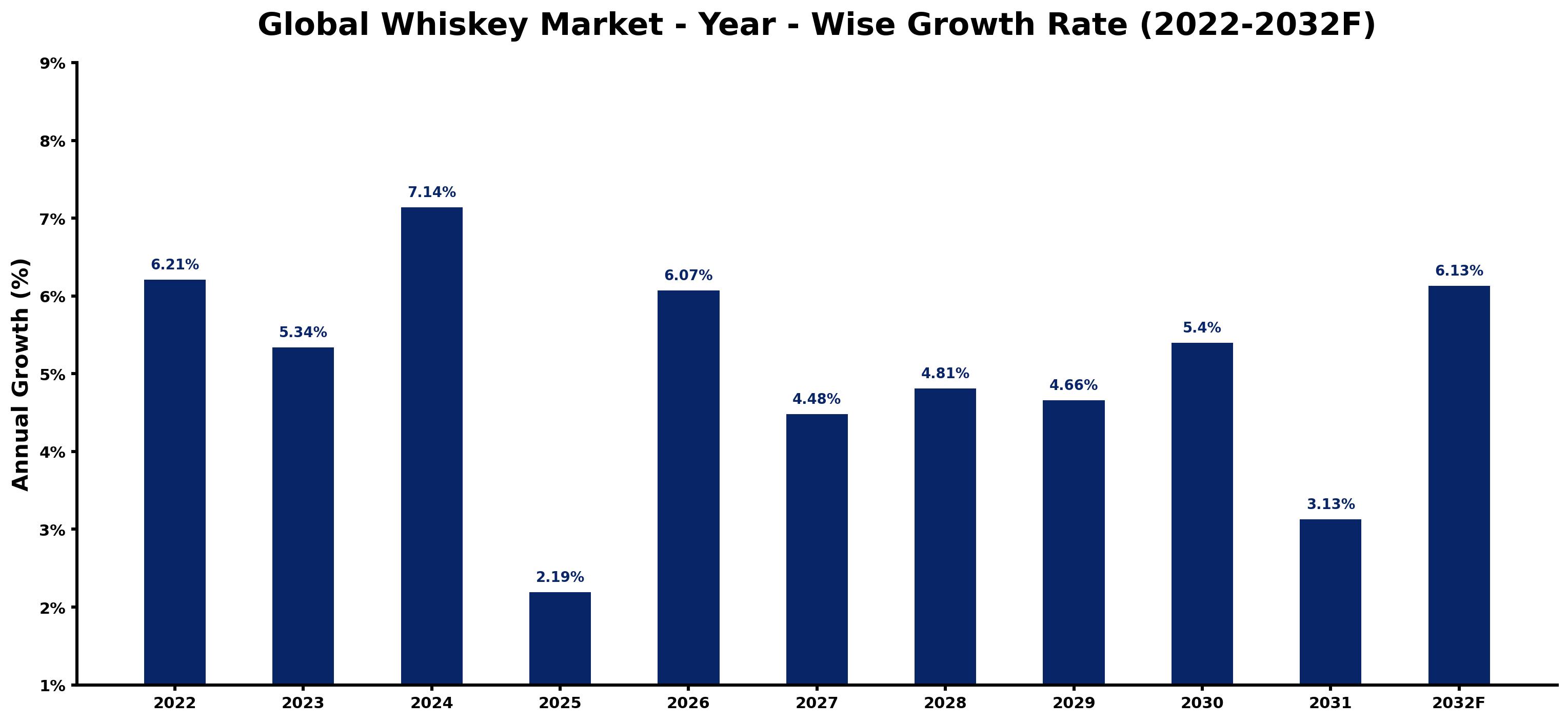
The table below presents the year‑wise growth rates along with the key drivers influencing the market
| Year | Growth Rate (%) | Major Drivers |
| 2022 | 6.21 | An increasing number of consumers seek premium whiskey options for quality experiences. |
| 2023 | 5.34 | Addressing supply chain bottlenecks enhances whiskey distribution to meet rising consumer needs. |
| 2024 | 7.14 | Consumers are prioritizing whiskey brands that engage in loyal brand loyalty programs. |
| 2025 | 2.19 | Investments in skilled labor improve whiskey production efficiency and overall product quality. |
| 2026 | 6.07 | In North America, a growing number of craft distilleries escalate whiskey market competition. |
| 2027 | 4.48 | Whiskey consumers increasingly benefit from clearer regulations regarding alcohol labeling standards. |
| 2028 | 4.81 | Fluctuating raw material costs are affecting pricing strategies for premium whiskey products. |
| 2029 | 4.66 | A shift toward sustainable packaging practices enhances the appeal of innovative whiskey brands. |
| 2030 | 5.4 | While mergers and acquisitions reshape the whiskey industry, brand consolidation progresses. |
| 2031 | 3.13 | Large distributors are enhancing their e-commerce channels to cater to whiskey enthusiasts online. |
| 2032 | 6.13 | Eco-friendly whiskey production methods are gaining traction as sustainability becomes a core focus. |
Note - Market size estimations and growth projections presented in this report are based on 6Wresearch's proprietary research methodology, combining internal industry data, secondary research, and primary validation, updated periodically to reflect current market conditions. As markets evolve rapidly, figures for certain industries may vary slightly and are intended as informed estimates rather than absolute figures. For the most current market sizing, we recommend validating figures with a 6Wresearch analyst.
Global Whiskey Market Key Takeaways
Below are some of the specific key takeaways from the market, including:
- Diageo launched a new range of premium products aimed at millennials in 2021, contributing to a growth rate of 6% in their whiskey portfolio that year.
- Irish Whiskey is expected to grow at a CAGR of 6.5% from 2026 to 2032, driven largely by international expansion and brand awareness.
- In 2022, the global whiskey market saw a noticeable shift with a reported 20% increase in limited-edition whiskey releases compared to the previous year.
- North America holds the largest market share, accounting for approximately 50% of the global whiskey consumption in 2025.
Evaluation of Restraints in Global Whiskey Market
The Global Whiskey Market faces notable challenges primarily stemming from regulatory hurdles and changing consumer preferences. Compliance with strict regulations surrounding alcohol production, such as the Federal Alcohol Administration Act in the U.S., can impose additional costs on manufacturers, often exceeding USD 1 million for smaller distilleries in securing necessary permits. For example, the recent increase in tariffs on imported spirits, such as the 25% duty enacted in 2020, places a financial strain on companies reliant on overseas ingredients, thereby affecting market dynamics and pricing strategies.
Global Whiskey Market Trends
Currently, the Global Whiskey Market is witnessing a clear shift towards sustainability and ethical production practices. Companies like The Glenlivet have initiated environmentally friendly distillation processes, aiming for a 15% reduction in carbon footprint by 2025. Additionally, the emergence of flavored whiskeys, such as honey or spice variants, reflects a diversification strategy aimed at appealing to a broader audience, particularly younger drinkers. A significant example of this trend is the launch of the WhistlePig 'Old World' series in late 2022, which incorporates innovative flavors influenced by global spirits.
Global Whiskey Market Opportunities
A substantial revenue opportunity exists in the growing Asian market, particularly in countries like China and India, where whiskey consumption is forecast to rise. Companies are increasingly focusing on education and marketing strategies to penetrate these emerging markets. For instance, Pernod Ricard’s investment of USD 50 million in a distillery in China in 2021 indicates confidence in this region's potential. Furthermore, the premiumization trend allows brands to command higher prices for unique products, creating avenues for enhanced profit margins. The demand for organic and natural ingredients is another opportunity, as consumers increasingly opt for whiskeys that emphasize transparency in sourcing and production.
Global Whiskey Market by Product Type
American Whisky currently leads the Global Whiskey Market with an impressive share of approximately 45% in 2025. In contrast, Irish Whisky is anticipated to be the fastest-growing segment, projected to rise at a CAGR of 6.5% from 2026 to 2032. This interest in Irish Whisky can be attributed to its rich history and the ongoing revival of traditional distilling methods, which resonate well with consumers seeking authenticity and quality.
Global Whiskey Market by Distribution Channel
The On-trade channel dominates the Global Whiskey Market with a share of approximately 70% as of 2025, largely bolstered by the robust cocktail culture in bars and restaurants. However, the Off-trade segment is projected to witness accelerated growth, with a CAGR of 6.0% from 2026 to 2032. This uptick is significantly driven by the increasing preference for home consumption and retail sales, especially in the aftermath of the global pandemic, highlighting changing consumer behaviors and purchasing habits.
Global Whiskey Market by Region
North America is the largest region for the Global Whiskey Market, capturing a formidable share of approximately 50% in 2025. Meanwhile, Asia Pacific is rapidly emerging as the fastest-growing market, expected to experience a CAGR of 7.0% from 2026 to 2032. This growth can be attributed to rising disposable incomes and increasing numbers of young consumers exploring whiskey culture, along with supportive government policies promoting local distilleries.
Government Initiatives in the Global Whiskey Market
The regulatory framework surrounding the Global Whiskey Market is evolving, directly influencing production and sales dynamics. Recent initiatives aimed at supporting domestic spirits production highlight a commitment to bolstering this historical industry while ensuring compliance with health and safety standards.
- U.S. Department of Agriculture - Farm Bill 2023, enacted in January 2023, promotes agricultural development for grain used in whiskey production, enhancing local sourcing.
- European Commission - Regulation (EU) 2019/787, effective since January 2021, aims to enforce stricter labeling standards for whiskey, ensuring transparency for consumers.
- Scotch Whisky Association - Regulatory review scheduled for 2024 aims to address new production guidelines to promote heritage and regional authenticity.
- Australian Government - National Spirits Development Strategy 2025, planned for mid-2024, focuses on enhancing international market access for Australian whiskey producers.
Future Insights of the Global Whiskey Market
As the Global Whiskey Market evolves, there will be a marked emphasis on the integration of technology in production processes. Innovations such as AI-driven flavor profiling and blockchain for ingredient sourcing are expected to gain traction by 2032. Companies, like Brown-Forman, are investing in digital marketing strategies that resonate with younger consumers and leverage data analytics for more personalized product offerings. Furthermore, sustainability initiatives will likely dominate investment directions, aligning with consumer expectations for ethical sourcing and environmental responsibility.
Global Whiskey Market Latest Developments
In recent months, several prominent companies have made strategic advancements in the Global Whiskey Market to enhance their market positioning and meet consumer demands. Below are some notable developments.
- In early 2023, Diageo announced the launch of a new premium whiskey line aimed specifically at the millennial demographic. This move strengthens its competitive edge in a growing segment.
- Recently, Pernod Ricard completed a significant expansion of its production capacity in India, reflecting a strategic effort to tap into the rapidly developing Asian market.
- In late 2022, Brown-Forman introduced a limited-edition whiskey aged in barrels previously used for rum, showcasing genuine flavor innovation that appeals to connoisseurs.
- Bacardi is set to invest in a new distillery in Scotland, anticipated for completion in 2024, which will bolster its presence in traditional whiskey markets and enhance its production capabilities.
Global Whiskey Market Key Players and Industry Positioning
The Global Whiskey Market is characterized by a competitive landscape that features both established giants and agile innovators. Major players, such as Diageo and Pernod Ricard, hold significant market shares, while emerging brands are carving niches with unique offerings. This dynamic structure reflects a blend of consolidated strengths and fragmented opportunities, fostering a diverse range of products and marketing strategies.
| Leading Company | Core Strength | Strategic Focus |
|---|---|---|
| Diageo | Strong global distribution network and brand portfolio | Targeting premium segments with innovation |
| Pernod Ricard | Focus on local sourcing and production | Expanding in developing markets like Asia |
| Brown-Forman | Rich heritage in whiskey craftsmanship | Investment in artisanal and limited-edition products |
| Beam Suntory | Diversified spirits portfolio | Leveraging flavors and regional authenticity |
| Bacardi | Strong brand recognition and legacy | Investing in sustainability and community engagement |
In conclusion, the industry's competitive dynamics highlight the importance of adaptability and innovation, as companies strive to meet the evolving tastes and preferences of whiskey consumers.
Key Attractiveness of the Report
- 10 Years of Market Numbers
- Historical Data Starting from 2022 to 2025
- Base Year: 2025
- Forecast Data until 2032
- Key Performance Indicators Impacting the Market
- Major Upcoming Developments and Projects
Key Highlights of the Report:
- Global Whiskey Market Outlook
- Market Size of Global Whiskey Market, 2025
- Forecast of Global Whiskey Market, 2032
- Historical Data and Forecast of Global Whiskey Revenues & Volume for the Period 2022-2032
- Global Whiskey Market Trend Evolution
- Global Whiskey Market Drivers and Challenges
- Global Whiskey Price Trends
- Global Whiskey Porter's Five Forces
- Global Whiskey Industry Life Cycle
- Historical Data and Forecast of Global Whiskey Market Revenues & Volume
- Historical Data and Forecast of Global Whiskey Market Revenues & Volume By Product Type for the Period 2022-2032
- Historical Data and Forecast of Global Whiskey Market Revenues & Volume By American Whisky for the Period 2022-2032
- Historical Data and Forecast of Global Whiskey Market Revenues & Volume By Irish Whisky for the Period 2022-2032
- Historical Data and Forecast of Global Whiskey Market Revenues & Volume By Scotch Whisky for the Period 2022-2032
- Historical Data and Forecast of Global Whiskey Market Revenues & Volume By Canadian Whisky for the Period 2022-2032
- Historical Data and Forecast of Global Whiskey Market Revenues & Volume By Others for the Period 2022-2032
- Historical Data and Forecast of Global Whiskey Market Revenues & Volume By Distribution Channel for the Period 2022-2032
- Historical Data and Forecast of Global Whiskey Market Revenues & Volume By On-trade for the Period 2022-2032
- Historical Data and Forecast of Global Whiskey Market Revenues & Volume By Off-trade for the Period 2022-2032
- Historical Data and Forecast of North America Whiskey Market Revenues & Volume By Product Type for the Period 2022-2032
- Historical Data and Forecast of North America Whiskey Market Revenues & Volume By American Whisky for the Period 2022-2032
- Historical Data and Forecast of North America Whiskey Market Revenues & Volume By Irish Whisky for the Period 2022-2032
- Historical Data and Forecast of North America Whiskey Market Revenues & Volume By Scotch Whisky for the Period 2022-2032
- Historical Data and Forecast of North America Whiskey Market Revenues & Volume By Canadian Whisky for the Period 2022-2032
- Historical Data and Forecast of North America Whiskey Market Revenues & Volume By Others for the Period 2022-2032
- Historical Data and Forecast of North America Whiskey Market Revenues & Volume By Distribution Channel for the Period 2022-2032
- Historical Data and Forecast of North America Whiskey Market Revenues & Volume By On-trade for the Period 2022-2032
- Historical Data and Forecast of North America Whiskey Market Revenues & Volume By Off-trade for the Period 2022-2032
- Historical Data and Forecast of United States of America Whiskey Market Revenues & Volume for the Period 2022-2032
- Historical Data and Forecast of Canada Whiskey Market Revenues & Volume for the Period 2022-2032
- Historical Data and Forecast of Rest of North America Whiskey Market Revenues & Volume for the Period 2022-2032
- Historical Data and Forecast of Latin America (LATAM) Whiskey Market Revenues & Volume By Product Type for the Period 2022-2032
- Historical Data and Forecast of Latin America (LATAM) Whiskey Market Revenues & Volume By American Whisky for the Period 2022-2032
- Historical Data and Forecast of Latin America (LATAM) Whiskey Market Revenues & Volume By Irish Whisky for the Period 2022-2032
- Historical Data and Forecast of Latin America (LATAM) Whiskey Market Revenues & Volume By Scotch Whisky for the Period 2022-2032
- Historical Data and Forecast of Latin America (LATAM) Whiskey Market Revenues & Volume By Canadian Whisky for the Period 2022-2032
- Historical Data and Forecast of Latin America (LATAM) Whiskey Market Revenues & Volume By Others for the Period 2022-2032
- Historical Data and Forecast of Latin America (LATAM) Whiskey Market Revenues & Volume By Distribution Channel for the Period 2022-2032
- Historical Data and Forecast of Latin America (LATAM) Whiskey Market Revenues & Volume By On-trade for the Period 2022-2032
- Historical Data and Forecast of Latin America (LATAM) Whiskey Market Revenues & Volume By Off-trade for the Period 2022-2032
- Historical Data and Forecast of Brazil Whiskey Market Revenues & Volume for the Period 2022-2032
- Historical Data and Forecast of Mexico Whiskey Market Revenues & Volume for the Period 2022-2032
- Historical Data and Forecast of Argentina Whiskey Market Revenues & Volume for the Period 2022-2032
- Historical Data and Forecast of Rest of LATAM Whiskey Market Revenues & Volume for the Period 2022-2032
- Historical Data and Forecast of Asia Whiskey Market Revenues & Volume By Product Type for the Period 2022-2032
- Historical Data and Forecast of Asia Whiskey Market Revenues & Volume By American Whisky for the Period 2022-2032
- Historical Data and Forecast of Asia Whiskey Market Revenues & Volume By Irish Whisky for the Period 2022-2032
- Historical Data and Forecast of Asia Whiskey Market Revenues & Volume By Scotch Whisky for the Period 2022-2032
- Historical Data and Forecast of Asia Whiskey Market Revenues & Volume By Canadian Whisky for the Period 2022-2032
- Historical Data and Forecast of Asia Whiskey Market Revenues & Volume By Others for the Period 2022-2032
- Historical Data and Forecast of Asia Whiskey Market Revenues & Volume By Distribution Channel for the Period 2022-2032
- Historical Data and Forecast of Asia Whiskey Market Revenues & Volume By On-trade for the Period 2022-2032
- Historical Data and Forecast of Asia Whiskey Market Revenues & Volume By Off-trade for the Period 2022-2032
- Historical Data and Forecast of China Whiskey Market Revenues & Volume for the Period 2022-2032
- Historical Data and Forecast of India Whiskey Market Revenues & Volume for the Period 2022-2032
- Historical Data and Forecast of Japan Whiskey Market Revenues & Volume for the Period 2022-2032
- Historical Data and Forecast of Rest of Asia Whiskey Market Revenues & Volume for the Period 2022-2032
- Historical Data and Forecast of Africa Whiskey Market Revenues & Volume By Product Type for the Period 2022-2032
- Historical Data and Forecast of Africa Whiskey Market Revenues & Volume By American Whisky for the Period 2022-2032
- Historical Data and Forecast of Africa Whiskey Market Revenues & Volume By Irish Whisky for the Period 2022-2032
- Historical Data and Forecast of Africa Whiskey Market Revenues & Volume By Scotch Whisky for the Period 2022-2032
- Historical Data and Forecast of Africa Whiskey Market Revenues & Volume By Canadian Whisky for the Period 2022-2032
- Historical Data and Forecast of Africa Whiskey Market Revenues & Volume By Others for the Period 2022-2032
- Historical Data and Forecast of Africa Whiskey Market Revenues & Volume By Distribution Channel for the Period 2022-2032
- Historical Data and Forecast of Africa Whiskey Market Revenues & Volume By On-trade for the Period 2022-2032
- Historical Data and Forecast of Africa Whiskey Market Revenues & Volume By Off-trade for the Period 2022-2032
- Historical Data and Forecast of South Africa Whiskey Market Revenues & Volume for the Period 2022-2032
- Historical Data and Forecast of Nigeria Whiskey Market Revenues & Volume for the Period 2022-2032
- Historical Data and Forecast of Egypt Whiskey Market Revenues & Volume for the Period 2022-2032
- Historical Data and Forecast of Rest of Africa Whiskey Market Revenues & Volume for the Period 2022-2032
- Historical Data and Forecast of Europe Whiskey Market Revenues & Volume By Product Type for the Period 2022-2032
- Historical Data and Forecast of Europe Whiskey Market Revenues & Volume By American Whisky for the Period 2022-2032
- Historical Data and Forecast of Europe Whiskey Market Revenues & Volume By Irish Whisky for the Period 2022-2032
- Historical Data and Forecast of Europe Whiskey Market Revenues & Volume By Scotch Whisky for the Period 2022-2032
- Historical Data and Forecast of Europe Whiskey Market Revenues & Volume By Canadian Whisky for the Period 2022-2032
- Historical Data and Forecast of Europe Whiskey Market Revenues & Volume By Others for the Period 2022-2032
- Historical Data and Forecast of Europe Whiskey Market Revenues & Volume By Distribution Channel for the Period 2022-2032
- Historical Data and Forecast of Europe Whiskey Market Revenues & Volume By On-trade for the Period 2022-2032
- Historical Data and Forecast of Europe Whiskey Market Revenues & Volume By Off-trade for the Period 2022-2032
- Historical Data and Forecast of United Kingdom Whiskey Market Revenues & Volume for the Period 2022-2032
- Historical Data and Forecast of France Whiskey Market Revenues & Volume for the Period 2022-2032
- Historical Data and Forecast of Germany Whiskey Market Revenues & Volume for the Period 2022-2032
- Historical Data and Forecast of Rest of Europe Whiskey Market Revenues & Volume for the Period 2022-2032
- Historical Data and Forecast of Middle East Whiskey Market Revenues & Volume By Product Type for the Period 2022-2032
- Historical Data and Forecast of Middle East Whiskey Market Revenues & Volume By American Whisky for the Period 2022-2032
- Historical Data and Forecast of Middle East Whiskey Market Revenues & Volume By Irish Whisky for the Period 2022-2032
- Historical Data and Forecast of Middle East Whiskey Market Revenues & Volume By Scotch Whisky for the Period 2022-2032
- Historical Data and Forecast of Middle East Whiskey Market Revenues & Volume By Canadian Whisky for the Period 2022-2032
- Historical Data and Forecast of Middle East Whiskey Market Revenues & Volume By Others for the Period 2022-2032
- Historical Data and Forecast of Middle East Whiskey Market Revenues & Volume By Distribution Channel for the Period 2022-2032
- Historical Data and Forecast of Middle East Whiskey Market Revenues & Volume By On-trade for the Period 2022-2032
- Historical Data and Forecast of Middle East Whiskey Market Revenues & Volume By Off-trade for the Period 2022-2032
- Historical Data and Forecast of Saudi Arabia Whiskey Market Revenues & Volume for the Period 2022-2032
- Historical Data and Forecast of UAE Whiskey Market Revenues & Volume for the Period 2022-2032
- Historical Data and Forecast of Turkey Whiskey Market Revenues & Volume for the Period 2022-2032
- Historical Data and Forecast of Rest of Middle East Whiskey Market Revenues & Volume for the Period 2022-2032
- Global Whiskey Market - Key Performance Indicators
- Global Whiskey Market - Import Export Trade Statistics
- Global Whiskey Market - Opportunity Assessment By Countries
- Global Whiskey Market - Opportunity Assessment By Product Type
- Global Whiskey Market - Opportunity Assessment By Distribution Channel
- Global Whiskey Market - Top Companies Market Share
- Global Whiskey Market - Top Companies Profiles
- Global Whiskey Market - Comparison of Players in Technical and Operating Parameters
- Global Whiskey Market - Strategic Recommendations
Markets Covered
The Global Whiskey Market report provides a detailed analysis of the following market segments:
By Regions and Countries:
- North America
- Europe
- LATAM
- Middle East
- Asia
- Africa
By Product Type:
- American Whisky
- Irish Whisky
- Scotch Whisky
- Canadian Whisky
- Others
By Distribution Channel:
- On-trade
- Off-trade






































