Italy Whiskey Market Size (2020-2030)
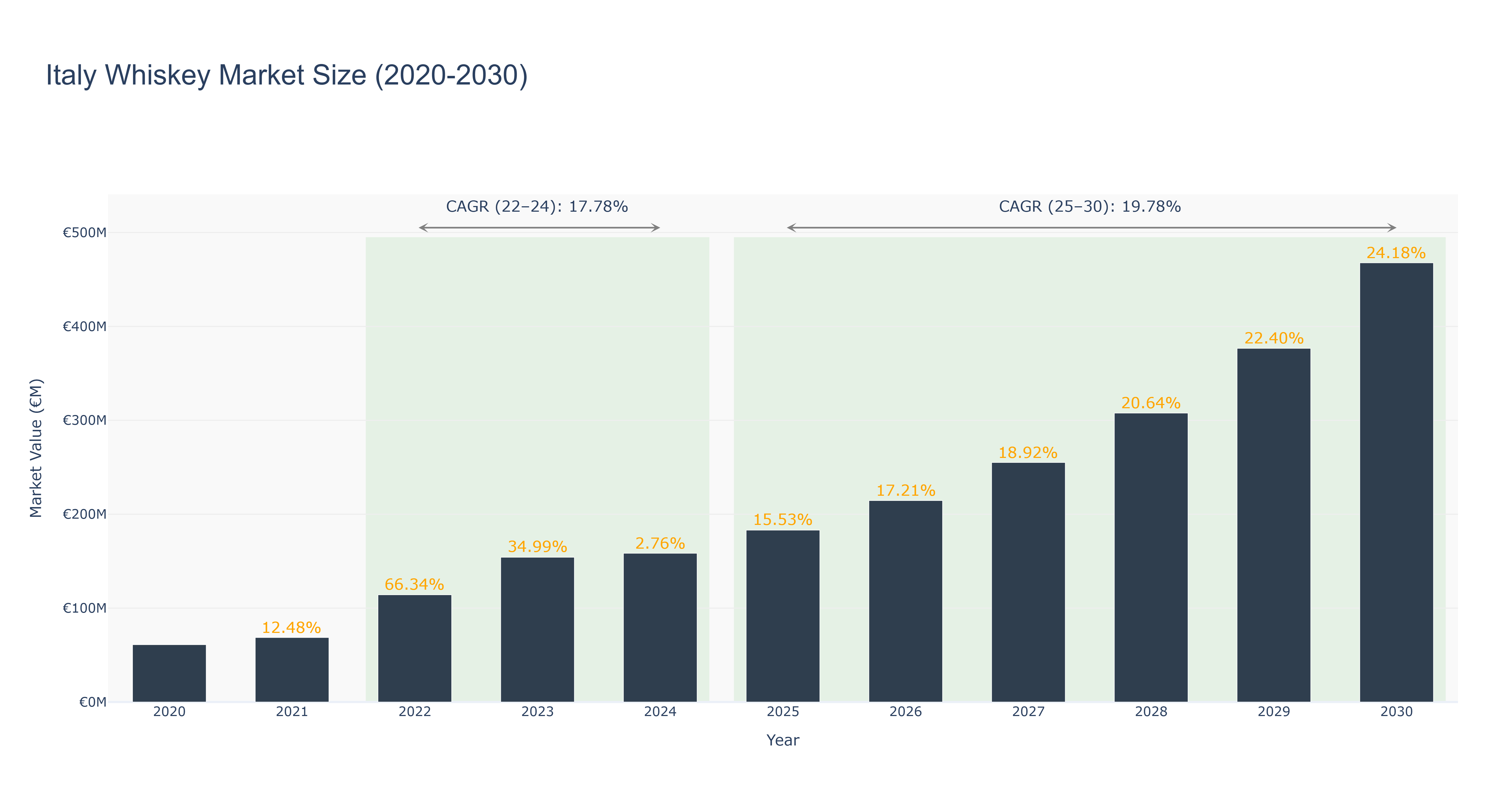
Italy Whiskey Market has shown a promising growth trajectory over the years. The market peaked at €467.70 million in 2030, with a consistent upward trend from 2020 to 2030. The market size increased steadily from €61.03 million in 2020 to €158.39 million in 2024, driven by increasing consumer demand and expanding product offerings. The forecasted market size is expected to reach €376.63 million by 2029, indicating a strong growth potential. Notably, the CAGR for the period 2025-2030 is 19.78%, reflecting sustained market expansion. Industry drivers such as evolving consumer preferences towards premium spirits and the rise of cocktail culture are contributing to the market's growth. Looking ahead, upcoming collaborations between Italian distilleries and international brands are set to further boost market competitiveness and drive innovation in the Italy Whiskey Market.
Italy Whiskey Market: Production & Trade Performance (2019-2025)
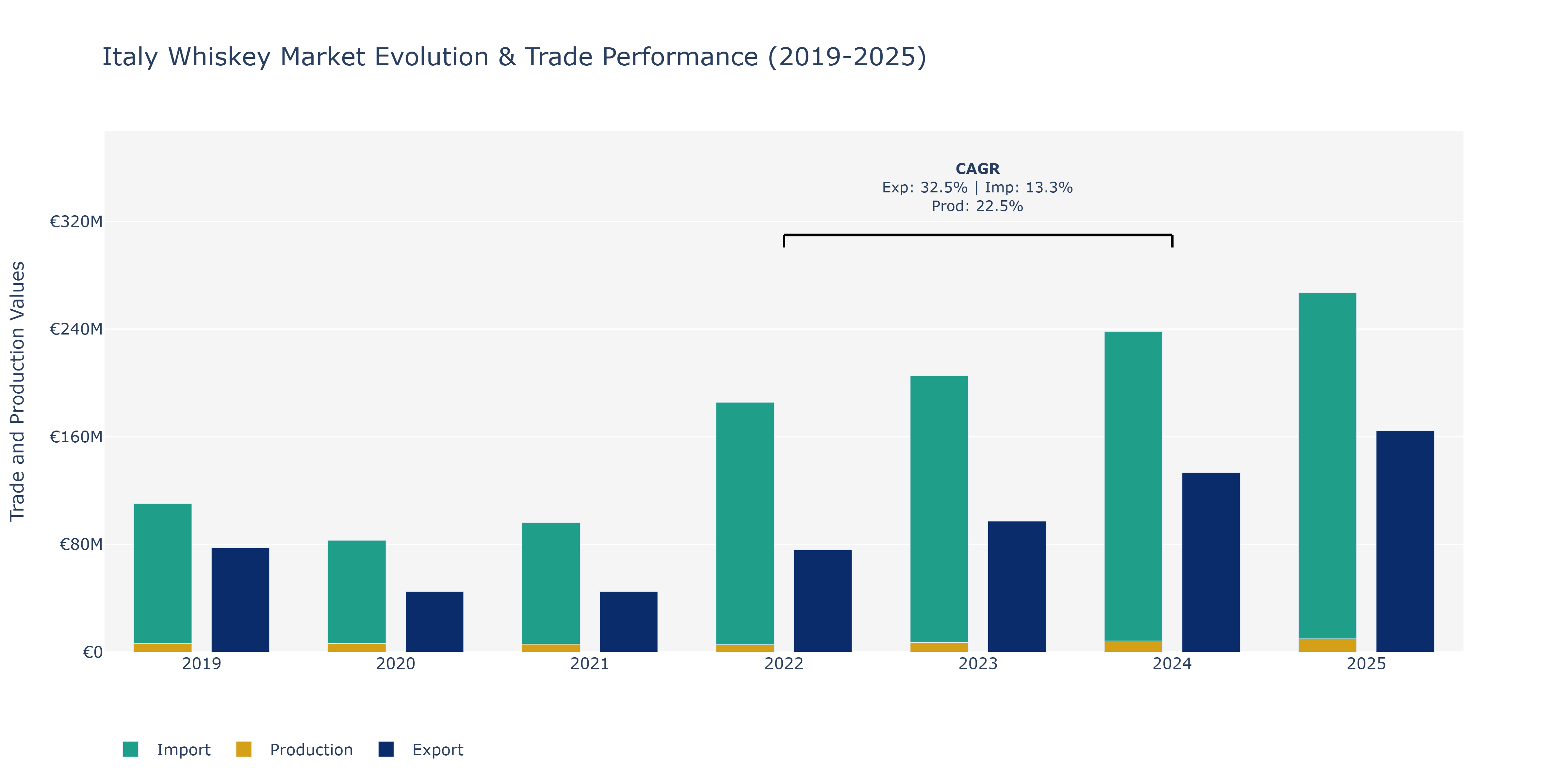
The Italy Whiskey Market experienced notable fluctuations in exports, imports, and production from 2019 to 2025. While exports started at €77.56 million in 2019, they surged to €164.59 million in 2025, showcasing a steady upward trajectory. In contrast, imports grew from €110.22 million in 2019 to €266.94 million in 2025, indicating a consistent rise year over year. Production value displayed a less consistent pattern, decreasing from €6.27 million in 2019 to €5.80 million in 2021 before rebounding to €9.81 million in 2025. The peak points were observed in 2025 for exports and imports, and in 2024 for production, aligning with a growing global demand for premium spirits like whiskey. Factors such as Italy's rich cultural heritage in winemaking, increasing disposable incomes, and expanding export markets contributed to the market's positive performance. Moving forward, continued focus on product innovation and marketing strategies can further boost Italy's position in the global whiskey market.
Italy Whiskey Market Synopsis
Italy whiskey market offers a wide selection of whiskies from around the world, including Scotch whisky, bourbon, Irish whiskey, and Italy whiskey. With a growing appreciation for premium and craft spirits, Italy whiskey market reflects diverse consumer preferences and tastes for aged and flavored whiskies.
Drivers of the market
The Italy whiskey market is experiencing growth driven by premiumization and the rise of cocktail culture. With increasing disposable incomes and evolving consumer tastes, there is growing interest in premium and artisanal whiskey brands among discerning drinkers and collectors. Moreover, the growing popularity of whiskey-based cocktails in bars, restaurants, and social gatherings is expanding the consumer base and driving consumption. Italy consumers are exploring diverse whiskey styles, including single malt, blended, and bourbon, and experimenting with creative cocktail recipes, fueling demand for a wide range of whiskey products. The convergence of premiumization and cocktail culture is shaping the Italy whiskey market landscape.
Challenges of the market
The whiskey market in Italy faces challenges such as regulatory compliance, market competition, and consumer preferences. Complying with stringent regulations governing the production and labeling of whiskey is essential for market entry and acceptance. The market is highly competitive, with numerous domestic and international brands vying for consumer attention, necessitating continuous innovation and marketing efforts. Additionally, catering to evolving consumer preferences and trends, such as the demand for premium and craft whiskey, requires flexibility and adaptability from producers.
Government Policy of the market
Government policies related to the Italy Whiskey Market may focus on alcohol taxation, import/export regulations, and advertising restrictions. Regulatory agencies may impose excise taxes on whiskey production and sales to generate revenue for public services, establish quotas or tariffs on imported whiskey to protect domestic distilleries, and enforce advertising guidelines to prevent the promotion of excessive alcohol consumption. Government initiatives may include public health campaigns on responsible drinking, support for small-scale whiskey producers, and measures to promote Italy whiskey brands in international markets.
Key Highlights of the Report:
- Italy Whiskey Market Outlook
- Market Size of Italy Whiskey Market, 2024
- Forecast of Italy Whiskey Market, 2031
- Historical Data and Forecast of Italy Whiskey Revenues & Volume for the Period 2018 - 2031
- Italy Whiskey Market Trend Evolution
- Italy Whiskey Market Drivers and Challenges
- Italy Whiskey Price Trends
- Italy Whiskey Porter's Five Forces
- Italy Whiskey Industry Life Cycle
- Historical Data and Forecast of Italy Whiskey Market Revenues & Volume By Product Type for the Period 2018 - 2031
- Historical Data and Forecast of Italy Whiskey Market Revenues & Volume By American Whisky for the Period 2018 - 2031
- Historical Data and Forecast of Italy Whiskey Market Revenues & Volume By Irish Whisky for the Period 2018 - 2031
- Historical Data and Forecast of Italy Whiskey Market Revenues & Volume By Scotch Whisky for the Period 2018 - 2031
- Historical Data and Forecast of Italy Whiskey Market Revenues & Volume By Canadian Whisky for the Period 2018 - 2031
- Historical Data and Forecast of Italy Whiskey Market Revenues & Volume By Others for the Period 2018 - 2031
- Historical Data and Forecast of Italy Whiskey Market Revenues & Volume By Distribution Channel for the Period 2018 - 2031
- Historical Data and Forecast of Italy Whiskey Market Revenues & Volume By On-trade for the Period 2018 - 2031
- Historical Data and Forecast of Italy Whiskey Market Revenues & Volume By Off-trade for the Period 2018 - 2031
- Italy Whiskey Import Export Trade Statistics
- Market Opportunity Assessment By Product Type
- Market Opportunity Assessment By Distribution Channel
- Italy Whiskey Top Companies Market Share
- Italy Whiskey Competitive Benchmarking By Technical and Operational Parameters
- Italy Whiskey Company Profiles
- Italy Whiskey Key Strategic Recommendations






































