Botswana Non-Ferrous Metal Market Year-wise Growth Rate (2021-2031F)
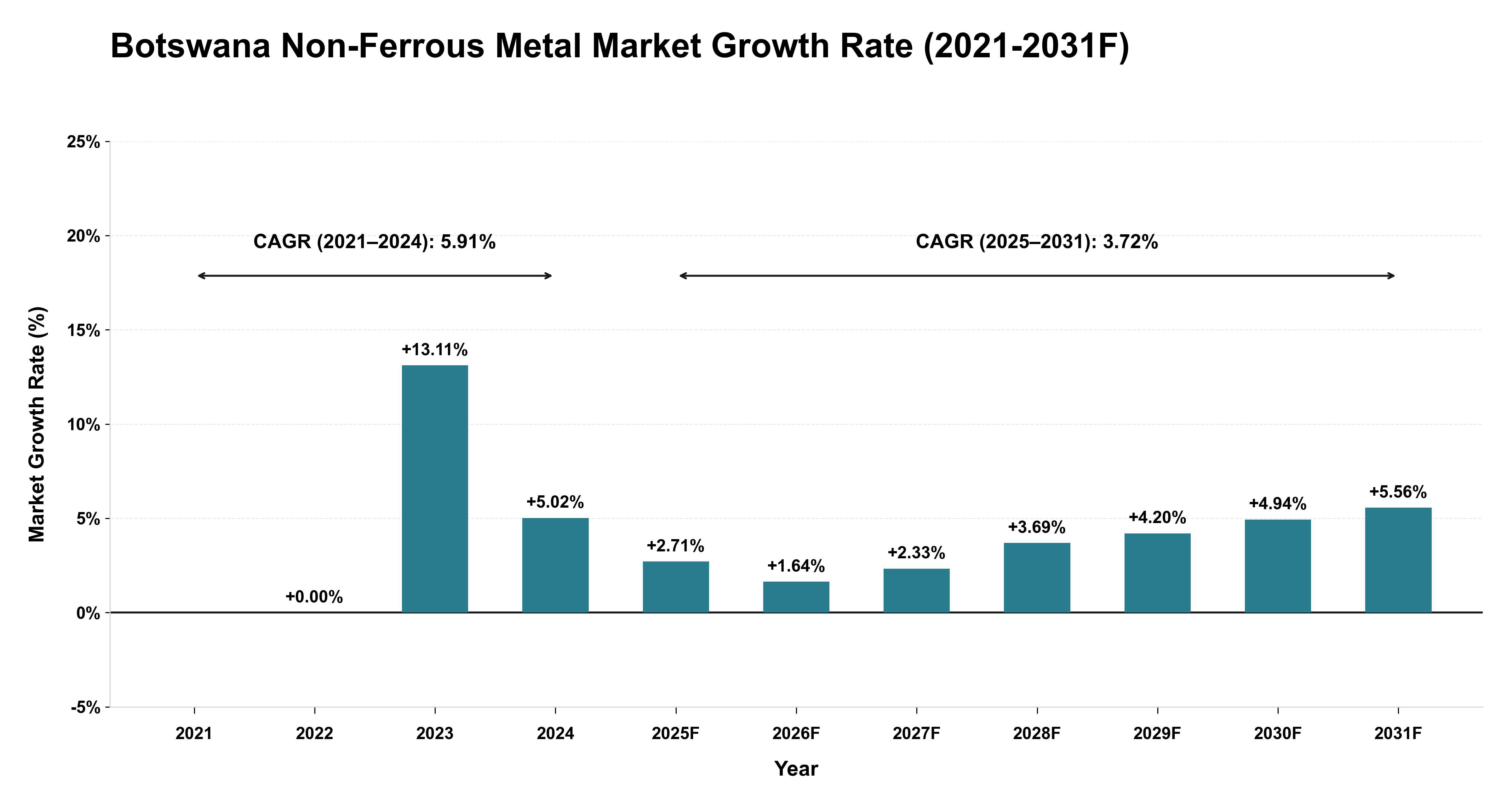
In the Botswana Non-Ferrous Metal Market, the historical period from 2021 to 2024 saw a steady growth trajectory with a CAGR of 5.91%. This growth was characterized by fluctuations, starting with stagnant growth in 2022, followed by a significant spike in 2023 at 13.11%, and a moderate increase in 2024 at 5.02%. Looking ahead to the forecast period of 2025-2031, there is an expected deceleration in growth with a forecasted CAGR of 3.72%. The gradual decline in annual growth rates from 2025 to 2026 can be attributed to shifting demand dynamics, possibly influenced by global economic conditions or regulatory changes impacting the non-ferrous metal industry in Botswana. Subsequent moderate growth rates from 2027 to 2031 indicate a stabilized market with incremental advancements and sustained demand for non-ferrous metals within Botswana's economy.
Key Highlights of the Report:
- Botswana Non-ferrous Metal Market Outlook
- Market Size of Botswana Non-ferrous Metal Market, 2024
- Forecast of Botswana Non-ferrous Metal Market, 2031
- Historical Data and Forecast of Botswana Non-ferrous Metal Revenues & Volume for the Period 2021-2031
- Botswana Non-ferrous Metal Market Trend Evolution
- Botswana Non-ferrous Metal Market Drivers and Challenges
- Botswana Non-ferrous Metal Price Trends
- Botswana Non-ferrous Metal Porter`s Five Forces
- Botswana Non-ferrous Metal Industry Life Cycle
- Historical Data and Forecast of Botswana Non-ferrous Metal Market Revenues & Volume By Types for the Period 2021-2031
- Historical Data and Forecast of Botswana Non-ferrous Metal Market Revenues & Volume By Aluminum for the Period 2021-2031
- Historical Data and Forecast of Botswana Non-ferrous Metal Market Revenues & Volume By Copper for the Period 2021-2031
- Historical Data and Forecast of Botswana Non-ferrous Metal Market Revenues & Volume By Lead for the Period 2021-2031
- Historical Data and Forecast of Botswana Non-ferrous Metal Market Revenues & Volume By Tin for the Period 2021-2031
- Historical Data and Forecast of Botswana Non-ferrous Metal Market Revenues & Volume By Nickel for the Period 2021-2031
- Historical Data and Forecast of Botswana Non-ferrous Metal Market Revenues & Volume By Titanium for the Period 2021-2031
- Historical Data and Forecast of Botswana Non-ferrous Metal Market Revenues & Volume By Zinc for the Period 2021-2031
- Historical Data and Forecast of Botswana Non-ferrous Metal Market Revenues & Volume By Applications for the Period 2021-2031
- Historical Data and Forecast of Botswana Non-ferrous Metal Market Revenues & Volume By Automobile Industry for the Period 2021-2031
- Historical Data and Forecast of Botswana Non-ferrous Metal Market Revenues & Volume By Electronic Power Industry for the Period 2021-2031
- Historical Data and Forecast of Botswana Non-ferrous Metal Market Revenues & Volume By Construction Industry for the Period 2021-2031
- Historical Data and Forecast of Botswana Non-ferrous Metal Market Revenues & Volume By Other for the Period 2021-2031
- Botswana Non-ferrous Metal Import Export Trade Statistics
- Market Opportunity Assessment By Types
- Market Opportunity Assessment By Applications
- Botswana Non-ferrous Metal Top Companies Market Share
- Botswana Non-ferrous Metal Competitive Benchmarking By Technical and Operational Parameters
- Botswana Non-ferrous Metal Company Profiles
- Botswana Non-ferrous Metal Key Strategic Recommendations






































