Brazil Acoustic Guitar Market Size, Share & Growth Rate
The Brazil Acoustic Guitar Market was estimated at USD 399 Million in 2025 and is projected to reach USD 478 Million by 2032, growing at a CAGR of 2.6% from 2026 to 2032. This growth trajectory is primarily driven by the cultural significance of music in Brazil, a country renowned for its vibrant musical traditions. The increasing interest in music education and the acoustic guitar's versatility across various genres further amplify market potential.
Brazil Acoustic Guitar Market Year-wise Growth Rate and Key Drivers
This graph highlights how the Brazil Acoustic Guitar Market has steadily grown over the years, supported by major growth factors.
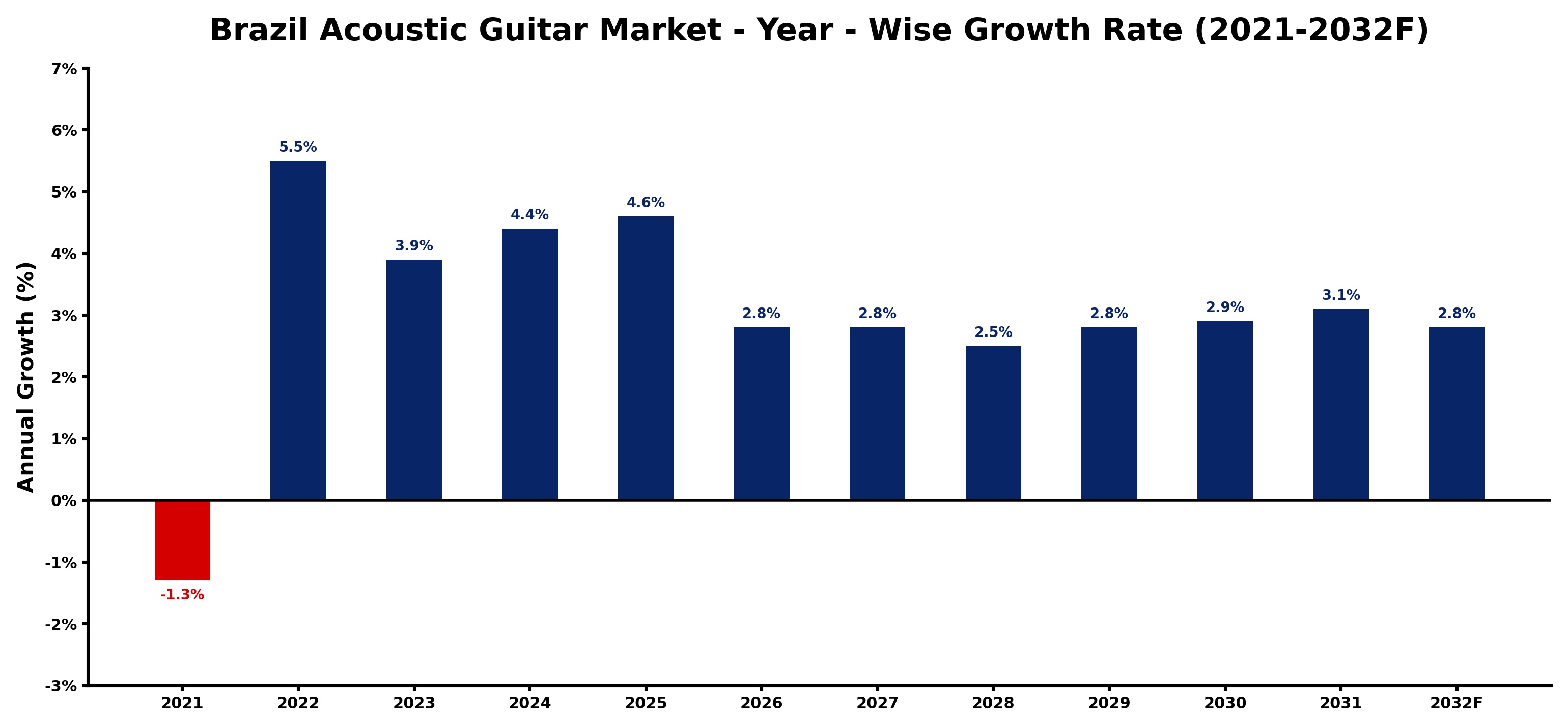
The table below presents the year‑wise growth rates along with the key drivers influencing the market
| Year | Growth Rate | Major Drivers |
| 2021 | -1.3% | Weak domestic demand for acoustic guitars hampers manufacturing capacity utilization |
| 2022 | 5.5% | Improved domestic manufacturing quality boosts local acoustic guitar exports |
| 2023 | 3.9% | Domestic acoustic guitar manufacturers adopt automation for increased productivity |
| 2024 | 4.4% | Domestic acoustic guitar manufacturers invest in advanced wood processing techniques |
| 2025 | 4.6% | Domestic guitar manufacturers adopt automation for efficient production scaling |
| 2026 | 2.8% | Manufacturing investments in automation boost acoustic guitar production efficiency |
| 2027 | 2.8% | Export driven technology integration boosted acoustic guitar manufacturing precision |
| 2028 | 2.5% | Foundry modernization initiatives boost acoustic guitar production capacity |
| 2029 | 2.8% | Manufacturing investments boosted acoustic guitar production and export capabilities |
| 2030 | 2.9% | Domestic guitar manufacturing expansion boosts local wood supply chain efficiency |
| 2031 | 3.1% | Domestic guitar manufacturing investment boosts skilled labor recruitment efforts |
| 2032 | 2.8% | Manufacturing investments in CNC machinery enhanced guitar production capacity |
Note - Market size estimations and growth projections presented in this report are based on 6Wresearch's advanced forecasting approach, validated with industry datasets as of June 2026.
Brazil Acoustic Guitar Market Synopsis
The most potent force shaping the Brazil Acoustic Guitar Market today is the cultural reverence for music, which continues to fuel consumer interest. As Brazilians increasingly embrace guitar playing across genres—from samba to rock—the demand for quality instruments rises correspondingly.
Additionally, the rise in music education programs in schools and community initiatives has created a conducive environment for budding musicians. This educational push not only encourages young talents but also builds a sustained market for acoustic guitars.
Brazil Acoustic Guitar Market Key Takeaways
- The acoustic guitar remains a symbol of cultural identity in Brazil, driving demand across demographics.
- Increased participation in music education programs is fostering a new generation of guitar enthusiasts.
- Quality craftsmanship and innovative designs are critical for manufacturers to differentiate themselves.
- Government support for arts and culture plays a crucial role in shaping market dynamics.
- Economic fluctuations continue to pose challenges, influencing consumer purchasing behavior.
Evaluation of Restraints in Brazil Acoustic Guitar Market
Despite the positive growth outlook, the Brazil Acoustic Guitar Market faces several restraints. Economic fluctuations can significantly impact discretionary spending, leading to reduced sales. Additionally, competition from global manufacturers presents a challenge, making it crucial for local producers to focus on niche marketing and brand building. The changing preferences of consumers, particularly younger generations favoring digital music experiences, also necessitate a strategic approach to maintain relevance.
Brazil Acoustic Guitar Market Trends
Current trends in the Brazil Acoustic Guitar Market reflect a blend of traditional craftsmanship with modern technology. Manufacturers are investing in innovative materials and eco-friendly production methods, appealing to environmentally conscious consumers. Moreover, the rise of social media platforms has fueled a digital community of musicians, leading to increased visibility for acoustic guitar performances and tutorials, subsequently driving sales.
Brazil Acoustic Guitar Market Opportunities
Significant growth opportunities lie in enhancing music education programs and promoting the acoustic guitar's versatility across various genres. Collaborations with educational institutions and local music festivals can enhance brand visibility and foster community engagement. Furthermore, targeting niche markets, such as custom-built guitars or specialized accessories, offers additional pathways for growth and consumer loyalty.
Government Initiatives in the Brazil Acoustic Guitar Market
Government initiatives supporting the arts, culture, and music education are vital for the Brazil Acoustic Guitar Market. Policies that promote music education in schools, funding for cultural events, and preservation of traditional craftsmanship help bolster the industry. Such supportive measures encourage local musicians and businesses, ensuring a thriving market ecosystem.
Future Insights of the Brazil Acoustic Guitar Market
Looking ahead to 2026-2032, the Brazil Acoustic Guitar Market is poised for steady growth. As societal appreciation for music deepens and educational programs expand, the demand for quality acoustic guitars will continue to rise. Manufacturers who prioritize innovation and craftsmanship, along with strategic marketing efforts, will be well-positioned to capitalize on this trend and enhance their market share.
Brazil Acoustic Guitar Market Latest Developments (May 2025 - June 2026)
In recent months, the Brazil Acoustic Guitar Market has seen a renewed focus on sustainability, with manufacturers exploring eco-friendly materials and production processes. Community-driven music festivals have gained popularity, providing a platform for local artists while promoting acoustic guitar sales. Additionally, partnerships between educational institutions and guitar manufacturers are fostering an environment of growth and creativity, encouraging more individuals to explore playing the instrument.
Brazil Acoustic Guitar Market - Key Attractiveness of the Report
- 10 Years of Market Numbers
- Historical Data Starting from 2022 to 2025
- Base Year: 2025
- Forecast Data until 2032
- Key Performance Indicators Impacting the Market
- Major Upcoming Developments and Projects
Key Highlights of the Report:
- Brazil Acoustic Guitar Market Outlook
- Market Size of Brazil Acoustic Guitar Market, 2025
- Forecast of Brazil Acoustic Guitar Market, 2032
- Historical Data and Forecast of Brazil Acoustic Guitar Revenues & Volume for the Period 2022-2032F
- Brazil Acoustic Guitar Market Trend Evolution
- Brazil Acoustic Guitar Market Drivers and Challenges
- Brazil Acoustic Guitar Price Trends
- Brazil Acoustic Guitar Porter's Five Forces
- Brazil Acoustic Guitar Industry Life Cycle
- Historical Data and Forecast of Brazil Acoustic Guitar Market Revenues & Volume By Product for the Period 2022-2032F
- Historical Data and Forecast of Brazil Acoustic Guitar Market Revenues & Volume By Nylon/gut Stringed Guitars for the Period 2022-2032F
- Historical Data and Forecast of Brazil Acoustic Guitar Market Revenues & Volume By Steel Stringed Guitars for the Period 2022-2032F
- Historical Data and Forecast of Brazil Acoustic Guitar Market Revenues & Volume By Other for the Period 2022-2032F
- Historical Data and Forecast of Brazil Acoustic Guitar Market Revenues & Volume By Application for the Period 2022-2032F
- Historical Data and Forecast of Brazil Acoustic Guitar Market Revenues & Volume By Perform for the Period 2022-2032F
- Historical Data and Forecast of Brazil Acoustic Guitar Market Revenues & Volume By Teaching for the Period 2022-2032F
- Historical Data and Forecast of Brazil Acoustic Guitar Market Revenues & Volume By Other for the Period 2022-2032F
- Brazil Acoustic Guitar Import Export Trade Statistics
- Market Opportunity Assessment By Product
- Market Opportunity Assessment By Application
- Brazil Acoustic Guitar Top Companies Market Share
- Brazil Acoustic Guitar Competitive Benchmarking By Technical and Operational Parameters
- Brazil Acoustic Guitar Company Profiles
- Brazil Acoustic Guitar Key Strategic Recommendations






































