Brazil Adjustable Spanners Market Size, Share & Growth Rate
The Brazil Adjustable Spanners Market was estimated at USD 217 Million in 2025 and is projected to reach USD 258 Million by 2032, growing at a CAGR of 2.5% from 2026 to 2032. This growth trajectory is primarily driven by the robust expansion in the construction and automotive sectors, which are witnessing a surge due to ongoing infrastructure development and rising vehicle ownership. Additionally, the increasing demand for versatile and durable hand tools further propels market dynamics, as industries seek efficiency and productivity in their operations.
Brazil Adjustable Spanners Market Year-wise Growth Rate and Key Drivers
This graph highlights how the Brazil Adjustable Spanners Market has steadily grown over the years, supported by major growth factors.
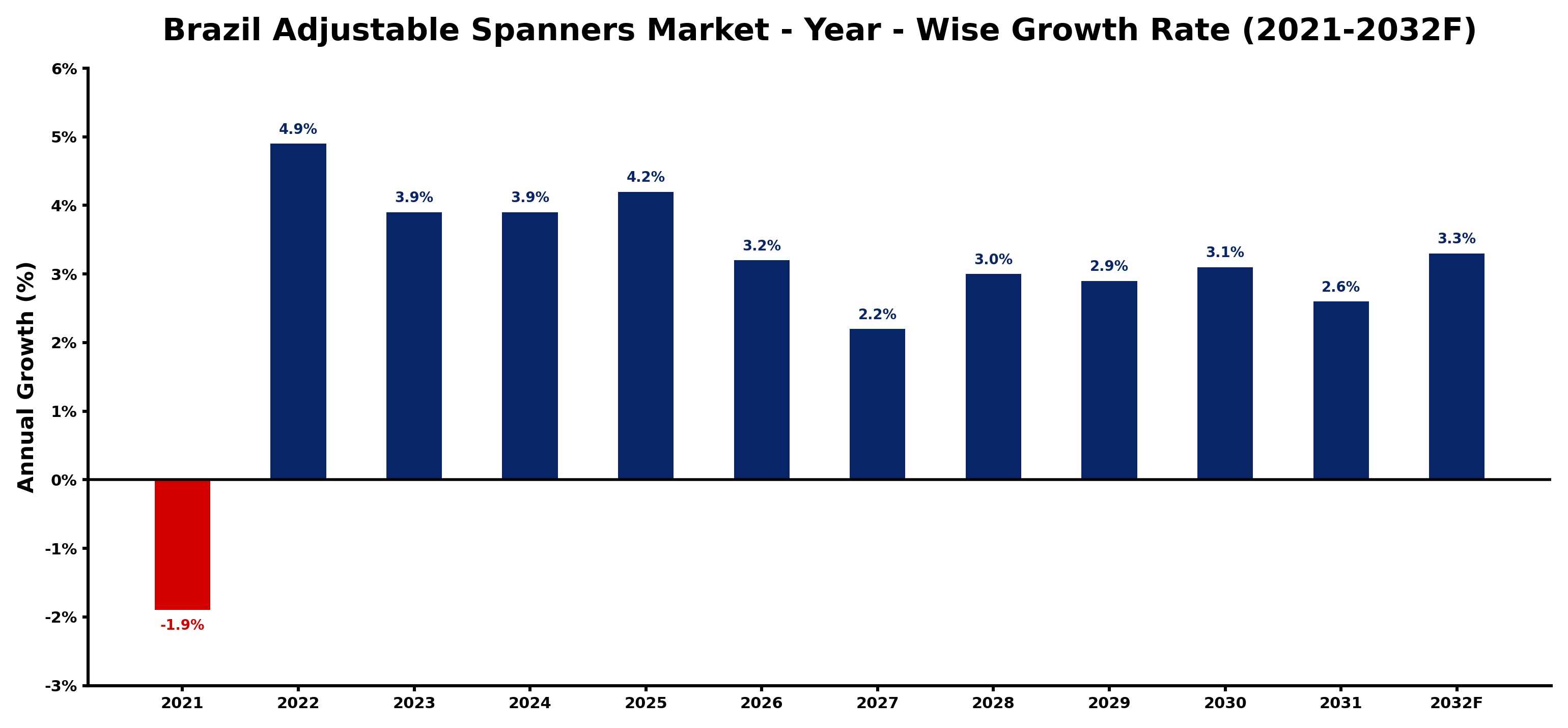
The table below presents the year‑wise growth rates along with the key drivers influencing the market
| Year | Growth Rate | Major Drivers |
| 2021 | -1.9% | Rising electricity demand across industries |
| 2022 | 4.9% | Expansion of manufacturing activities |
| 2023 | 3.9% | Growing renewable energy integration projects |
| 2024 | 3.9% | Increasing smart city development projects |
| 2025 | 4.2% | Expansion of transportation and logistics networks |
| 2026 | 3.2% | Expansion of manufacturing activities |
| 2027 | 2.2% | Increasing adoption of advanced technologies |
| 2028 | 3.0% | Expansion of commercial construction activities |
| 2029 | 2.9% | Government infrastructure modernization initiatives |
| 2030 | 3.1% | Increasing smart city development projects |
| 2031 | 2.6% | Rising electricity demand across industries |
| 2032 | 3.3% | Government infrastructure modernization initiatives |
Note - Market size estimations and growth projections presented in this report are based on 6Wresearch’s advanced forecasting approach, validated with industry datasets as of June 2026.
Brazil Adjustable Spanners Market Synopsis
The Brazil Adjustable Spanners Market is currently experiencing notable activity as sectors such as construction and automotive thrive. This has resulted in a heightened need for high-quality tools that can handle various mechanical tasks, positioning adjustable spanners as essential instruments in maintenance and repair operations.
The versatility and ergonomic design of adjustable spanners cater to a wide range of applications, making them a staple in workshops and industrial settings. As manufacturers strive to meet growing consumer demands, innovations in tool design and materials are poised to shape the future of the market significantly.
Brazil Adjustable Spanners Market Key Takeaways
- Strong growth is fueled by infrastructure projects and rising automotive ownership.
- The market is characterized by a demand for ergonomic and durable tool designs.
- Product differentiation is essential for players to remain competitive.
- Quality standards and compliance with safety regulations drive market dynamics.
- Emerging technologies are influencing manufacturing processes and tool efficiency.
Evaluation of Restraints in Brazil Adjustable Spanners Market
Despite the positive growth outlook, the Brazil Adjustable Spanners Market faces significant restraints that may hinder its potential. Market players grapple with challenges in achieving product differentiation amid fierce competition, which can pressure profit margins. The presence of counterfeit products poses a serious threat, as it undermines consumer trust and complicates market dynamics. Additionally, supply chain disruptions, often exacerbated by fluctuating demand across industries, can affect production capabilities and lead times, further complicating the operational landscape.
Brazil Adjustable Spanners Market Trends
Current trends within the Brazil Adjustable Spanners Market reveal a strong inclination towards the development of ergonomic designs that prioritize user comfort and efficiency. Manufacturers are increasingly adopting innovative materials that enhance durability and reduce production costs. Additionally, the integration of smart technology in tools is gaining traction, allowing for improved functionalities and user experience. Sustainability practices are also becoming more prevalent, with companies aiming to reduce their environmental footprint through eco-friendly production methods.
Brazil Adjustable Spanners Market Opportunities
The landscape of the Brazil Adjustable Spanners Market is ripe with opportunities for growth and investment. As the construction and automotive sectors expand, the demand for high-quality adjustable spanners is set to rise, encouraging manufacturers to innovate. Furthermore, tapping into e-commerce platforms can provide wider reach and accessibility to consumers. There is also potential in developing specialized tools tailored for specific industries, fostering differentiation and appealing to niche markets.
Government Initiatives in the Brazil Adjustable Spanners Market
Brazilian government policies significantly impact the Adjustable Spanners Market, particularly through regulations that govern manufacturing standards and product safety. These policies not only ensure that tools are of high quality but also promote compliance with occupational health and safety standards in industries utilizing adjustable spanners. Government initiatives aimed at enhancing infrastructure and supporting local manufacturing can further bolster market growth.
Future Insights of the Brazil Adjustable Spanners Market
Looking ahead to the period from 2026 to 2032, the Brazil Adjustable Spanners Market is expected to evolve in alignment with technological advancements and changing consumer preferences. The ongoing growth in key sectors such as construction and automotive will continue to be a primary driver of demand. Moreover, innovations in tool design and materials are anticipated to enhance product offerings, allowing manufacturers to meet the diverse needs of users. By focusing on sustainability and ergonomic efficiency, the market is positioned for a promising future.
Brazil Adjustable Spanners Market Latest Developments (May 2025 - June 2026)
Recent developments in the Brazil Adjustable Spanners Market indicate a shift towards increased collaboration among manufacturers to enhance product standards and design innovations. There is a noticeable focus on improving supply chain resilience, responding to global disruptions, and ensuring steady product availability. Furthermore, the trend towards online retail is rapidly gaining traction, as consumers seek convenient purchasing options and manufacturers adapt to meet these changing shopping behaviors.
Brazil Adjustable Spanners Market - Key Attractiveness of the Report
- 10 Years of Market Numbers
- Historical Data Starting from 2022 to 2025
- Base Year: 2025
- Forecast Data until 2032
- Key Performance Indicators Impacting the Market
- Major Upcoming Developments and Projects
Key Highlights of the Report:
- Brazil Adjustable Spanners Market Outlook
- Market Size of Brazil Adjustable Spanners Market, 2025
- Forecast of Brazil Adjustable Spanners Market, 2032
- Historical Data and Forecast of Brazil Adjustable Spanners Revenues & Volume for the Period 2022-2032F
- Brazil Adjustable Spanners Market Trend Evolution
- Brazil Adjustable Spanners Market Drivers and Challenges
- Brazil Adjustable Spanners Price Trends
- Brazil Adjustable Spanners Porter's Five Forces
- Brazil Adjustable Spanners Industry Life Cycle
- Historical Data and Forecast of Brazil Adjustable Spanners Market Revenues & Volume By Type for the Period 2022-2032F
- Historical Data and Forecast of Brazil Adjustable Spanners Market Revenues & Volume By 150 mm for the Period 2022-2032F
- Historical Data and Forecast of Brazil Adjustable Spanners Market Revenues & Volume By 170 mm for the Period 2022-2032F
- Historical Data and Forecast of Brazil Adjustable Spanners Market Revenues & Volume By 200 mm for the Period 2022-2032F
- Historical Data and Forecast of Brazil Adjustable Spanners Market Revenues & Volume By 250 mm for the Period 2022-2032F
- Historical Data and Forecast of Brazil Adjustable Spanners Market Revenues & Volume By 300 mm for the Period 2022-2032F
- Historical Data and Forecast of Brazil Adjustable Spanners Market Revenues & Volume By Other for the Period 2022-2032F
- Historical Data and Forecast of Brazil Adjustable Spanners Market Revenues & Volume By Application for the Period 2022-2032F
- Historical Data and Forecast of Brazil Adjustable Spanners Market Revenues & Volume By Automotive for the Period 2022-2032F
- Historical Data and Forecast of Brazil Adjustable Spanners Market Revenues & Volume By Construction for the Period 2022-2032F
- Historical Data and Forecast of Brazil Adjustable Spanners Market Revenues & Volume By Home Appliance for the Period 2022-2032F
- Historical Data and Forecast of Brazil Adjustable Spanners Market Revenues & Volume By Others for the Period 2022-2032F
- Brazil Adjustable Spanners Import Export Trade Statistics
- Market Opportunity Assessment By Type
- Market Opportunity Assessment By Application
- Brazil Adjustable Spanners Top Companies Market Share
- Brazil Adjustable Spanners Competitive Benchmarking By Technical and Operational Parameters
- Brazil Adjustable Spanners Company Profiles
- Brazil Adjustable Spanners Key Strategic Recommendations






































