Brazil Agricultural Waste Market Summary
The brazil agricultural waste market was estimated at USD 183 Million in 2025 and is projected to reach USD 217 Million by 2032, growing at a CAGR of 3.1% from 2026 to 2032.
Brazil Agricultural Waste Market Year-wise Growth Rate and Key Drivers
This graph highlights how the Brazil Agricultural Waste Market has steadily grown over the past five years, supported by major growth factors.
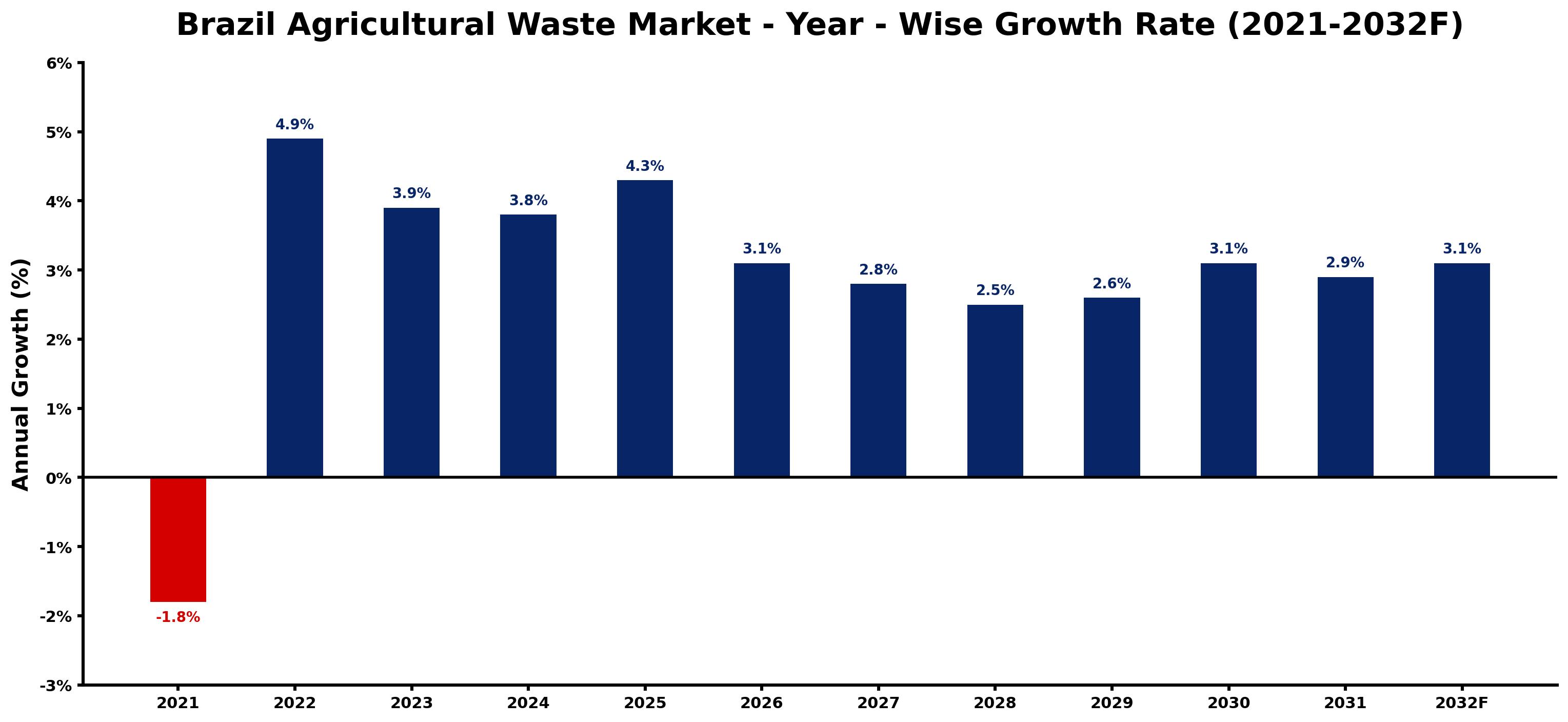
The table below presents the year wise growth rates along with the key drivers influencing the market
| Year | Growth Rate | Major Drivers |
| 2021 | -1.8% | Severe drought conditions limited crop yields, resulting in decreased availability of agricultural waste for processing. |
| 2022 | 4.9% | Investment in biogas facilities increased interest in converting waste to energy resources. |
| 2023 | 3.9% | Partnerships between agribusiness firms and tech startups emerged, promoting innovative waste solutions. |
| 2024 | 3.8% | Increased awareness of climate change impacts led to more eco-friendly agricultural practices. |
| 2025 | 4.3% | Local universities initiated research programs focused on waste-to-value technologies in agriculture. |
| 2026 | 3.1% | Export opportunities for bio-based products prompted farmers to improve waste utilization methods. |
| 2027 | 2.8% | Adoption of circular economy principles became commonplace among Brazilian agricultural enterprises. |
| 2028 | 2.5% | Growing interest in organic farming encouraged better management of agricultural by-products. |
| 2029 | 2.6% | Investment in infrastructure for waste processing revealed potential for higher revenue streams. |
| 2030 | 3.1% | The food supply chain's need for sustainability catalyzed innovations in waste recycling methods. |
| 2031 | 2.9% | Increased competition in the agricultural sector spurred demand for efficiency in waste management. |
| 2032 | 3.1% | Consumer preferences shifted towards sustainably sourced products, positively impacting waste transformation trends. |
Note - Market size estimations and growth projections presented in this report are based on 6Wresearch's advanced forecasting approach, validated with industry datasets as of June 2026.
Brazil Agricultural Waste Market Synopsis
The Brazil Agricultural Waste Market is projected to reach 3.1% and witness significant growth during the forecast period (2026-2032). This emerging market is a response to the increasing recognition of waste management challenges within the agricultural sector, as sustainable practices gain traction in Brazil. The focus on recycling and resource recovery from agricultural waste is driving innovation and investment, enabling farmers and agribusinesses to adopt more environmentally-conscious methods of managing by-products from agricultural operations.
Brazil Agricultural Waste Market Growth Drivers
The growth of the Brazil Agricultural Waste Market can be attributed to several key drivers that align with global sustainability trends.
- The increasing awareness of environmental issues among stakeholders in agriculture encourages the adoption of waste management solutions that minimize ecological footprints.
- Government policies promoting sustainable practices further bolster demand for innovative agricultural waste management techniques.
- Technological advancements in waste processing and recycling facilitate efficient resource recovery and valorization of agricultural by-products.
- The rising significance of organic farming and soil health maintenance drives the need for effective crop residue management and recycling strategies.
- Efforts to implement circular economy principles in agriculture create opportunities for new business models centered around waste recycling and valorization.
Brazil Agricultural Waste Market Challenges and Restraints
While the Brazil Agricultural Waste Market shows promise, several challenges must be addressed to fully capitalize on its potential.
- Optimizing economic viability for waste utilization remains a critical concern, as the cost of advanced waste processing technologies can deter widespread adoption.
- Logistical issues, such as the effective collection and transportation of agricultural waste, complicate the implementation of efficient management systems.
- There is a need for increased awareness among farmers and stakeholders regarding the benefits of waste recycling and management practices, which is currently lacking.
- Regulatory barriers may hinder innovation and the implementation of new waste management solutions within the sector.
- Market fragmentation and limited access to financing options for small-scale farmers impede their ability to invest in sustainable waste management technologies.
Brazil Agricultural Waste Market Government Investment and Initiatives
The Brazilian government plays a crucial role in the development of the agricultural waste market through various policies and initiatives aimed at promoting sustainable practices.
- Regulatory frameworks have been established to encourage recycling and composting of agricultural waste, significantly reducing environmental impact.
- Public funding is increasingly allocated to research and development projects focusing on innovative waste management technologies and systems.
- Incentive programs for farmers adopting sustainable practices and technologies help facilitate the transition towards effective agricultural waste management.
- Strategic partnerships between government agencies and industry stakeholders aim to enhance the efficiency of waste collection and processing infrastructure.
- Public awareness campaigns are in place to educate farmers about the importance of waste management and recycling, fostering a culture of sustainability in the agricultural sector.
Brazil Agricultural Waste Market Trends and Opportunities
The Brazil Agricultural Waste Market is experiencing notable trends that present numerous opportunities for growth.
- The integration of advanced technologies, such as digital monitoring and data analytics, is enhancing waste management efficiency and enabling better decision-making.
- There is a notable shift towards organic waste recycling, with an emphasis on producing high-quality compost and biofertilizers from agricultural by-products.
- Collaboration between stakeholders, including farmers, researchers, and technology providers, is fostering innovation and knowledge sharing within the agricultural waste management space.
- Sustainable supply chain practices are gaining traction, as companies seek to minimize waste and enhance resource efficiency across operations.
- Investment in training and capacity-building programs for farmers is becoming increasingly important to drive engagement and facilitate the adoption of effective waste management practices.
Brazil Agricultural Waste Market Latest Developments (May 2025 - June 2026)
During the period from May 2025 to June 2026, the Brazil Agricultural Waste Market witnessed several key developments that indicate a positive shift towards improved waste management practices.
- There has been an uptick in collaborative efforts between agricultural producers and technology innovators, aiming to create scalable solutions for waste processing.
- Increased investment in research initiatives focused on optimizing waste recovery processes has been observed, indicating a commitment to advancing the sector.
- Regulatory revisions to promote sustainable agricultural practices have been introduced, creating a more conducive environment for waste recycling initiatives.
- Public-private partnerships have emerged, aimed at enhancing the infrastructure necessary for efficient waste collection and processing.
- Awareness campaigns targeting farmers and agricultural stakeholders have been intensified, emphasizing the economic and environmental benefits of effective waste management.
Brazil Agricultural Waste Market - Key Attractiveness of the Report
- 10 Years of Market Numbers
- Historical Data Starting from 2022 to 2025
- Base Year: 2025
- Forecast Data until 2032
- Key Performance Indicators Impacting the Market
- Major Upcoming Developments and Projects
Key Highlights of the Report:
- Brazil Agricultural Waste Market Outlook
- Market Size of Brazil Agricultural Waste Market, 2025
- Forecast of Brazil Agricultural Waste Market, 2032
- Historical Data and Forecast of Brazil Agricultural Waste Revenues & Volume for the Period 2022-2032F
- Brazil Agricultural Waste Market Trend Evolution
- Brazil Agricultural Waste Market Drivers and Challenges
- Brazil Agricultural Waste Price Trends
- Brazil Agricultural Waste Porter's Five Forces
- Brazil Agricultural Waste Industry Life Cycle
- Historical Data and Forecast of Brazil Agricultural Waste Market Revenues & Volume By Product Type for the Period 2022-2032F
- Historical Data and Forecast of Brazil Agricultural Waste Market Revenues & Volume By Nonpoint Source for the Period 2022-2032F
- Historical Data and Forecast of Brazil Agricultural Waste Market Revenues & Volume By Point Source for the Period 2022-2032F
- Historical Data and Forecast of Brazil Agricultural Waste Market Revenues & Volume By Applications for the Period 2022-2032F
- Historical Data and Forecast of Brazil Agricultural Waste Market Revenues & Volume By Food Industry for the Period 2022-2032F
- Historical Data and Forecast of Brazil Agricultural Waste Market Revenues & Volume By Fish Forming Industry for the Period 2022-2032F
- Brazil Agricultural Waste Import Export Trade Statistics
- Market Opportunity Assessment By Product Type
- Market Opportunity Assessment By Applications
- Brazil Agricultural Waste Top Companies Market Share
- Brazil Agricultural Waste Competitive Benchmarking By Technical and Operational Parameters
- Brazil Agricultural Waste Company Profiles
- Brazil Agricultural Waste Key Strategic Recommendations






































