Brazil Anti-aging Products Market Size, Share & Growth Rate
The Brazil Anti-aging Products Market was estimated at USD 405 Million in 2025 and is projected to reach USD 485 Million by 2032, growing at a CAGR of 2.6% from 2026 to 2032. This steady growth trajectory is primarily driven by an increasingly beauty-conscious population that prioritizes skincare, particularly among the aging demographic. As disposable incomes rise, consumers are more willing to invest in high-quality anti-aging creams, serums, and dietary supplements designed to enhance their appearance and vitality.
Brazil Anti-aging Products Market Year-wise Growth Rate and Key Drivers
This graph highlights how the Brazil Anti-aging Products Market has steadily grown over the years, supported by major growth factors.
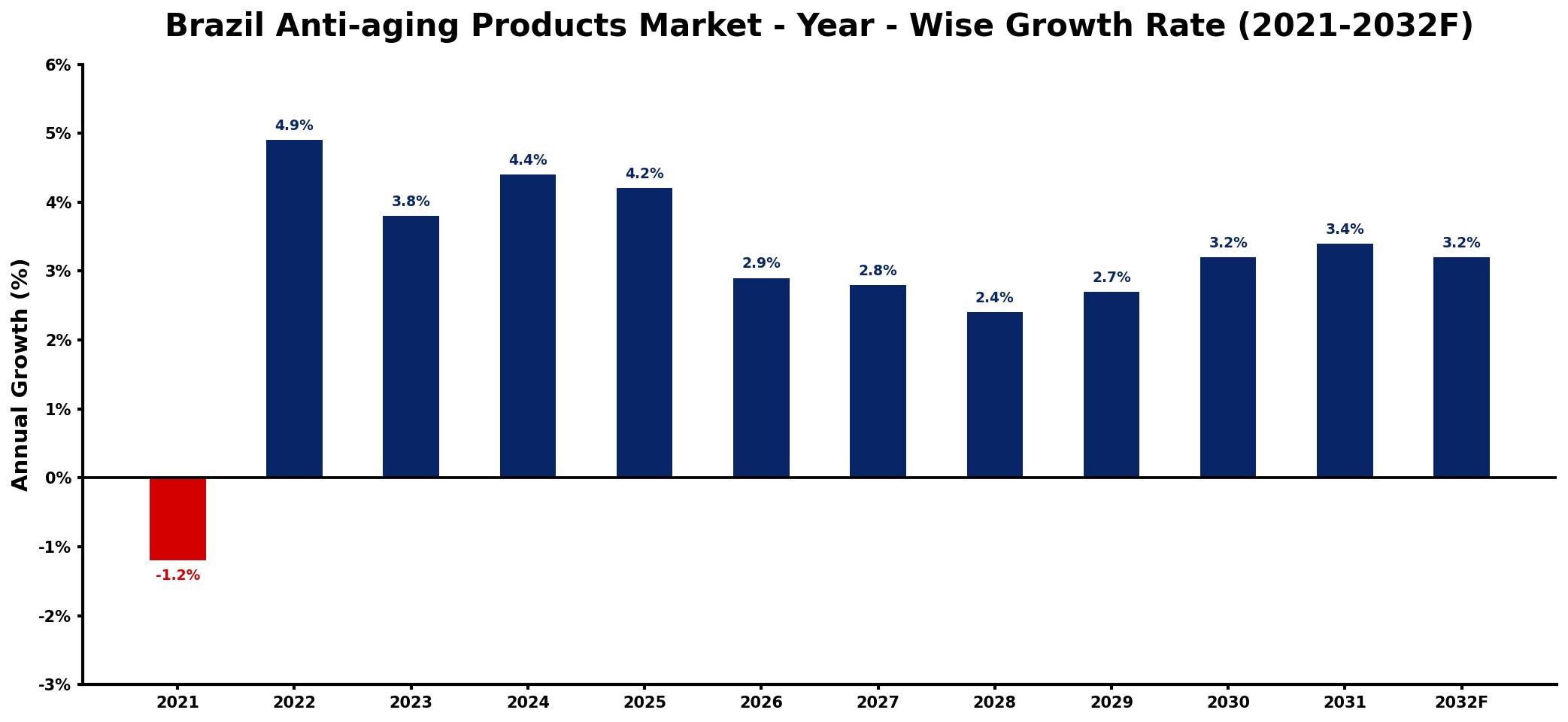
The table below presents the year‑wise growth rates along with the key drivers influencing the market
| Year | Growth Rate | Major Drivers |
| 2021 | -1.2% | Consumer interest in wellness declines |
| 2022 | 4.9% | Rise in health consciousness trends |
| 2023 | 3.8% | Increased investment in skincare innovations |
| 2024 | 4.4% | Growing demand for natural ingredients |
| 2025 | 4.2% | Expansion of e-commerce platforms |
| 2026 | 2.9% | Emergence of personalized beauty solutions |
| 2027 | 2.8% | growing regional consumption patterns |
| 2028 | 2.4% | Increased focus on holistic beauty |
| 2029 | 2.7% | growing commercial sector adoption |
| 2030 | 3.2% | Growth in global beauty tourism |
| 2031 | 3.4% | Rising popularity of wellness retreats |
| 2032 | 3.2% | Increased collaboration with dermatologists |
Note: Market size estimations and growth projections presented in this report are based on 6Wresearch's proprietary forecasting methodology, utilizing the latest available industry data, government publications, and primary research inputs.
Brazil Anti-aging Products Market Synopsis
Recently, the anti-aging products market in Brazil has experienced robust momentum, driven by the growing interest in skincare and personal grooming among a diverse consumer base. However, as the market evolves, it faces emerging dynamics shaped by economic factors and shifts in consumer preferences that could influence growth trajectories.
In the coming years, innovation will play a pivotal role in meeting the changing demands of Brazilian consumers. New formulations that focus on holistic wellness and scientifically backed ingredients are set to capture attention, as consumers seek products that not only address visible signs of aging but also promote overall skin health.
Brazil Anti-aging Products Market Key Takeaways
- The market is poised for steady growth, with a projected increase from USD 405 Million in 2025 to USD 485 Million by 2032.
- Consumer trends emphasize the importance of skincare, especially among the aging population in Brazil.
- Innovation in formulations and ingredients is essential to meet evolving consumer expectations.
- Regulatory frameworks aim to ensure product safety and transparency, affecting market dynamics.
- Economic factors and shifting consumer preferences are critical to understanding the market landscape.
Evaluation of Restraints in Brazil Anti-aging Products Market
Despite the promising outlook, the Brazil Anti-aging Products Market grapples with significant restraints that could hinder its growth. Consumer skepticism regarding the efficacy of anti-aging claims can dampen demand, especially amidst regulatory restrictions that limit how products can be marketed. Additionally, economic uncertainties may lead to cautious spending habits, making consumers hesitant to invest in premium anti-aging solutions. Lastly, competition from alternative skincare options poses a challenge, as consumers increasingly explore holistic or natural solutions for their skincare needs.
Brazil Anti-aging Products Market Trends
The landscape of the Brazil Anti-aging Products Market is being shaped by several current and emerging trends. One significant trend is the increased demand for multifunctional products that deliver anti-aging benefits while also addressing hydration and skin protection. Moreover, as consumers become more informed about ingredients, there is a noticeable shift towards products featuring natural and organic components. Personalized skincare routines, driven by technology and consumer education, are also gaining traction, as individuals seek customized solutions tailored to their unique skin concerns.
Brazil Anti-aging Products Market Opportunities
The market presents a wealth of opportunities, particularly for brands that can innovate and effectively communicate their value propositions. Investment in research and development of advanced formulations that promise visible results can resonate well with consumers. Furthermore, tapping into the e-commerce boom allows companies to reach a broader audience, particularly the younger demographic eager to explore anti-aging solutions early on. Collaborations with dermatologists and skincare experts for endorsements can further enhance credibility and trust among consumers.
Government Initiatives in the Brazil Anti-aging Products Market
Government policies play a crucial role in the Brazil Anti-aging Products Market, with regulations focusing on consumer safety and the advertising of cosmetic products. These policies are designed to enforce compliance with safety standards and ensure that claims made by manufacturers are substantiated. Initiatives aimed at promoting transparency in the market help protect consumers from misleading information. Additionally, the regulatory environment encourages companies to engage in ethical marketing practices and product testing, fostering a more trustworthy market landscape.
Future Insights of the Brazil Anti-aging Products Market
Looking ahead, the Brazil Anti-aging Products Market is expected to evolve significantly from 2026 to 2032. The aging population will remain a key driver of growth, with increasing demands for products that offer not only aesthetic benefits but also contribute to overall well-being. Companies focusing on transparency and clinical efficacy will likely gain a competitive edge. Moreover, as digital engagement continues to grow, brands that can effectively leverage online platforms for direct consumer engagement will find new pathways to success.
Brazil Anti-aging Products Market Latest Developments (2025 - 2026)
In the recent months, the Brazil Anti-aging Products Market has seen a surge in new product launches, particularly in the skincare segment, as companies aim to capitalize on the growing consumer interest in anti-aging solutions. Innovation continues to be a driving force, with brands increasingly investing in clinical research to back their product claims. Social media campaigns highlighting the benefits of these products have also gained traction, effectively reaching the target demographic and enhancing brand engagement.
Brazil Anti-aging Products Market - Key Attractiveness of the Report
- 10 Years of Market Numbers
- Historical Data Starting from 2022 to 2025
- Base Year: 2025
- Forecast Data until 2032
- Key Performance Indicators Impacting the Market
- Major Upcoming Developments and Projects
Key Highlights of the Report:
- Brazil Anti-aging Products Market Outlook
- Market Size of Brazil Anti-aging Products Market, 2025
- Forecast of Brazil Anti-aging Products Market, 2032
- Historical Data and Forecast of Brazil Anti-aging Products Revenues & Volume for the Period 2022-2032F
- Brazil Anti-aging Products Market Trend Evolution
- Brazil Anti-aging Products Market Drivers and Challenges
- Brazil Anti-aging Products Price Trends
- Brazil Anti-aging Products Porter's Five Forces
- Brazil Anti-aging Products Industry Life Cycle
- Historical Data and Forecast of Brazil Anti-aging Products Market Revenues & Volume By Product for the Period 2022-2032F
- Historical Data and Forecast of Brazil Anti-aging Products Market Revenues & Volume By Body Wash for the Period 2022-2032F
- Historical Data and Forecast of Brazil Anti-aging Products Market Revenues & Volume By Body Moisturizer for the Period 2022-2032F
- Historical Data and Forecast of Brazil Anti-aging Products Market Revenues & Volume By Eye Cream & Lotion for the Period 2022-2032F
- Historical Data and Forecast of Brazil Anti-aging Products Market Revenues & Volume By Facial Cleanser for the Period 2022-2032F
- Historical Data and Forecast of Brazil Anti-aging Products Market Revenues & Volume By Facial Mask for the Period 2022-2032F
- Historical Data and Forecast of Brazil Anti-aging Products Market Revenues & Volume By Facial Serum for the Period 2022-2032F
- Historical Data and Forecast of Brazil Anti-aging Products Market Revenues & Volume By Facial Cream & Lotion for the Period 2022-2032F
- Historical Data and Forecast of Brazil Anti-aging Products Market Revenues & Volume By Distribution Channel for the Period 2022-2032F
- Historical Data and Forecast of Brazil Anti-aging Products Market Revenues & Volume By Hypermarket & Supermarket for the Period 2022-2032F
- Historical Data and Forecast of Brazil Anti-aging Products Market Revenues & Volume By Pharmacy & Drug Stores for the Period 2022-2032F
- Historical Data and Forecast of Brazil Anti-aging Products Market Revenues & Volume By Specialty Store for the Period 2022-2032F
- Historical Data and Forecast of Brazil Anti-aging Products Market Revenues & Volume By Online for the Period 2022-2032F
- Historical Data and Forecast of Brazil Anti-aging Products Market Revenues & Volume By Others for the Period 2022-2032F
- Brazil Anti-aging Products Import Export Trade Statistics
- Market Opportunity Assessment By Product
- Market Opportunity Assessment By Distribution Channel
- Brazil Anti-aging Products Top Companies Market Share
- Brazil Anti-aging Products Competitive Benchmarking By Technical and Operational Parameters
- Brazil Anti-aging Products Company Profiles
- Brazil Anti-aging Products Key Strategic Recommendations






































