Brazil Anti-money Laundering Market Size & Growth Rate (2026-2032)
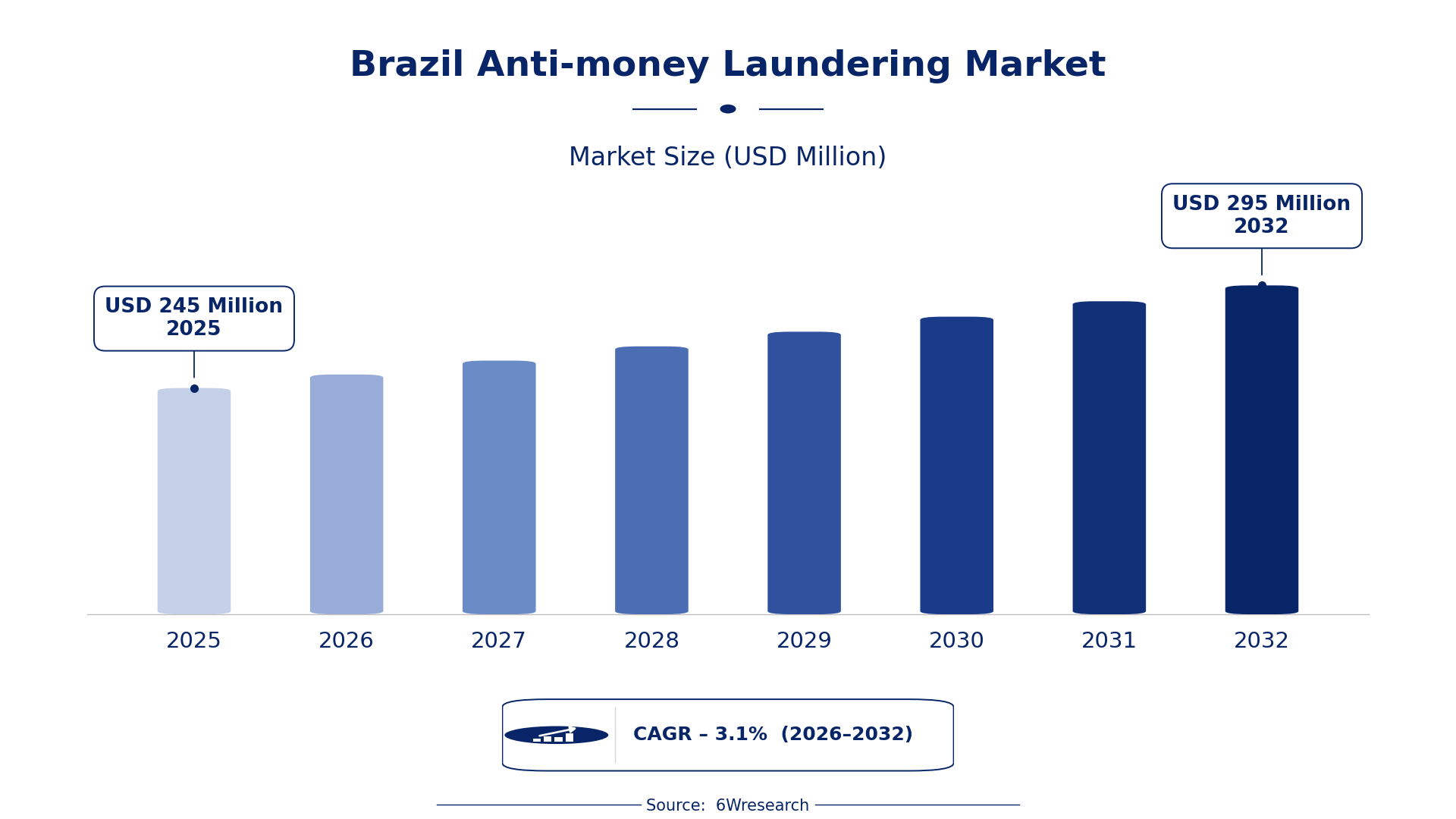
The Brazil Anti-money Laundering Market was estimated at USD 245 Million in 2025 and is projected to reach USD 295 Million by 2032, growing at a CAGR of 3.1% from 2026 to 2032.
Brazil Anti-money Laundering Market Synopsis
The Brazil Anti-money Laundering market is increasingly crucial for financial institutions as regulatory requirements tighten. Institutions are investing in sophisticated technologies to identify and mitigate risks associated with illicit financial activities. Given Brazil's growing economic presence, the demand for effective AML solutions is surging as organizations strive to maintain compliance and protect their reputations.
Recent developments in Brazil's financial regulatory framework have propelled the need for anti-money laundering measures. The increasing sophistication of money laundering techniques necessitates a proactive stance from financial institutions, which are now focused on real-time monitoring and advanced analytics to detect fraudulent activities effectively.
Brazil Anti-money Laundering Market Year-wise Growth Rate and Key Drivers
This graph illustrates the annual growth rates of the Brazil Anti-money Laundering Market from 2021 to 2032, highlighting a steady upward trajectory and projected expansion over the forecast period.
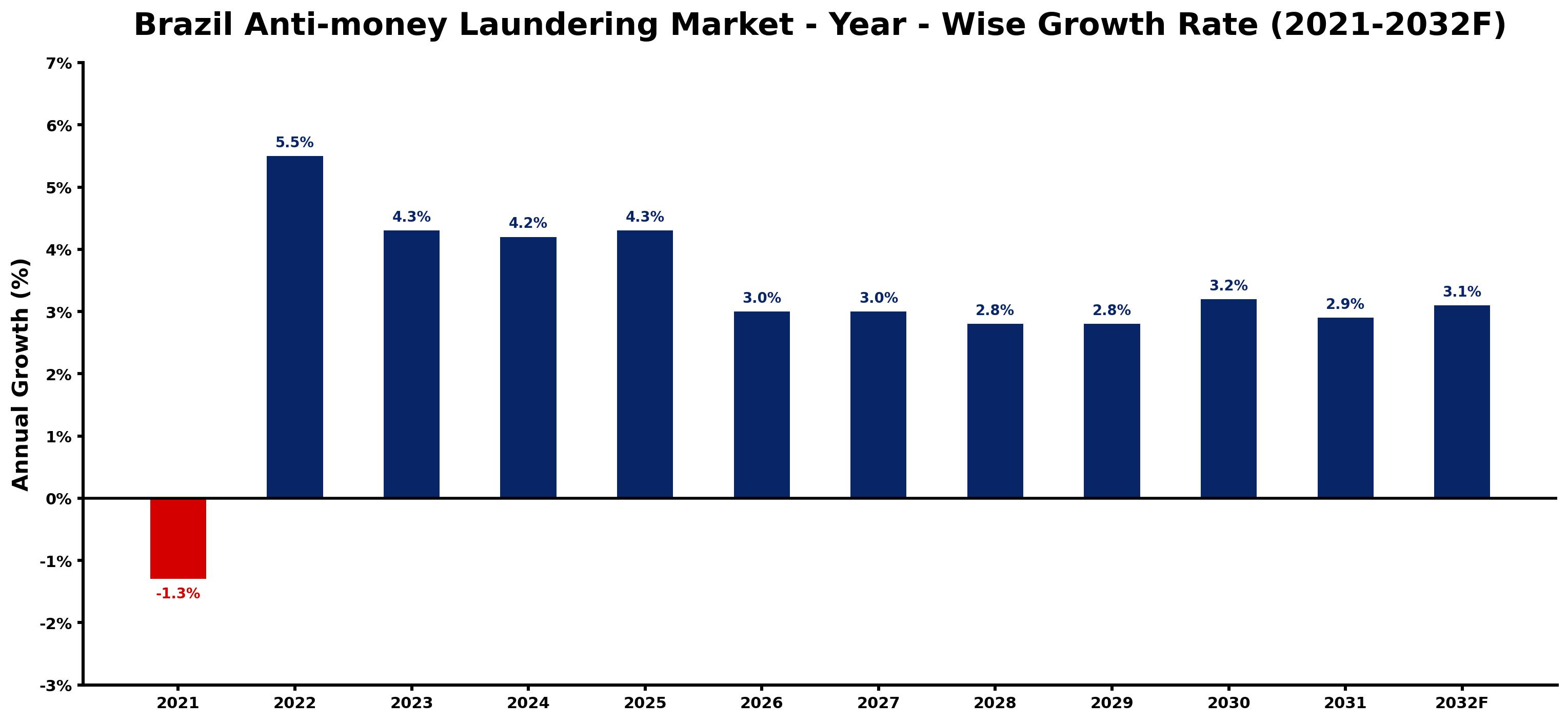
The table below presents the year‑wise growth rates along with the key drivers influencing the market
| Year | Growth Rate | Major Drivers |
| 2021 | -1.3% | Increased emphasis on tax enforcement by Receita Federal. |
| 2022 | 5.5% | Federal Police strengthen anti-money laundering regulations. |
| 2023 | 4.3% | Increased financial institution compliance programs for AML. |
| 2024 | 4.2% | New legislation enhancing digital asset transaction oversight. |
| 2025 | 4.3% | Central Bank of Brazil promotes financial transparency initiatives. |
| 2026 | 3.0% | Rising concerns about cryptocurrency-related fraud in Brazil. |
| 2027 | 3.0% | Enhanced cross-border collaboration on money laundering issues. |
| 2028 | 2.8% | Government incentives for adopting advanced AML technologies. |
| 2029 | 2.8% | Local fintechs developing innovative AML compliance solutions. |
| 2030 | 3.2% | Growing public awareness of financial crime impacts. |
| 2031 | 2.9% | Strengthened reporting requirements for high-risk transactions. |
| 2032 | 3.1% | Evolving consumer demands for secure digital banking practices. |
Note: Market size estimations and growth projections presented in this report are based on 6Wresearch's proprietary forecasting methodology, utilizing the latest available industry data, government publications, and primary research inputs.
Brazil Anti-money Laundering Market Key Takeaways
Below are some of the specific key takeaways from the market, including:
- The market is driven by stringent regulatory standards and the necessity for financial institutions to combat financial crimes.
- Technological advancements play a critical role in enhancing transaction monitoring capabilities.
- Collaboration among institutions is essential for effective sharing of threat intelligence.
- Compliance with evolving regulations remains a major challenge for financial organizations.
- Investment in innovative AML solutions is increasing as institutions adapt to new money laundering tactics.
Evaluation of Restraints in Brazil Anti-money Laundering Market
Despite the market's growth, several constraints hinder its full potential. Chief among these is the rapid evolution of money laundering techniques, which consistently challenge existing compliance frameworks. Financial institutions often find themselves grappling with large volumes of transactions, complicating their ability to detect suspicious activities swiftly. Additionally, the need for ongoing staff training and system upgrades to stay aligned with regulatory changes adds to operational costs, limiting resources for innovation.
Brazil Anti-money Laundering Market Trends
Several trends are shaping the Brazil Anti-money Laundering market. First, there’s a notable shift towards the integration of artificial intelligence and machine learning in transaction monitoring systems, enhancing detection accuracy. Second, the increasing prioritization of data analytics is allowing institutions to preemptively identify potential threats. Third, partnerships between financial institutions and technology providers are on the rise, facilitating better information sharing and response strategies. As the threat landscape evolves, regulatory bodies are also emphasizing the need for real-time compliance solutions.
Brazil Anti-money Laundering Market Opportunities
The opportunities for growth in the Brazil Anti-money Laundering market are significant. Emerging fintech solutions present a chance for institutions to enhance their AML capabilities without extensive infrastructure changes. Additionally, the rising demand for automated compliance solutions enables institutions to improve operational efficiency while ensuring adherence to regulations. With the continuous introduction of regulatory frameworks, there is an increasing need for consulting services focused on AML compliance strategies. Furthermore, as cross-border transactions increase, the integration of international standards presents an avenue for collaborative enforcement.
Government Initiatives in the Brazil Anti-money Laundering Market
Brazil’s government is actively shaping the Anti-money Laundering market through rigorous policy enforcement and a commitment to enhancing financial integrity. Recent initiatives have focused on improving collaboration among financial institutions, bolstering regulatory frameworks, and adopting advanced technologies. This regulatory climate is critical as Brazil seeks to elevate its international standing in financial compliance.
- A comprehensive regulatory framework introduced in 2025 mandates enhanced transparency in financial reporting.
- The Central Bank of Brazil is currently rolling out a new digital platform for real-time transaction monitoring, aimed at strengthening AML compliance.
- A public-private partnership initiative planned for 2026 will facilitate better data sharing among banks and law enforcement agencies.
- The establishment of a national AML task force to improve coordination between various government sectors has been completed in early 2024.
- Ongoing efforts are underway to implement a certification program for AML professionals to ensure expertise and compliance across the industry.
Future Insights of the Brazil Anti-money Laundering Market
From 2026 to 2032, the Brazil Anti-money Laundering market is expected to evolve as financial technologies advance. Institutions will likely adopt more sophisticated tools that integrate real-time analytics and machine learning to enhance threat detection capabilities. Regulatory bodies will maintain stringent oversight, pushing institutions to innovate and adapt continuously. As compliance becomes more complex, there's likely to be a stronger emphasis on collaboration among financial entities, fostering a more unified approach to combating money laundering.
Brazil Anti-money Laundering Market Latest Developments
Recent activity in the Brazil Anti-money Laundering market indicates a significant shift towards advanced technologies and collaborative efforts among institutions. Over the last year, organizations have been focused on integrating new tools and frameworks that enhance compliance measures while reducing operational risks. This trend reflects a growing recognition of the importance of proactive AML strategies.
- A new fraud detection system integrating AI technology was launched in early 2025, significantly improving transaction oversight.
- Ongoing partnerships between local banks and international fintech firms aim to enhance data sharing capabilities for AML compliance.
- A regional conference on AML strategies, scheduled for late 2025, is expected to gather industry leaders to discuss best practices and innovative solutions.
- The roll-out of an upgraded regulatory compliance software platform is currently underway, designed to facilitate real-time reporting by mid-2026.
- A pilot program focused on enhancing cross-institutional cooperation in data sharing is planned for launch in early 2026.
Brazil Anti-money Laundering Market - Key Attractiveness of the Report
- 10 Years of Market Numbers
- Historical Data Starting from 2022 to 2025
- Base Year: 2025
- Forecast Data until 2032
- Key Performance Indicators Impacting the Market
- Major Upcoming Developments and Projects
Key Highlights of the Report:
- Brazil Anti-money Laundering Market Outlook
- Market Size of Brazil Anti-money Laundering Market, 2025
- Forecast of Brazil Anti-money Laundering Market, 2032
- Historical Data and Forecast of Brazil Anti-money Laundering Revenues & Volume for the Period 2022-2032F
- Brazil Anti-money Laundering Market Trend Evolution
- Brazil Anti-money Laundering Market Drivers and Challenges
- Brazil Anti-money Laundering Price Trends
- Brazil Anti-money Laundering Porter's Five Forces
- Brazil Anti-money Laundering Industry Life Cycle
- Historical Data and Forecast of Brazil Anti-money Laundering Market Revenues & Volume By Component for the Period 2022-2032F
- Historical Data and Forecast of Brazil Anti-money Laundering Market Revenues & Volume By Services for the Period 2022-2032F
- Historical Data and Forecast of Brazil Anti-money Laundering Market Revenues & Volume By Solutions for the Period 2022-2032F
- Historical Data and Forecast of Brazil Anti-money Laundering Market Revenues & Volume By Deployment Mode for the Period 2022-2032F
- Historical Data and Forecast of Brazil Anti-money Laundering Market Revenues & Volume By On-Premises for the Period 2022-2032F
- Historical Data and Forecast of Brazil Anti-money Laundering Market Revenues & Volume By Cloud for the Period 2022-2032F
- Historical Data and Forecast of Brazil Anti-money Laundering Market Revenues & Volume By End User for the Period 2022-2032F
- Historical Data and Forecast of Brazil Anti-money Laundering Market Revenues & Volume By Banking & Financial Institutes for the Period 2022-2032F
- Historical Data and Forecast of Brazil Anti-money Laundering Market Revenues & Volume By Insurance for the Period 2022-2032F
- Historical Data and Forecast of Brazil Anti-money Laundering Market Revenues & Volume By Gaming & Gambling for the Period 2022-2032F
- Historical Data and Forecast of Brazil Anti-money Laundering Market Revenues & Volume By Organization Size for the Period 2022-2032F
- Historical Data and Forecast of Brazil Anti-money Laundering Market Revenues & Volume By Large Enterprises for the Period 2022-2032F
- Historical Data and Forecast of Brazil Anti-money Laundering Market Revenues & Volume By SMEs for the Period 2022-2032F
- Brazil Anti-money Laundering Import Export Trade Statistics
- Market Opportunity Assessment By Component
- Market Opportunity Assessment By Deployment Mode
- Market Opportunity Assessment By End User
- Market Opportunity Assessment By Organization Size
- Brazil Anti-money Laundering Top Companies Market Share
- Brazil Anti-money Laundering Competitive Benchmarking By Technical and Operational Parameters
- Brazil Anti-money Laundering Company Profiles
- Brazil Anti-money Laundering Key Strategic Recommendations






































