Brazil Antifreeze & Coolants Market Size, Share & Growth Rate
The Brazil Antifreeze & Coolants Market was estimated at USD 483 Million in 2025 and is projected to reach USD 578 Million by 2032, growing at a CAGR of 2.6% from 2026 to 2032. This growth trajectory is significantly propelled by the expansion of the automotive sector, alongside increasing vehicle ownership in urban and rural areas. Additionally, the demand for environmentally friendly coolant solutions continues to rise due to stricter regulatory frameworks aimed at reducing vehicular emissions.
Brazil Antifreeze & Coolants Market Growth Rate Analysis (2021-2032)
The Brazilian antifreeze and coolants market has experienced a notable rebound in recent years following a decline of 1.4% in 2021, primarily due to pandemic-related disruptions. With a resurgence in automotive production and maintenance activities, the market grew by 5.3% in 2022 and is projected to maintain an upward trend, reaching 4.4% in 2024. This growth is fueled by increasing consumer demand for efficient cooling solutions and rising investments in infrastructure and industrial enhancements. However, the pace of growth is expected to gradually stabilize, reflecting a forecasted 2.3% in 2027 as market saturation and evolving technology influence consumer preferences.
Brazil Antifreeze & Coolants Market Year-wise Growth Rate and Key Drivers
This graph highlights how the Brazil Antifreeze & Coolants Market has steadily grown over the past five years, supported by major growth factors.
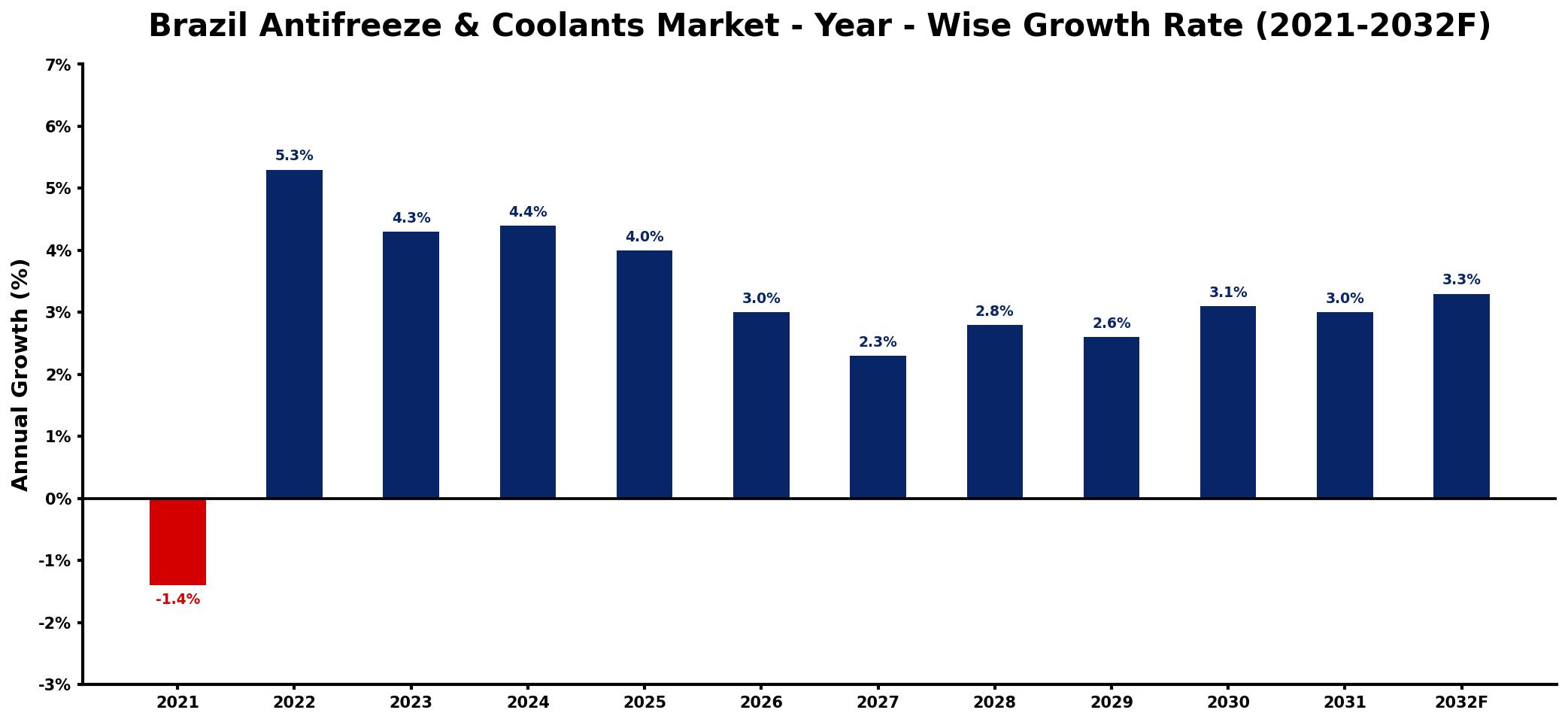
The table below presents the year‑wise growth rates along with the key drivers influencing the market
| Year | Growth Rate | Major Drivers |
| 2021 | -1.4% | Automotive production faced significant disruptions |
| 2022 | 5.3% | Increase in automotive manufacturing investments |
| 2023 | 4.3% | Rising demand for electric vehicles |
| 2024 | 4.4% | growing commercial sector adoption |
| 2025 | 4.0% | Expansion of renewable energy initiatives |
| 2026 | 3.0% | Higher consumer spending on vehicles |
| 2027 | 2.3% | Emergence of advanced vehicle technology |
| 2028 | 2.8% | Increased focus on sustainability practices |
| 2029 | 2.6% | Growth in automotive aftermarket services |
| 2030 | 3.1% | Enhancements in vehicle safety standards |
| 2031 | 3.0% | Development of smart mobility solutions |
| 2032 | 3.3% | Surge in fleet management services |
Note: Market size estimations and growth projections presented in this report are based on 6Wresearch's proprietary forecasting methodology, utilizing the latest available industry data, government publications, and primary research inputs.
Brazil Antifreeze & Coolants Market Synopsis
The Brazilian antifreeze coolants market has experienced robust growth fueled by a dynamic automotive industry, which serves as a crucial driver for coolant demand. While the recent uptick in production and sales reflects positive momentum, the market is poised for further evolution in the coming years, particularly in the face of burgeoning environmental concerns.
Looking ahead, the focus is shifting towards more sustainable and biodegradable coolant options as regulatory standards tighten. This changing landscape is not only reshaping product formulations but also influencing purchasing behaviors among consumers, as they increasingly favor eco-friendly solutions that align with environmental sustainability efforts.
- The automotive industry's expansion is a primary driver of coolant demand.
- Environmental regulations are prompting a shift towards greener antifreeze formulations.
- Periodic maintenance and replacement contribute significantly to recurring demand.
- Industrial applications for coolants are on the rise, supporting diverse sectors like manufacturing and HVAC.
- Technological advancements may influence traditional coolant requirements as electric vehicles gain traction.
Despite the promising growth outlook, the Brazil antifreeze coolants market faces several restraints that could inhibit its full potential. Technological advancements, particularly the shift toward electric vehicles, may lessen reliance on traditional antifreeze solutions. Furthermore, competition from alternative cooling methods poses a challenge as consumers and industries explore more efficient and sustainable options. The evolving landscape of regulatory standards also necessitates that manufacturers continuously adapt their formulations, which can be resource-intensive and complex.
Current trends in the Brazil antifreeze coolants market indicate a marked interest in bio-based and environmentally friendly formulations. Manufacturers are increasingly investing in R&D to develop products that not only meet regulatory requirements but also appeal to the environmentally conscious consumer. Additionally, there is a growing acceptance of alternative coolant solutions, such as water-based options, as industries seek to improve sustainability while maintaining efficiency.
The ongoing transition towards greener technologies offers significant growth opportunities for the antifreeze coolants market in Brazil. Investment in R&D for bio-based coolants and innovative coolant management systems can position companies favorably in this evolving market. Moreover, as electric vehicle adoption accelerates, new formulations tailored to these advanced technologies may emerge, providing fresh avenues for revenue and market share expansion.
The Brazilian government has introduced various initiatives aimed at enhancing environmental sustainability within the automotive sector. These initiatives include stricter regulations on emissions and coolant disposal practices, which compel manufacturers to innovate and comply with eco-friendly standards. Public spending on infrastructure and clean energy solutions further supports the industry's transition toward sustainable coolant alternatives.
From 2026 to 2032, the Brazil antifreeze coolants market is expected to navigate through a landscape characterized by innovation and adaptation. As consumers increasingly prioritize sustainability, manufacturers will likely pivot their strategies to develop high-performance, environmentally conscious products. This evolution will be critical in meeting both consumer demand and regulatory expectations, shaping the trajectory of the market well into the next decade.
Recent developments in the Brazil antifreeze coolants market reflect a concerted push towards sustainability. Manufacturers are exploring biodegradable formulations and enhancing product performance to meet emerging consumer preferences. In parallel, partnerships between companies and research institutions are becoming more common as stakeholders collaborate on innovative cooling technologies. The market is also witnessing heightened awareness regarding the proper disposal and recycling of used coolants, leading to improved practices within the industry.
- 10 Years of Market Numbers
- Historical Data Starting from 2022 to 2025
- Base Year: 2025
- Forecast Data until 2032
- Key Performance Indicators Impacting the Market
- Major Upcoming Developments and Projects
Key Highlights of the Report:
- Brazil Antifreeze & Coolants Market Outlook
- Market Size of Brazil Antifreeze & Coolants Market, 2025
- Forecast of Brazil Antifreeze & Coolants Market, 2032
- Historical Data and Forecast of Brazil Antifreeze & Coolants Revenues & Volume for the Period 2022-2032F
- Brazil Antifreeze & Coolants Market Trend Evolution
- Brazil Antifreeze & Coolants Market Drivers and Challenges
- Brazil Antifreeze & Coolants Price Trends
- Brazil Antifreeze & Coolants Porter's Five Forces
- Brazil Antifreeze & Coolants Industry Life Cycle
- Historical Data and Forecast of Brazil Antifreeze & Coolants Market Revenues & Volume By Product Type for the Period 2022-2032F
- Historical Data and Forecast of Brazil Antifreeze & Coolants Market Revenues & Volume By Ethylene Glycol for the Period 2022-2032F
- Historical Data and Forecast of Brazil Antifreeze & Coolants Market Revenues & Volume By Propylene Glycol for the Period 2022-2032F
- Historical Data and Forecast of Brazil Antifreeze & Coolants Market Revenues & Volume By Others for the Period 2022-2032F
- Historical Data and Forecast of Brazil Antifreeze & Coolants Market Revenues & Volume By Technology for the Period 2022-2032F
- Historical Data and Forecast of Brazil Antifreeze & Coolants Market Revenues & Volume By Inorganic Additive Technology (IAT) for the Period 2022-2032F
- Historical Data and Forecast of Brazil Antifreeze & Coolants Market Revenues & Volume By Organic Acid Technology (OAT) for the Period 2022-2032F
- Historical Data and Forecast of Brazil Antifreeze & Coolants Market Revenues & Volume By Nitrated Organic Acid Technology (NOAT) for the Period 2022-2032F
- Historical Data and Forecast of Brazil Antifreeze & Coolants Market Revenues & Volume By Hybrid Organic Acid Technology (HOAT) for the Period 2022-2032F
- Historical Data and Forecast of Brazil Antifreeze & Coolants Market Revenues & Volume By Others for the Period 2022-2032F
- Historical Data and Forecast of Brazil Antifreeze & Coolants Market Revenues & Volume By Application for the Period 2022-2032F
- Historical Data and Forecast of Brazil Antifreeze & Coolants Market Revenues & Volume By Automobiles for the Period 2022-2032F
- Historical Data and Forecast of Brazil Antifreeze & Coolants Market Revenues & Volume By Industrial for the Period 2022-2032F
- Historical Data and Forecast of Brazil Antifreeze & Coolants Market Revenues & Volume By Others for the Period 2022-2032F
- Brazil Antifreeze & Coolants Import Export Trade Statistics
- Market Opportunity Assessment By Product Type
- Market Opportunity Assessment By Technology
- Market Opportunity Assessment By Application
- Brazil Antifreeze & Coolants Top Companies Market Share
- Brazil Antifreeze & Coolants Competitive Benchmarking By Technical and Operational Parameters
- Brazil Antifreeze & Coolants Company Profiles
- Brazil Antifreeze & Coolants Key Strategic Recommendations






































