Brazil Application Security Market Size & Growth Rate (2026-2032)
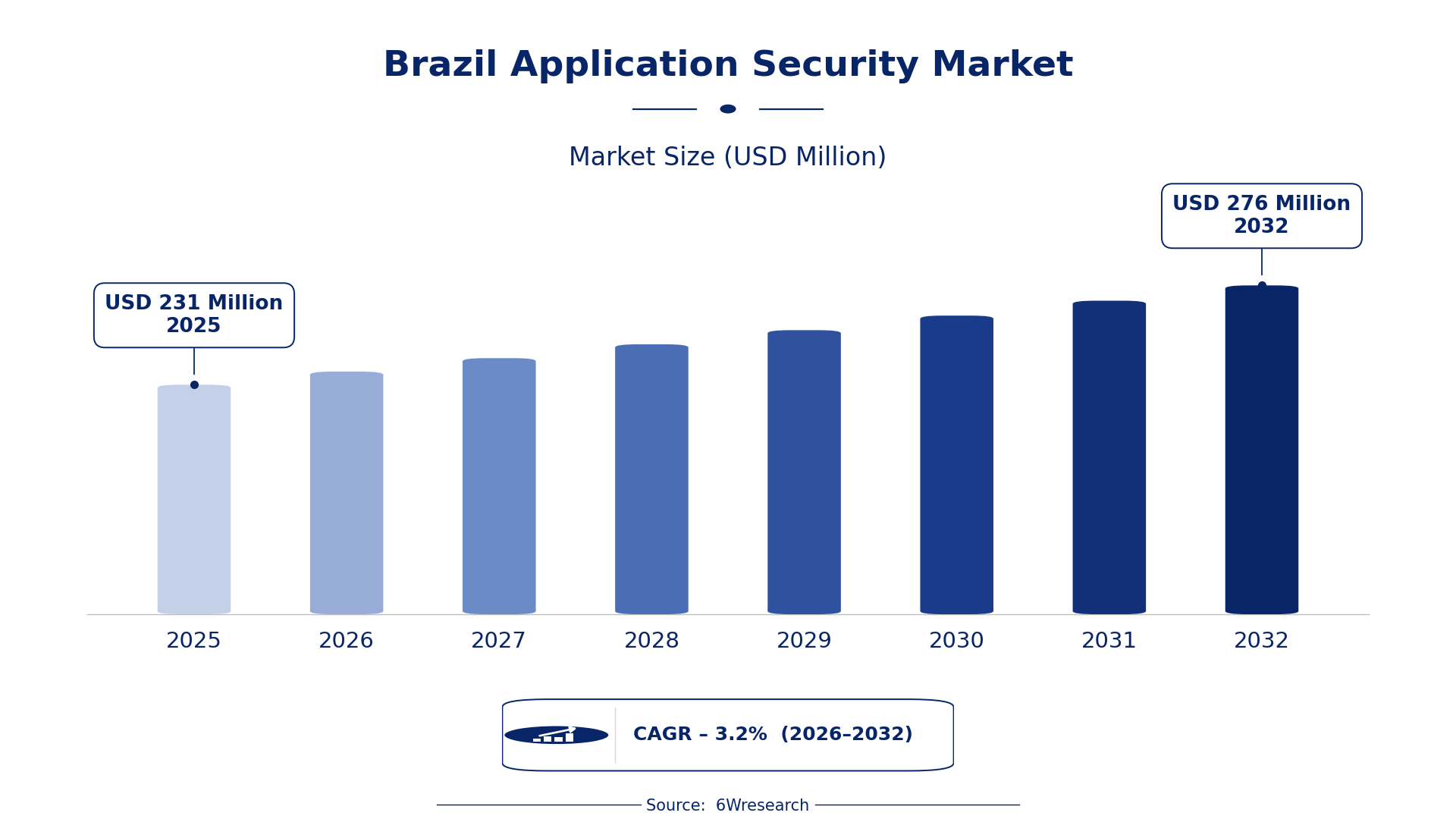
The Brazil Application Security Market was estimated at USD 231 Million in 2025 and is projected to reach USD 276 Million by 2032, growing at a CAGR of 3.2% from 2026 to 2032.
Brazil Application Security Market Synopsis
At present, the escalating reliance on software applications stands as the foremost force influencing the Brazil Application Security Market. As businesses increasingly incorporate digital solutions into their operations, the imperative for robust security measures has never been clearer.
A growing threat landscape, compounded by heightened awareness of the ramifications of application vulnerabilities, is driving organizational investment in security solutions. Companies recognize that safeguarding their applications is not merely a technical necessity but a cornerstone of maintaining trust and protecting their reputations.
Brazil Application Security Market Year-wise Growth Rate and Key Drivers
This graph illustrates the annual growth rates of the Brazil Application Security Market from 2021 to 2032, highlighting a steady upward trajectory and projected expansion over the forecast period.
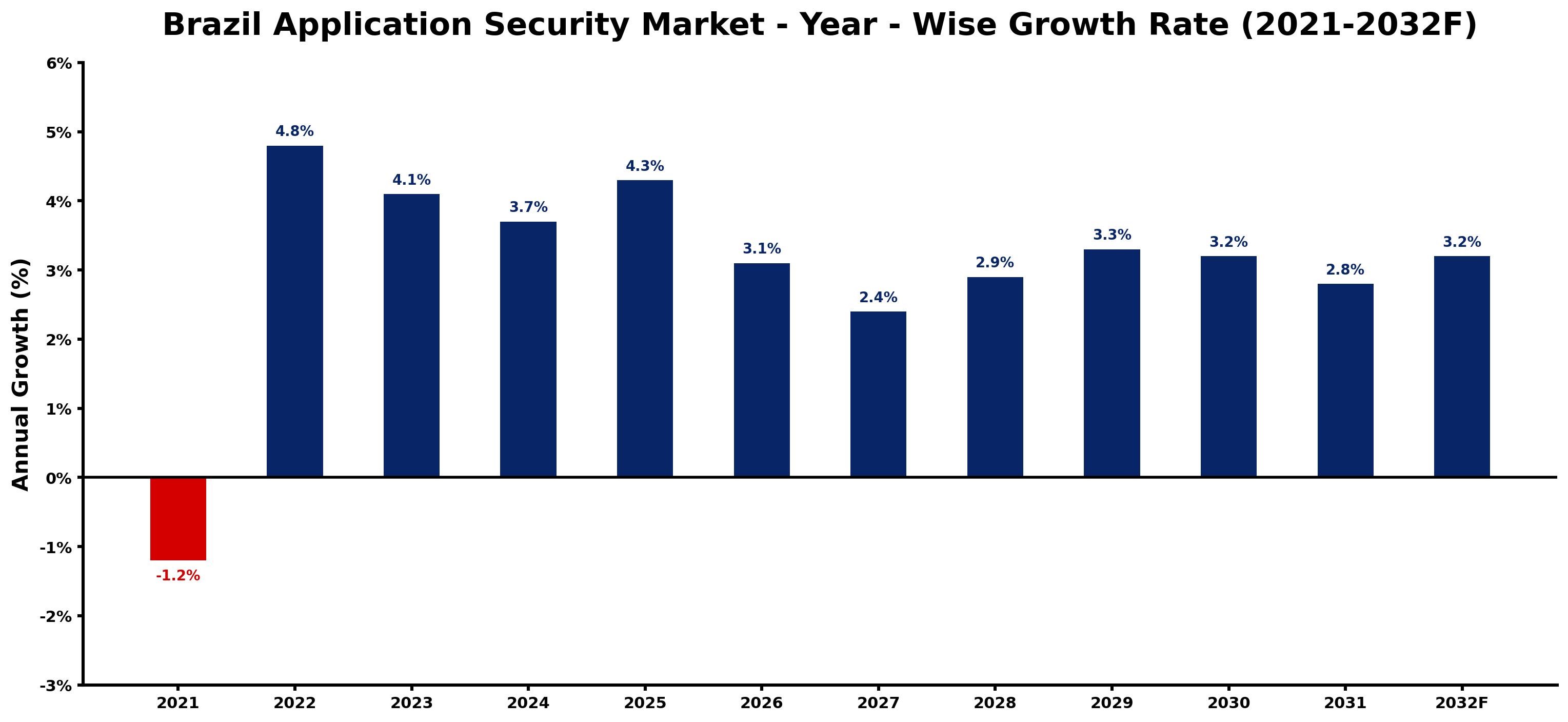
The table below presents the year‑wise growth rates along with the key drivers influencing the market
| Year | Growth Rate | Major Drivers |
| 2021 | -1.2% | Lack of enforcement on data protection laws in Brazil. |
| 2022 | 4.8% | New data protection regulations from ANPD enforcing compliance. |
| 2023 | 4.1% | Government COVID-19 initiatives boosting remote work application security. |
| 2024 | 3.7% | Increasing cyber threats targeting Brazil's financial sector applications. |
| 2025 | 4.3% | Regulatory push for improved cybersecurity in fintech startups. |
| 2026 | 3.1% | Growth of e-commerce leading to higher security investments. |
| 2027 | 2.4% | Expanding digital payment platforms require enhanced security measures. |
| 2028 | 2.9% | Rising concerns over data breaches necessitating stronger protections. |
| 2029 | 3.3% | Increased cloud adoption driving demand for application security. |
| 2030 | 3.2% | Health tech innovation spurring investment in secure applications. |
| 2031 | 2.8% | Emergence of AI technologies necessitating robust application defenses. |
| 2032 | 3.2% | Local enterprises prioritizing cybersecurity for digital transformation efforts. |
Note: Market size estimations and growth projections presented in this report are based on 6Wresearch's proprietary forecasting methodology, utilizing the latest available industry data, government publications, and primary research inputs.
Brazil Application Security Market Key Takeaways
Below are some of the specific key takeaways from the market, including:
- The increasing complexity of software development has heightened the demand for application security solutions.
- Awareness of the financial and reputational risks from application vulnerabilities is reshaping investment priorities.
- Regulatory focus on secure software development practices is compelling organizations to bolster their security measures.
- Continuous monitoring and the integration of security throughout the development lifecycle are gaining traction.
- The market is evolving to address emerging technologies like AI and cloud-based applications, which require tailored security approaches.
Evaluation of Restraints in Brazil Application Security Market
Despite the promising growth trajectory, the Brazil Application Security Market grapples with several real constraints. The primary hurdle remains the challenge of securing applications throughout their lifecycle. Many organizations struggle to adopt secure coding practices consistently, leaving them vulnerable to exploitation. Additionally, the rapid pace of technological change means that security measures must constantly adapt, which can be resource-intensive and require specialized expertise. Finally, the awareness of these issues is still maturing within many companies, hindering swift investment in necessary application security technologies.
Brazil Application Security Market Trends
Current trends indicate a shift towards more integrated security solutions that encompass both preventive and reactive measures. Companies are increasingly adopting DevSecOps practices, which embed security within the software development lifecycle from the outset. on top of that, as mobile and web applications proliferate, solutions tailored for specific platforms are becoming essential. Continuous monitoring tools that utilize machine learning to detect anomalies are also gaining popularity, enabling organizations to stay ahead of emerging threats.
Brazil Application Security Market Opportunities
Looking ahead, opportunities in the Brazil Application Security Market are abundant. The rise of cloud computing and the Internet of Things (IoT) presents a unique landscape where robust security solutions can be implemented. Companies that specialize in adaptive security technologies that can seamlessly integrate with existing systems are well-positioned for growth. The emphasis on compliance with international standards also paves the way for local firms to offer innovative solutions tailored to meet regulatory requirements.
Government Initiatives in the Brazil Application Security Market
Government policy is playing a crucial role in shaping the Brazil Application Security Market. As the digital economy expands, the Brazilian government is actively working to set standards for secure software development. This involves regulatory frameworks that guide organizations in implementing necessary security measures to protect against evolving cyber threats.
- A recently completed initiative focused on updating national cybersecurity guidelines, enhancing protection for public sector applications.
- Currently ongoing efforts include a series of workshops aimed at educating businesses on best practices for application security.
- Planned regulations to be introduced in 2026 will mandate regular security audits for software applications used in critical infrastructure.
- Upcoming public-private partnerships are set to foster innovation in security solutions for mobile applications.
- The government is expected to launch a national campaign to promote awareness around application security among SMEs by 2027.
Future Insights of the Brazil Application Security Market
In the period from 2026 to 2032, the Brazil Application Security Market is expected to evolve significantly. The trend towards integrating security within the development process will likely solidify, as companies seek to mitigate risks before they escalate. Emerging technologies, including AI-driven security solutions and enhanced threat intelligence, will redefine how organizations approach application security. Additionally, as regulatory frameworks mature, compliance will be a key driver of security investments.
Brazil Application Security Market Latest Developments
Recent developments in the Brazil Application Security Market reflect a proactive approach to countering cyber threats. Over the past year, stakeholders have ramped up efforts to fortify application security against sophisticated attacks.
- A major technology vendor launched an advanced application security platform in Q2 2025, integrating automated vulnerability scanning features.
- An initiative that began in early 2025 is currently ongoing, focusing on enhancing security protocols for government applications.
- In early 2026, a new cybersecurity framework is expected to roll out, aimed at aligning local practices with international security standards.
- A collaborative project among major tech firms to develop open-source security tools is currently underway, with initial prototypes expected by mid-2026.
- An expansion of application security training programs within universities is planned for late 2026, aimed at increasing the skilled workforce in the sector.
Brazil Application Security Market - Key Attractiveness of the Report
- 10 Years of Market Numbers
- Historical Data Starting from 2022 to 2025
- Base Year: 2025
- Forecast Data until 2032
- Key Performance Indicators Impacting the Market
- Major Upcoming Developments and Projects
Key Highlights of the Report:
- Brazil Application Security Market Outlook
- Market Size of Brazil Application Security Market, 2025
- Forecast of Brazil Application Security Market, 2032
- Historical Data and Forecast of Brazil Application Security Revenues & Volume for the Period 2022-2032F
- Brazil Application Security Market Trend Evolution
- Brazil Application Security Market Drivers and Challenges
- Brazil Application Security Price Trends
- Brazil Application Security Porter's Five Forces
- Brazil Application Security Industry Life Cycle
- Historical Data and Forecast of Brazil Application Security Market Revenues & Volume By Component for the Period 2022-2032F
- Historical Data and Forecast of Brazil Application Security Market Revenues & Volume By Software Tools (SAST and DAST) for the Period 2022-2032F
- Historical Data and Forecast of Brazil Application Security Market Revenues & Volume By Services for the Period 2022-2032F
- Historical Data and Forecast of Brazil Application Security Market Revenues & Volume By Type for the Period 2022-2032F
- Historical Data and Forecast of Brazil Application Security Market Revenues & Volume By Web Application Security for the Period 2022-2032F
- Historical Data and Forecast of Brazil Application Security Market Revenues & Volume By Mobile Application Security for the Period 2022-2032F
- Historical Data and Forecast of Brazil Application Security Market Revenues & Volume By Deployment Mode for the Period 2022-2032F
- Historical Data and Forecast of Brazil Application Security Market Revenues & Volume By On-premises for the Period 2022-2032F
- Historical Data and Forecast of Brazil Application Security Market Revenues & Volume By Cloud for the Period 2022-2032F
- Historical Data and Forecast of Brazil Application Security Market Revenues & Volume By Organization Size for the Period 2022-2032F
- Historical Data and Forecast of Brazil Application Security Market Revenues & Volume By Large Enterprises for the Period 2022-2032F
- Historical Data and Forecast of Brazil Application Security Market Revenues & Volume By SMEs for the Period 2022-2032F
- Historical Data and Forecast of Brazil Application Security Market Revenues & Volume By Vertical Healthcare for the Period 2022-2032F
- Historical Data and Forecast of Brazil Application Security Market Revenues & Volume By Healthcare for the Period 2022-2032F
- Historical Data and Forecast of Brazil Application Security Market Revenues & Volume By BFSI for the Period 2022-2032F
- Brazil Application Security Import Export Trade Statistics
- Market Opportunity Assessment By Component
- Market Opportunity Assessment By Type
- Market Opportunity Assessment By Deployment Mode
- Market Opportunity Assessment By Organization Size
- Market Opportunity Assessment By Vertical Healthcare
- Brazil Application Security Top Companies Market Share
- Brazil Application Security Competitive Benchmarking By Technical and Operational Parameters
- Brazil Application Security Company Profiles
- Brazil Application Security Key Strategic Recommendations






































