Brazil Art and Sculpture Market Size, Share & Growth Rate
The Brazil Art and Sculpture Market was estimated at USD 228 Million in 2025 and is projected to reach USD 272 Million by 2032, growing at a CAGR of 2.6% from 2026 to 2032. This positive trajectory reflects a growing appreciation for art and cultural expressions in Brazil, spurred by an influx of art tourism and government support for the arts. Moreover, the emergence of new artists and innovative art forms plays a pivotal role in attracting both individual and institutional buyers, further solidifying the market's robust outlook.
Brazil Art and Sculpture Market Year-wise Growth Rate and Key Drivers
This graph highlights how the Brazil Art and Sculpture Market has steadily grown over the years, supported by major growth factors.
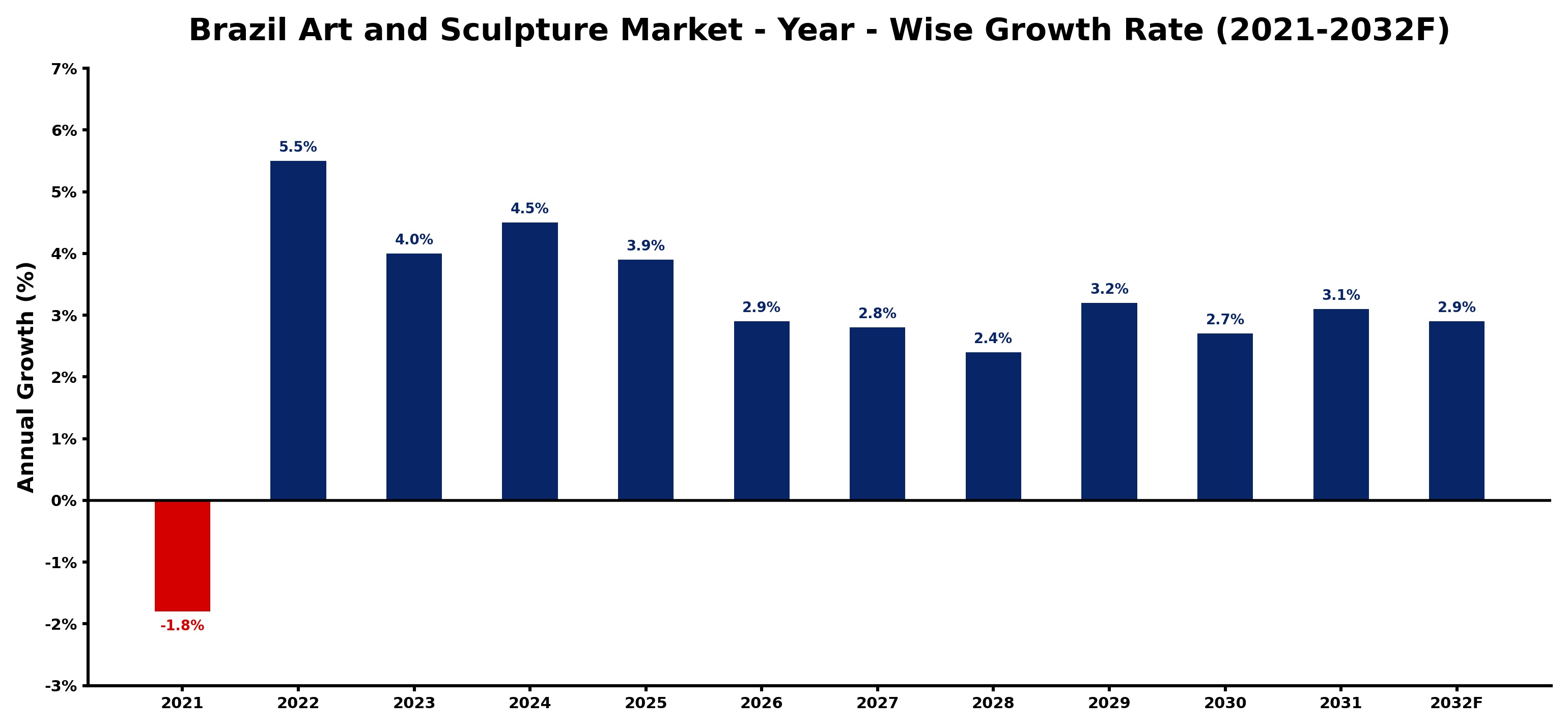
The table below presents the year‑wise growth rates along with the key drivers influencing the market
| Year | Growth Rate | Major Drivers |
| 2021 | -1.8% | Rapid growth in telecom and data center sectors |
| 2022 | 5.5% | Increasing industrial infrastructure investments |
| 2023 | 4.0% | Increasing adoption of advanced technologies |
| 2024 | 4.5% | Government infrastructure modernization initiatives |
| 2025 | 3.9% | Expansion of manufacturing activities |
| 2026 | 2.9% | Increasing adoption of advanced technologies |
| 2027 | 2.8% | Government infrastructure modernization initiatives |
| 2028 | 2.4% | Increasing industrial infrastructure investments |
| 2029 | 3.2% | Growing urbanization and commercial development |
| 2030 | 2.7% | Expansion of transportation and logistics networks |
| 2031 | 3.1% | Government infrastructure modernization initiatives |
| 2032 | 2.9% | Expansion of commercial construction activities |
Note - Market size estimations and growth projections presented in this report are based on 6Wresearch’s advanced forecasting approach, validated with industry datasets as of June 2026.
Brazil Art and Sculpture Market Synopsis
Recent momentum in the Brazil Art and Sculpture market highlights a burgeoning interest in artistic pursuits, driven by increasing access to artistic works and platforms. As we look to the future, the market is on a trajectory that promises not only growth but also diversification, with new artists emerging and the digital landscape expanding opportunities for exposure.
While the current enthusiasm showcases a strong appetite for cultural engagement, the future will depend on how effectively the industry navigates challenges such as economic fluctuations and the need for enhanced distribution strategies. By focusing on nurturing local talent and leveraging online platforms, the market can cultivate a thriving ecosystem that fosters artistic expression and investment.
Brazil Art and Sculpture Market Key Takeaways
- The market is set to experience significant growth due to rising art appreciation and tourism.
- Investment in the arts is gaining traction among both individual collectors and institutions.
- Government support is vital for combating challenges like counterfeit products and intellectual property protection.
- The integration of digital platforms is reshaping how art is marketed and distributed.
- Emerging artists and innovative practices are key drivers of market dynamism.
Evaluation of Restraints in Brazil Art and Sculpture Market
Despite the promising growth prospects, several restraints pose challenges to the Brazil Art and Sculpture market. The inherently subjective nature of art appreciation often complicates marketing strategies, making it difficult to reach broader audiences effectively. Additionally, economic fluctuations can lead to reduced discretionary spending on art, impacting sales. Issues such as counterfeit products and the preservation of cultural heritage further necessitate robust government policies and protective measures. It is imperative for stakeholders to address these issues strategically to unlock the market's full potential.
Brazil Art and Sculpture Market Trends
The Brazil Art and Sculpture market is currently witnessing a shift towards the integration of technology, as artists and galleries embrace digital platforms for showcasing and selling artwork. The rise of art tourism is also shaping demand, encouraging collaborations between local artists and international buyers. Moreover, a growing focus on sustainable and culturally authentic practices is influencing both creation and consumption within the market, appealing to a more socially-conscious audience.
Brazil Art and Sculpture Market Opportunities
The opportunities for growth within the Brazil Art and Sculpture market are manifold. A burgeoning interest in art as an investment vehicle invites potential buyers and collectors to engage more deeply with the market. Additionally, fostering art education and supporting local talent can cultivate a new generation of artists who contribute to a more vibrant artistic landscape. Exploring online platforms not only expands market reach but also democratizes access to art, opening doors for a diverse array of buyers.
Government Initiatives in the Brazil Art and Sculpture Market
Government initiatives play a critical role in the Brazil Art and Sculpture market, particularly through policies that support cultural heritage preservation and provide funding for the arts. Efforts to establish copyright protection and combat counterfeit products are essential for sustaining market integrity. Public spending aimed at cultural programs encourages creativity and supports local artists, fostering an environment conducive to artistic growth.
Future Insights of the Brazil Art and Sculpture Market
Looking ahead to the years 2026-2032, the Brazil Art and Sculpture market is poised for significant evolution. The increasing merging of traditional artistry with contemporary themes will likely attract a wider audience. Additionally, as investment in art continues to gain traction, the market could see enhanced interactions between artists, collectors, and institutions. Strategic efforts to overcome current challenges will be crucial in ensuring that the market thrives and meets the needs of an increasingly diverse clientele.
Brazil Art and Sculpture Market Latest Developments (May 2025 - June 2026)
In recent months, the Brazil Art and Sculpture market has seen an uptick in collaborations between local artists and international galleries, enhancing exposure for emerging talent. There has been a noticeable trend towards sustainable practices in art production, resonating well with eco-conscious collectors. Digital platforms continue to gain prominence, allowing for innovative marketing strategies that connect artists directly with buyers. As the market adapts to these developments, it remains focused on nurturing a vibrant and inclusive art ecosystem.
Brazil Art and Sculpture Market - Key Attractiveness of the Report
- 10 Years of Market Numbers
- Historical Data Starting from 2022 to 2025
- Base Year: 2025
- Forecast Data until 2032
- Key Performance Indicators Impacting the Market
- Major Upcoming Developments and Projects
Key Highlights of the Report:
- Brazil Art and Sculpture Market Outlook
- Market Size of Brazil Art and Sculpture Market, 2025
- Forecast of Brazil Art and Sculpture Market, 2032
- Historical Data and Forecast of Brazil Art and Sculpture Revenues & Volume for the Period 2022-2032F
- Brazil Art and Sculpture Market Trend Evolution
- Brazil Art and Sculpture Market Drivers and Challenges
- Brazil Art and Sculpture Price Trends
- Brazil Art and Sculpture Porter's Five Forces
- Brazil Art and Sculpture Industry Life Cycle
- Historical Data and Forecast of Brazil Art and Sculpture Market Revenues & Volume By Types for the Period 2022-2032F
- Historical Data and Forecast of Brazil Art and Sculpture Market Revenues & Volume By Artifacts for the Period 2022-2032F
- Historical Data and Forecast of Brazil Art and Sculpture Market Revenues & Volume By Sculpture for the Period 2022-2032F
- Historical Data and Forecast of Brazil Art and Sculpture Market Revenues & Volume By Sales Channel for the Period 2022-2032F
- Historical Data and Forecast of Brazil Art and Sculpture Market Revenues & Volume By Auction Houses for the Period 2022-2032F
- Historical Data and Forecast of Brazil Art and Sculpture Market Revenues & Volume By Dealers for the Period 2022-2032F
- Historical Data and Forecast of Brazil Art and Sculpture Market Revenues & Volume By Galleries for the Period 2022-2032F
- Historical Data and Forecast of Brazil Art and Sculpture Market Revenues & Volume By Art Fairs for the Period 2022-2032F
- Historical Data and Forecast of Brazil Art and Sculpture Market Revenues & Volume By Online Sales for the Period 2022-2032F
- Historical Data and Forecast of Brazil Art and Sculpture Market Revenues & Volume By Retail Outlets for the Period 2022-2032F
- Historical Data and Forecast of Brazil Art and Sculpture Market Revenues & Volume By Artists Studios for the Period 2022-2032F
- Historical Data and Forecast of Brazil Art and Sculpture Market Revenues & Volume By Others for the Period 2022-2032F
- Historical Data and Forecast of Brazil Art and Sculpture Market Revenues & Volume By End-user for the Period 2022-2032F
- Historical Data and Forecast of Brazil Art and Sculpture Market Revenues & Volume By Private Collectors for the Period 2022-2032F
- Historical Data and Forecast of Brazil Art and Sculpture Market Revenues & Volume By Museums for the Period 2022-2032F
- Historical Data and Forecast of Brazil Art and Sculpture Market Revenues & Volume By Real Estate Developers for the Period 2022-2032F
- Historical Data and Forecast of Brazil Art and Sculpture Market Revenues & Volume By Interior Designers for the Period 2022-2032F
- Historical Data and Forecast of Brazil Art and Sculpture Market Revenues & Volume By Residential Individual Buyers for the Period 2022-2032F
- Historical Data and Forecast of Brazil Art and Sculpture Market Revenues & Volume By Other Professionals for the Period 2022-2032F
- Brazil Art and Sculpture Import Export Trade Statistics
- Market Opportunity Assessment By Types
- Market Opportunity Assessment By Sales Channel
- Market Opportunity Assessment By End-user
- Brazil Art and Sculpture Top Companies Market Share
- Brazil Art and Sculpture Competitive Benchmarking By Technical and Operational Parameters
- Brazil Art and Sculpture Company Profiles
- Brazil Art and Sculpture Key Strategic Recommendations






































