Brazil Artificial Wood Beams Market Size, Share & Growth Rate
The Brazil Artificial Wood Beams Market was estimated at USD 212 Million in 2025 and is projected to reach USD 252 Million by 2032, growing at a CAGR of 2.5% from 2026 to 2032. This steady growth trajectory can be attributed to the robust expansion of Brazils construction industry and increasing infrastructural projects. The rising preference for sustainable building materials and the architectural aesthetic appeal of artificial wood beams further enhance market demand, supported by innovative engineering solutions in the sector.
Brazil Artificial Wood Beams Market Year-wise Growth Rate and Key Drivers
This graph highlights how the Brazil Artificial Wood Beams Market has steadily grown over the years, supported by major growth factors.
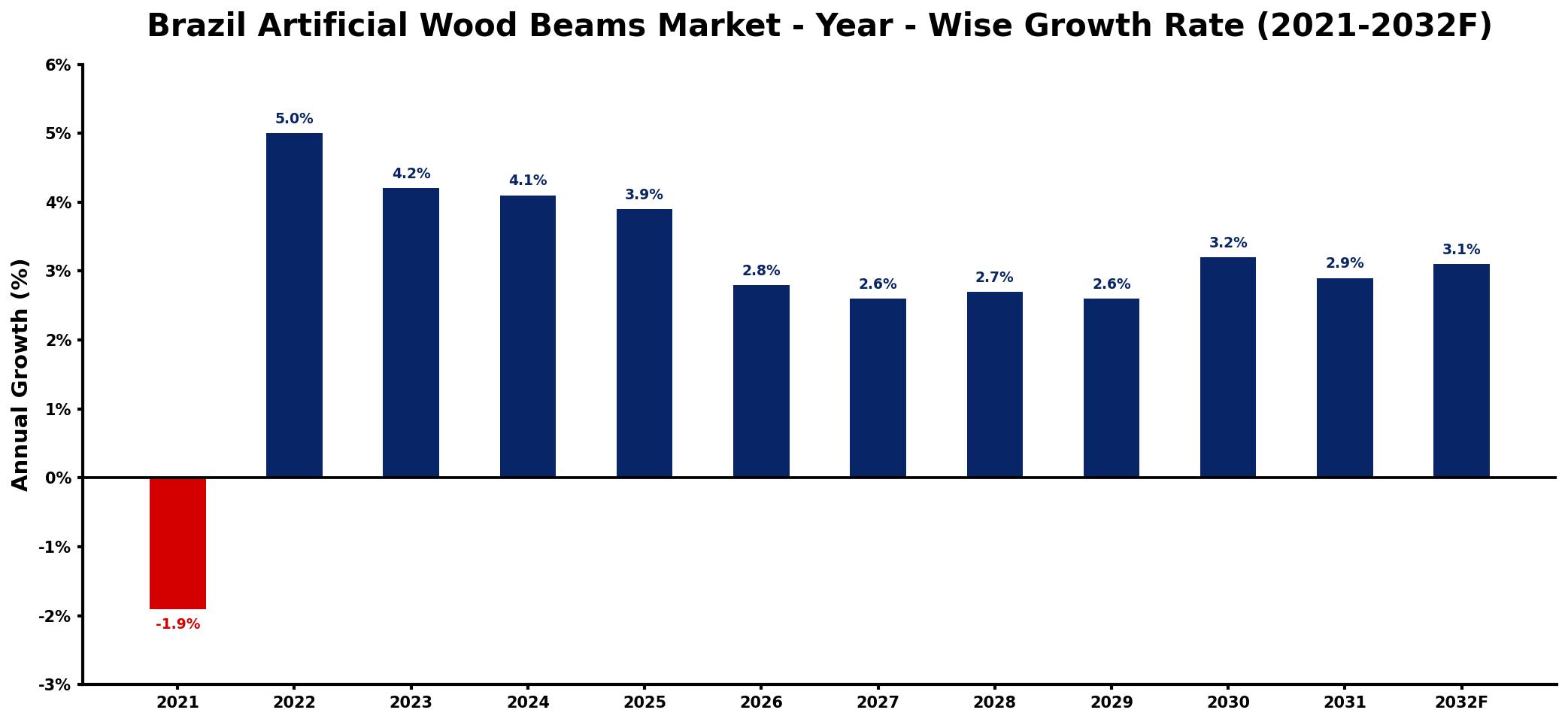
The table below presents the year‑wise growth rates along with the key drivers influencing the market
| Year | Growth Rate | Major Drivers |
| 2021 | -1.9% | Construction projects faced delays |
| 2022 | 5.0% | Rising construction sector investments |
| 2023 | 4.2% | Growing demand for sustainable materials |
| 2024 | 4.1% | Increase in residential building permits |
| 2025 | 3.9% | Expansion of infrastructure projects |
| 2026 | 2.8% | Enhanced focus on eco-friendly solutions |
| 2027 | 2.6% | Surge in remodeling activities |
| 2028 | 2.7% | Boost in commercial construction |
| 2029 | 2.6% | Increased urban development initiatives |
| 2030 | 3.2% | Strengthened regulations for sustainability |
| 2031 | 2.9% | Growth in green building trends |
| 2032 | 3.1% | Emergence of new construction technologies |
Note: Market size estimations and growth projections presented in this report are based on 6Wresearch's proprietary forecasting methodology, utilizing the latest available industry data, government publications, and primary research inputs.
Brazil Artificial Wood Beams Market Synopsis
The demand for artificial wood beams in Brazil is significantly driven by the need for aesthetically pleasing and structurally sound building materials across various sectors. These engineered wood products, notably laminated veneer lumber (LVL) and glued laminated timber (glulam), are increasingly favored in both residential and commercial construction.
Additionally, the emphasis on sustainability in construction practices is promoting the use of composite materials. The architectural community is increasingly leveraging artificial wood beams for both functional and decorative elements, illustrating a clear trend towards integrating eco-friendly options into modern designs.
Brazil Artificial Wood Beams Market Key Takeaways
- Artificial wood beams are preferred for their aesthetic and structural properties in construction.
- The market is buoyed by rising sustainable building practices and environmental consciousness.
- Innovation in engineering techniques is enhancing product offerings in the sector.
- Regulatory compliance and technical standards play a critical role in product acceptance.
- Government initiatives focusing on sustainable forestry are influencing market growth.
Evaluation of Restraints in Brazil Artificial Wood Beams Market
While the Brazil Artificial Wood Beams Market demonstrates promising growth, several restraints can impact its trajectory. Fluctuations in construction activities due to economic volatility pose significant challenges, making it essential for companies to remain adaptable. Additionally, compliance with strict building codes and regulations regarding construction materials can complicate market entry for new players. Finally, competition from alternative building materials—such as traditional timber and steel—could limit market share unless companies emphasize innovation and differentiation in their product offerings.
Brazil Artificial Wood Beams Market Trends
Current trends in the Brazil Artificial Wood Beams Market indicate a shift towards customization and prefabrication, driven by advancements in technology. Manufacturers are increasingly offering tailored solutions to meet the specific needs of architects and builders. Furthermore, there is a noticeable uptick in the integration of smart building technologies, which enhances the functionality of artificial wood beams in modern constructions, making them more attractive to environmentally conscious consumers.
Brazil Artificial Wood Beams Market Opportunities
The Brazilian market for artificial wood beams presents various growth and investment opportunities. With the rise of urbanization and infrastructural development, there is an increasing demand for innovative building materials. Companies can leverage this by focusing on sustainable production methods and eco-friendly certifications. Additionally, as more commercial entities prioritize green building standards, the market can benefit from partnerships in both private and public sectors to enhance distribution and visibility.
Government Initiatives in the Brazil Artificial Wood Beams Market
Government policies in Brazil play a pivotal role in shaping the artificial wood beams market. Regulatory frameworks ensuring environmental sustainability and adherence to technical specifications promote the use of engineered wood products. Moreover, incentives for sustainable building practices and public spending on infrastructure projects create an advantageous environment for the market. These initiatives bolster the adoption of artificial wood beams and address the pressing need for sustainable construction solutions.
Future Insights of the Brazil Artificial Wood Beams Market
Looking ahead to 2026-2032, the Brazil Artificial Wood Beams Market is poised for gradual yet steady growth, driven by a robust construction sector and an increasing focus on sustainable practices. As the architectural landscape evolves, the demand for aesthetically appealing, yet eco-friendly materials will become more pronounced. Additionally, continuous advancements in manufacturing technology will further enhance the capabilities and appeal of artificial wood beams, ensuring they remain a preferred choice in Brazilian constructions.
Brazil Artificial Wood Beams Market Latest Developments (2025 - 2026)
Recent developments in the Brazil Artificial Wood Beams Market reflect an increasing emphasis on sustainability and innovation. Companies are introducing new lines of composite materials that offer both durability and enhanced aesthetic qualities. Furthermore, collaborations between manufacturers and architectural firms are becoming more prevalent, aimed at creating bespoke solutions that cater to contemporary design trends. Additionally, government initiatives promoting green building practices are becoming instrumental in expanding market opportunities.
Brazil Artificial Wood Beams Market - Key Attractiveness of the Report
- 10 Years of Market Numbers
- Historical Data Starting from 2022 to 2025
- Base Year: 2025
- Forecast Data until 2032
- Key Performance Indicators Impacting the Market
- Major Upcoming Developments and Projects
Key Highlights of the Report:
- Brazil Artificial Wood Beams Market Outlook
- Market Size of Brazil Artificial Wood Beams Market, 2025
- Forecast of Brazil Artificial Wood Beams Market, 2032
- Historical Data and Forecast of Brazil Artificial Wood Beams Revenues & Volume for the Period 2022-2032F
- Brazil Artificial Wood Beams Market Trend Evolution
- Brazil Artificial Wood Beams Market Drivers and Challenges
- Brazil Artificial Wood Beams Price Trends
- Brazil Artificial Wood Beams Porter's Five Forces
- Brazil Artificial Wood Beams Industry Life Cycle
- Historical Data and Forecast of Brazil Artificial Wood Beams Market Revenues & Volume By Product Type for the Period 2022-2032F
- Historical Data and Forecast of Brazil Artificial Wood Beams Market Revenues & Volume By U-shaped Beams for the Period 2022-2032F
- Historical Data and Forecast of Brazil Artificial Wood Beams Market Revenues & Volume By Box Beams for the Period 2022-2032F
- Historical Data and Forecast of Brazil Artificial Wood Beams Market Revenues & Volume By Arched Beams for the Period 2022-2032F
- Historical Data and Forecast of Brazil Artificial Wood Beams Market Revenues & Volume By Decorative Beams for the Period 2022-2032F
- Historical Data and Forecast of Brazil Artificial Wood Beams Market Revenues & Volume By Others for the Period 2022-2032F
- Historical Data and Forecast of Brazil Artificial Wood Beams Market Revenues & Volume By Material Type for the Period 2022-2032F
- Historical Data and Forecast of Brazil Artificial Wood Beams Market Revenues & Volume By Thermoplastic for the Period 2022-2032F
- Historical Data and Forecast of Brazil Artificial Wood Beams Market Revenues & Volume By Thermosetting for the Period 2022-2032F
- Historical Data and Forecast of Brazil Artificial Wood Beams Market Revenues & Volume By Others for the Period 2022-2032F
- Historical Data and Forecast of Brazil Artificial Wood Beams Market Revenues & Volume By End Users for the Period 2022-2032F
- Historical Data and Forecast of Brazil Artificial Wood Beams Market Revenues & Volume By Residential for the Period 2022-2032F
- Historical Data and Forecast of Brazil Artificial Wood Beams Market Revenues & Volume By Commercial for the Period 2022-2032F
- Brazil Artificial Wood Beams Import Export Trade Statistics
- Market Opportunity Assessment By Product Type
- Market Opportunity Assessment By Material Type
- Market Opportunity Assessment By End Users
- Brazil Artificial Wood Beams Top Companies Market Share
- Brazil Artificial Wood Beams Competitive Benchmarking By Technical and Operational Parameters
- Brazil Artificial Wood Beams Company Profiles
- Brazil Artificial Wood Beams Key Strategic Recommendations






































