Brazil Automotive Lighting Market Size Growth Rate
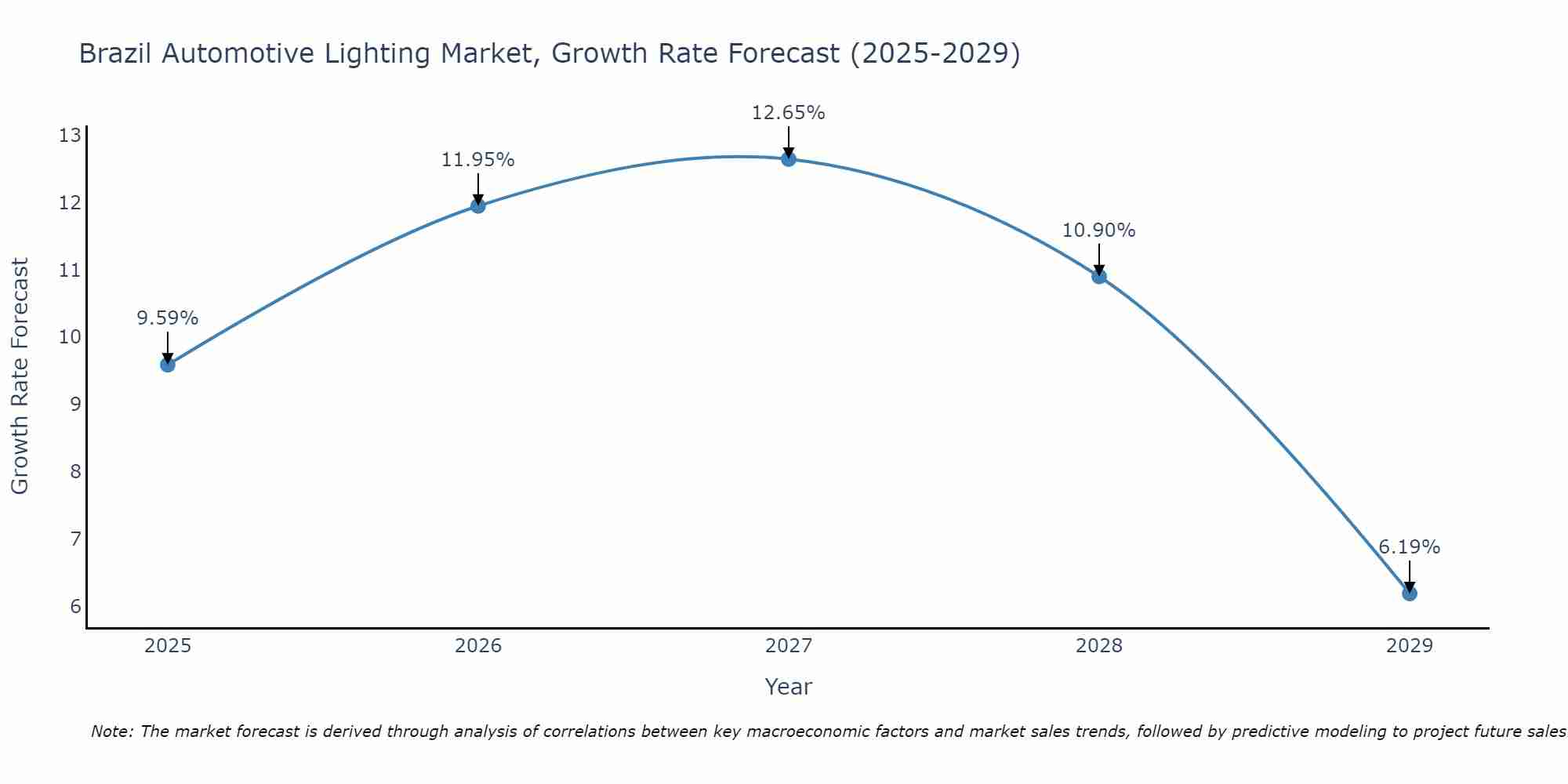
The Brazil Automotive Lighting Market is projected to witness mixed growth rate patterns during 2025 to 2029. Starting at 9.59% in 2025, the market peaks at 12.65% in 2027, and settles at 6.19% by 2029.
Brazil Automotive Lighting Market Overview
The automotive lighting market in Brazil supplies lighting components and systems for vehicles, including headlights, taillights, fog lights, and interior lighting. With advancements in automotive technology, safety regulations, and design trends, there is a growing demand for energy-efficient, high-performance lighting solutions. The market encompasses traditional halogen lamps, LED lighting, and adaptive lighting systems, offering enhanced visibility, safety, and aesthetics for vehicles on Brazil roads.
Drivers of the market
The automotive lighting market in Brazil experiences growth influenced by vehicle safety regulations and aesthetic preferences. Automotive lighting systems, including headlights, taillights, and signal lights, are essential for visibility, signaling, and safety on roads, and as automotive design trends emphasize style and functionality, there`s a demand for advanced lighting technologies.
Challenges of the market
Challenges in Brazil automotive lighting market include compliance with safety regulations and lighting standards, which impact product design and manufacturing processes. Market players must also contend with technological advancements in LED and adaptive lighting systems, driving demand for energy-efficient and advanced lighting solutions. Moreover, competition from imported automotive lighting products and aftermarket suppliers adds pressure on pricing and market share.
Government Policy of the market
Government policies in Brazil automotive lighting market aim to regulate vehicle safety standards, promote energy efficiency, and support automotive industry development. Policies may include regulations on automotive lighting design and performance to ensure compliance with visibility and signaling requirements. Additionally, the government may provide incentives for the adoption of energy-efficient lighting technologies, such as LED and xenon headlights, to reduce vehicle energy consumption and emissions. Furthermore, the government may implement measures to enforce lighting standards testing and certification to ensure product quality and reliability.
Key Highlights of the Report:
- Brazil Automotive Lighting Market Outlook
- Market Size of Brazil Automotive Lighting Market, 2024
- Forecast of Brazil Automotive Lighting Market, 2031
- Historical Data and Forecast of Brazil Automotive Lighting Revenues & Volume for the Period 2021-2031
- Brazil Automotive Lighting Market Trend Evolution
- Brazil Automotive Lighting Market Drivers and Challenges
- Brazil Automotive Lighting Price Trends
- Brazil Automotive Lighting Porter's Five Forces
- Brazil Automotive Lighting Industry Life Cycle
- Historical Data and Forecast of Brazil Automotive Lighting Market Revenues & Volume By Vehicle Type for the Period 2021-2031
- Historical Data and Forecast of Brazil Automotive Lighting Market Revenues & Volume By Passenger Vehicle for the Period 2021-2031
- Historical Data and Forecast of Brazil Automotive Lighting Market Revenues & Volume By Commercial Vehicle for the Period 2021-2031
- Historical Data and Forecast of Brazil Automotive Lighting Market Revenues & Volume By Technology for the Period 2021-2031
- Historical Data and Forecast of Brazil Automotive Lighting Market Revenues & Volume By Halogen for the Period 2021-2031
- Historical Data and Forecast of Brazil Automotive Lighting Market Revenues & Volume By Xenon/HID (High-intensity Discharge Lamp) for the Period 2021-2031
- Historical Data and Forecast of Brazil Automotive Lighting Market Revenues & Volume By LED (Light Emitting Diode) for the Period 2021-2031
- Historical Data and Forecast of Brazil Automotive Lighting Market Revenues & Volume By Application for the Period 2021-2031
- Historical Data and Forecast of Brazil Automotive Lighting Market Revenues & Volume By Front/Headlamps for the Period 2021-2031
- Historical Data and Forecast of Brazil Automotive Lighting Market Revenues & Volume By Rear Lighting for the Period 2021-2031
- Historical Data and Forecast of Brazil Automotive Lighting Market Revenues & Volume By Side for the Period 2021-2031
- Historical Data and Forecast of Brazil Automotive Lighting Market Revenues & Volume By Interior Lighting for the Period 2021-2031
- Brazil Automotive Lighting Import Export Trade Statistics
- Market Opportunity Assessment By Vehicle Type
- Market Opportunity Assessment By Technology
- Market Opportunity Assessment By Application
- Brazil Automotive Lighting Top Companies Market Share
- Brazil Automotive Lighting Competitive Benchmarking By Technical and Operational Parameters
- Brazil Automotive Lighting Company Profiles
- Brazil Automotive Lighting Key Strategic Recommendations






































