Brazil Baby Prams and Strollers Market Size, Share & Growth Rate
The Brazil Baby Prams and Strollers Market was estimated at USD 109 Million in 2025 and is projected to reach USD 129 Million by 2032, growing at a CAGR of 2.4% from 2026 to 2032. This growth trajectory is fueled by several factors, including an increasing birth rate and rising disposable incomes among Brazilian families. The evolving lifestyles of parents, who prioritize convenience and safety, also bolster demand for innovative products that cater to modern needs.
Brazil Baby Prams and Strollers Market Year-wise Growth Rate and Key Drivers
This graph highlights how the Brazil Baby Prams and Strollers Market has steadily grown over the years, supported by major growth factors.
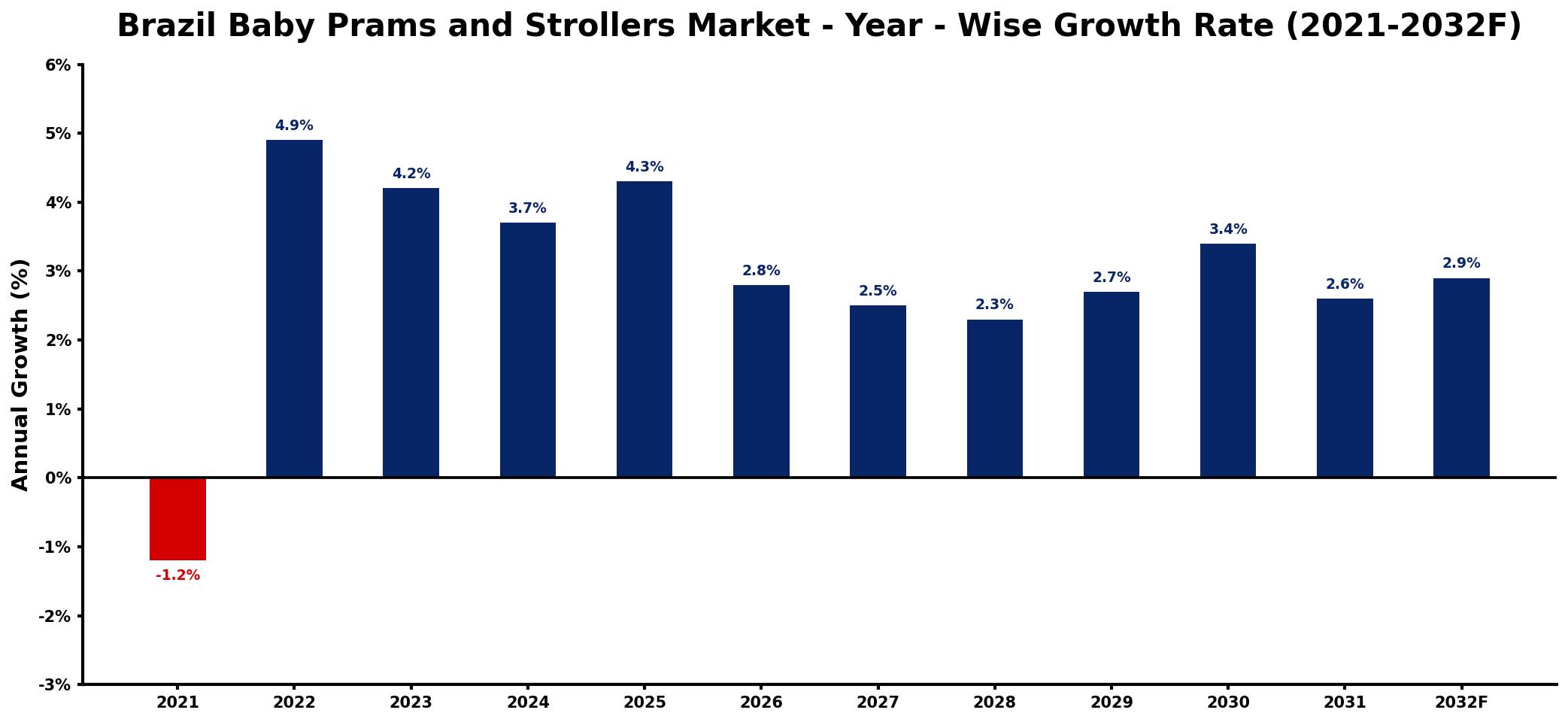
The table below presents the year‑wise growth rates along with the key drivers influencing the market
| Year | Growth Rate | Major Drivers |
| 2021 | -1.2% | decrease in consumer spending power |
| 2022 | 4.9% | rising demand for premium products |
| 2023 | 4.2% | increased focus on safety standards |
| 2024 | 3.7% | growth in online retail platforms |
| 2025 | 4.3% | expansion of eco-friendly options |
| 2026 | 2.8% | higher investments in innovation |
| 2027 | 2.5% | increased urbanization and mobility |
| 2028 | 2.3% | growing awareness of parenting trends |
| 2029 | 2.7% | surge in disposable income levels |
| 2030 | 3.4% | enhanced marketing strategies adopted |
| 2031 | 2.6% | rising trend of urban families |
| 2032 | 2.9% | increased collaboration with retailers |
Note: Market size estimations and growth projections presented in this report are based on 6Wresearch's proprietary forecasting methodology, utilizing the latest available industry data, government publications, and primary research inputs.
Brazil Baby Prams and Strollers Market Synopsis
In Brazil, the rising number of working parents significantly influences the demand for baby prams and strollers, with a marked preference for models that offer ease of transport and versatility. Additionally, safety concerns drive consumer decisions, pushing manufacturers to invest in compliance with rigorous safety standards and incorporate innovative designs.
As lifestyles continue to shift, an increasing emphasis on urban living presents opportunities for lightweight, compact strollers suited for city environments. Moreover, parents are seeking multifunctional products that provide not only comfort but also adaptability to different situations, thereby driving the innovation curve within the market.
Brazil Baby Prams and Strollers Market Key Takeaways
- The market is projected to grow steadily, reflecting changing consumer demographics and preferences.
- Safety standards remain a top priority, with stringent regulations governing product compliance.
- Innovation in design and materials is vital for market differentiation amidst increasing competition.
- Economic factors, including disposable income, significantly impact consumer purchasing power.
- Urbanization trends are shaping demand for compact and lightweight stroller options.
Evaluation of Restraints in Brazil Baby Prams and Strollers Market
The Brazil Baby Prams and Strollers Market faces several restraints that could impact its growth trajectory. Price sensitivity among consumers is a significant challenge, especially as economic uncertainties affect overall spending capabilities. Additionally, market saturation has led to fierce competition, making product differentiation crucial. Companies must navigate these factors by leveraging effective marketing strategies and focusing on product innovation that resonates with diverse consumer needs.
Brazil Baby Prams and Strollers Market Trends
The current trends in the Brazil Baby Prams and Strollers Market point towards a growing preference for eco-friendly materials and sustainable manufacturing practices. Parents are increasingly aware of the environmental impact of their purchases, which has led to a demand for products that reflect their values. Furthermore, advancements in technology, such as smart strollers equipped with safety features and connectivity options, are beginning to reshape consumer expectations and drive market evolution.
Brazil Baby Prams and Strollers Market Opportunities
The market presents several genuine growth opportunities, particularly in the realm of innovation. As parents seek products that provide enhanced safety and convenience, manufacturers can capitalize on the demand for high-tech features. Additionally, exploring partnerships with e-commerce platforms can enhance distribution channels and accessibility, tapping into the growing trend of online shopping among consumers.
Government Initiatives in the Brazil Baby Prams and Strollers Market
Brazilian government policies surrounding the Baby Prams and Strollers Market are largely focused on enforcing stringent safety standards for infant and child products. Regulatory frameworks are in place to ensure that products meet established safety criteria. Additionally, the government encourages the promotion of locally manufactured products, which can include financial support initiatives for manufacturers that adhere to quality and safety norms.
Future Insights of the Brazil Baby Prams and Strollers Market
Looking ahead to 2026-2032, the Brazil Baby Prams and Strollers Market is expected to see significant advancements driven by evolving consumer needs and preferences. The ongoing focus on safety, coupled with technological innovations, will likely redefine product offerings. Moreover, as economic conditions stabilize and disposable incomes rise, the demand for premium, multifunctional strollers is projected to increase, encouraging further investment and growth opportunities.
Brazil Baby Prams and Strollers Market Latest Developments (2025 - 2026)
Recent developments in the Brazil Baby Prams and Strollers Market indicate a strategic shift towards more eco-conscious manufacturing processes, with several brands launching lines of sustainably produced products. Additionally, collaborations between manufacturers and technology firms are becoming more common, resulting in innovative features aimed at enhancing user experience. The marketplace is increasingly dynamic, reflecting the multifaceted needs of modern Brazilian families.
Brazil Baby Prams and Strollers Market - Key Attractiveness of the Report
- 10 Years of Market Numbers
- Historical Data Starting from 2022 to 2025
- Base Year: 2025
- Forecast Data until 2032
- Key Performance Indicators Impacting the Market
- Major Upcoming Developments and Projects
Key Highlights of the Report:
- Brazil Baby Prams and Strollers Market Outlook
- Market Size of Brazil Baby Prams and Strollers Market, 2025
- Forecast of Brazil Baby Prams and Strollers Market, 2032
- Historical Data and Forecast of Brazil Baby Prams and Strollers Revenues & Volume for the Period 2022-2032F
- Brazil Baby Prams and Strollers Market Trend Evolution
- Brazil Baby Prams and Strollers Market Drivers and Challenges
- Brazil Baby Prams and Strollers Price Trends
- Brazil Baby Prams and Strollers Porter's Five Forces
- Brazil Baby Prams and Strollers Industry Life Cycle
- Historical Data and Forecast of Brazil Baby Prams and Strollers Market Revenues & Volume By Product Type for the Period 2022-2032F
- Historical Data and Forecast of Brazil Baby Prams and Strollers Market Revenues & Volume By Lightweight Strollers for the Period 2022-2032F
- Historical Data and Forecast of Brazil Baby Prams and Strollers Market Revenues & Volume By Jogging Strollers for the Period 2022-2032F
- Historical Data and Forecast of Brazil Baby Prams and Strollers Market Revenues & Volume By Standard Strollers for the Period 2022-2032F
- Historical Data and Forecast of Brazil Baby Prams and Strollers Market Revenues & Volume By Double / Triple Strollers for the Period 2022-2032F
- Historical Data and Forecast of Brazil Baby Prams and Strollers Market Revenues & Volume By Multi-Optional System Strollers for the Period 2022-2032F
- Historical Data and Forecast of Brazil Baby Prams and Strollers Market Revenues & Volume By Age for the Period 2022-2032F
- Historical Data and Forecast of Brazil Baby Prams and Strollers Market Revenues & Volume By 0 - 6 months for the Period 2022-2032F
- Historical Data and Forecast of Brazil Baby Prams and Strollers Market Revenues & Volume By 6 - 12 months for the Period 2022-2032F
- Historical Data and Forecast of Brazil Baby Prams and Strollers Market Revenues & Volume By 12 - 36 months for the Period 2022-2032F
- Historical Data and Forecast of Brazil Baby Prams and Strollers Market Revenues & Volume By Sales Channel for the Period 2022-2032F
- Historical Data and Forecast of Brazil Baby Prams and Strollers Market Revenues & Volume By BaBoutiques for the Period 2022-2032F
- Historical Data and Forecast of Brazil Baby Prams and Strollers Market Revenues & Volume By Specialty Stores for the Period 2022-2032F
- Historical Data and Forecast of Brazil Baby Prams and Strollers Market Revenues & Volume By Modern Trade for the Period 2022-2032F
- Historical Data and Forecast of Brazil Baby Prams and Strollers Market Revenues & Volume By Departmental Stores for the Period 2022-2032F
- Historical Data and Forecast of Brazil Baby Prams and Strollers Market Revenues & Volume By Mono-brand Stores for the Period 2022-2032F
- Historical Data and Forecast of Brazil Baby Prams and Strollers Market Revenues & Volume By Online retailers for the Period 2022-2032F
- Historical Data and Forecast of Brazil Baby Prams and Strollers Market Revenues & Volume By Other Sales Channel for the Period 2022-2032F
- Brazil Baby Prams and Strollers Import Export Trade Statistics
- Market Opportunity Assessment By Product Type
- Market Opportunity Assessment By Age
- Market Opportunity Assessment By Sales Channel
- Brazil Baby Prams and Strollers Top Companies Market Share
- Brazil Baby Prams and Strollers Competitive Benchmarking By Technical and Operational Parameters
- Brazil Baby Prams and Strollers Company Profiles
- Brazil Baby Prams and Strollers Key Strategic Recommendations






































