Brazil Bean To Bar Chocolate Market Growth Rate Analysis (2021-2031)
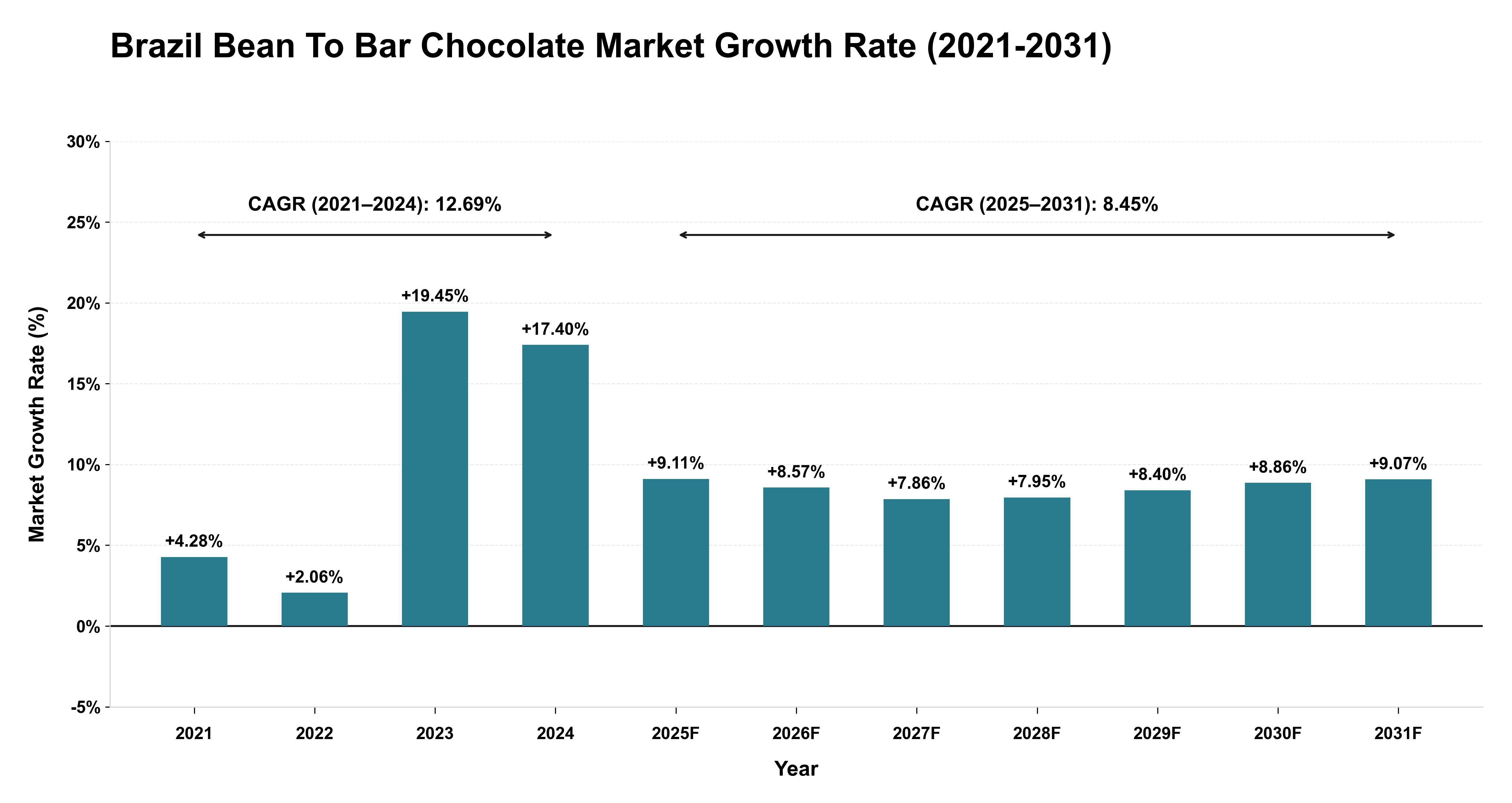
The Brazil Bean To Bar Chocolate market demonstrated robust growth from 2021 to 2024, with a CAGR of 12.69%, driven by increasing disposable income and a preference for premium, locally sourced products. The market experienced volatility in growth rates, notably in 2023 (19.45%) and 2024 (17.40%), potentially due to promotional activities or new product launches. Looking forward to 2031, the market is projected to continue expanding at a slower pace, with a forecasted CAGR of 8.45%. This deceleration may be linked to market saturation and challenges like inflation impacting consumer purchasing power. However, the sector is expected to stabilize post-pandemic spikes, indicating a more sustainable growth trajectory in the upcoming years.
Key Highlights of the Report:
- Brazil Bean-To-Bar Chocolate Market Outlook
- Market Size of Brazil Bean-To-Bar Chocolate Market, 2024
- Forecast of Brazil Bean-To-Bar Chocolate Market, 2031
- Historical Data and Forecast of Brazil Bean-To-Bar Chocolate Revenues & Volume for the Period 2021- 2031
- Brazil Bean-To-Bar Chocolate Market Trend Evolution
- Brazil Bean-To-Bar Chocolate Market Drivers and Challenges
- Brazil Bean-To-Bar Chocolate Price Trends
- Brazil Bean-To-Bar Chocolate Porter's Five Forces
- Brazil Bean-To-Bar Chocolate Industry Life Cycle
- Historical Data and Forecast of Brazil Bean-To-Bar Chocolate Market Revenues & Volume By Type for the Period 2021- 2031
- Historical Data and Forecast of Brazil Bean-To-Bar Chocolate Market Revenues & Volume By Dark Chocolate for the Period 2021- 2031
- Historical Data and Forecast of Brazil Bean-To-Bar Chocolate Market Revenues & Volume By Milk Chocolate for the Period 2021- 2031
- Historical Data and Forecast of Brazil Bean-To-Bar Chocolate Market Revenues & Volume By White Chocolate for the Period 2021- 2031
- Historical Data and Forecast of Brazil Bean-To-Bar Chocolate Market Revenues & Volume By Chocolate Bean for the Period 2021- 2031
- Historical Data and Forecast of Brazil Bean-To-Bar Chocolate Market Revenues & Volume By Others for the Period 2021- 2031
- Historical Data and Forecast of Brazil Bean-To-Bar Chocolate Market Revenues & Volume By Application for the Period 2021- 2031
- Historical Data and Forecast of Brazil Bean-To-Bar Chocolate Market Revenues & Volume By Supermarkets for the Period 2021- 2031
- Historical Data and Forecast of Brazil Bean-To-Bar Chocolate Market Revenues & Volume By Convenience Stores for the Period 2021- 2031
- Historical Data and Forecast of Brazil Bean-To-Bar Chocolate Market Revenues & Volume By Independent Retailers for the Period 2021- 2031
- Historical Data and Forecast of Brazil Bean-To-Bar Chocolate Market Revenues & Volume By Online Sales for the Period 2021- 2031
- Historical Data and Forecast of Brazil Bean-To-Bar Chocolate Market Revenues & Volume By Others for the Period 2021- 2031
- Brazil Bean-To-Bar Chocolate Import Export Trade Statistics
- Market Opportunity Assessment By Type
- Market Opportunity Assessment By Application
- Brazil Bean-To-Bar Chocolate Top Companies Market Share
- Brazil Bean-To-Bar Chocolate Competitive Benchmarking By Technical and Operational Parameters
- Brazil Bean-To-Bar Chocolate Company Profiles
- Brazil Bean-To-Bar Chocolate Key Strategic Recommendations






































