Brazil Cashmere Yarn Market Size, Share & Growth Rate
The Brazil Cashmere Yarn Market was estimated at USD 453 Million in 2025 and is projected to reach USD 542 Million by 2032, growing at a CAGR of 2.6% from 2026 to 2032. This growth is fueled by an increasing consumer preference for luxurious textiles, especially among affluent demographics in urban centers. Additionally, the trend towards sustainable and ethically sourced fashion is promoting cashmere yarn as a favored choice for high-end apparel.
Brazil Cashmere Yarn Market Year-wise Growth Rate and Key Drivers
This graph highlights how the Brazil Cashmere Yarn Market has steadily grown over the years, supported by major growth factors.
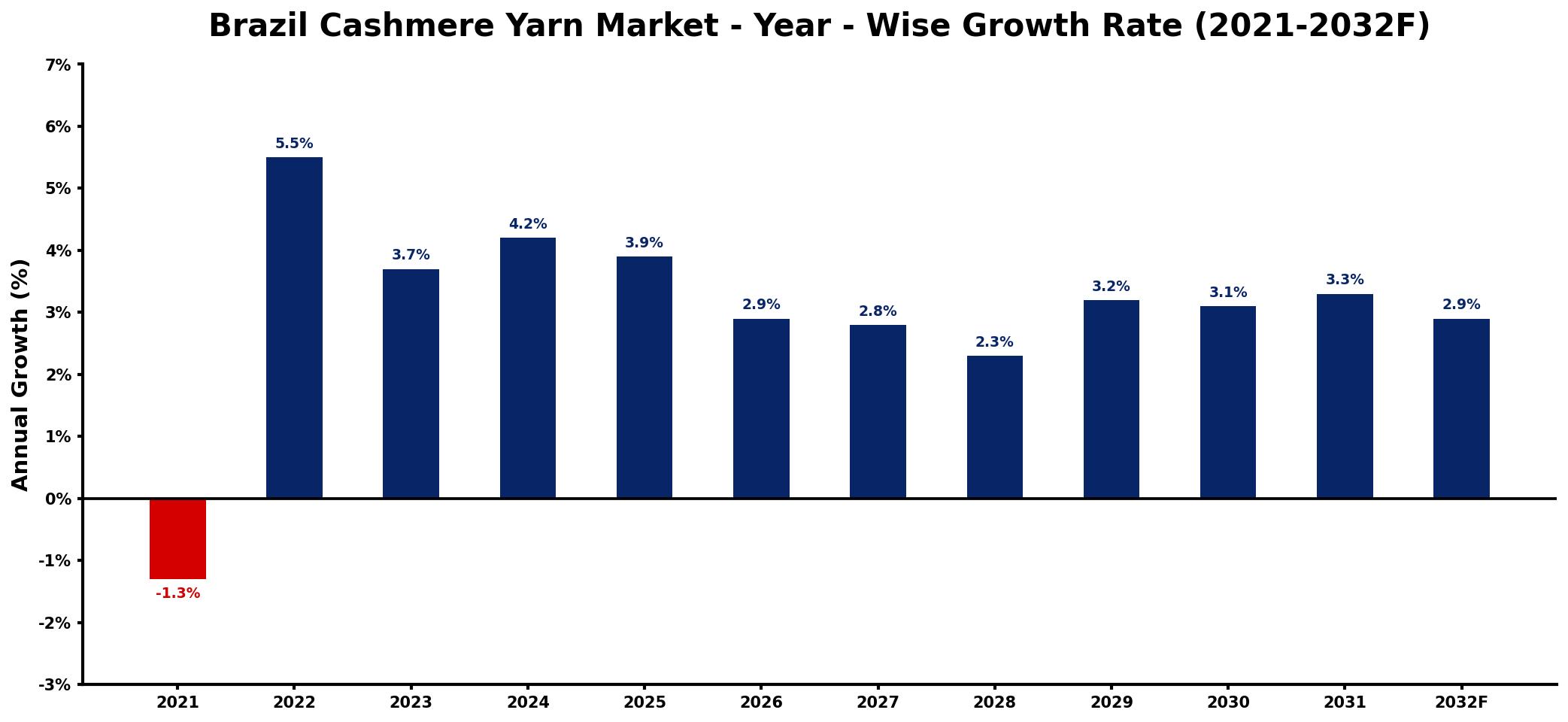
The table below presents the year‑wise growth rates along with the key drivers influencing the market
| Year | Growth Rate | Major Drivers |
| 2021 | -1.3% | shifts in consumer spending habits |
| 2022 | 5.5% | rise in luxury fashion demand |
| 2023 | 3.7% | increased online retail sales |
| 2024 | 4.2% | expansion of textile manufacturing |
| 2025 | 3.9% | growing interest in sustainability |
| 2026 | 2.9% | enhanced supply chain efficiency |
| 2027 | 2.8% | emergence of new fashion trends |
| 2028 | 2.3% | influx of foreign investments |
| 2029 | 3.2% | strengthening artisan craft markets |
| 2030 | 3.1% | greater focus on quality materials |
| 2031 | 3.3% | improvement in global trade agreements |
| 2032 | 2.9% | increased consumer awareness campaigns |
Note: Market size estimations and growth projections presented in this report are based on 6Wresearch's proprietary forecasting methodology, utilizing the latest available industry data, government publications, and primary research inputs.
Brazil Cashmere Yarn Market Synopsis
The Brazilian cashmere yarn market is thriving, driven by a burgeoning appetite for premium fabrics that exude luxury and comfort. This demand is manifesting in diverse applications, particularly in knitwear and high-fashion garments, appealing to consumers who value quality and exclusivity.
Notably, the market is witnessing a transformative shift towards sustainability, with brands increasingly opting for responsibly sourced cashmere. This alignment with environmentally conscious practices resonates with a growing segment of consumers who prioritize ethical considerations in their purchasing decisions.
Brazil Cashmere Yarn Market Key Takeaways
- The market is expected to see steady growth driven by rising disposable incomes and changing fashion trends.
- Sustainable sourcing and ethical production practices are becoming critical market differentiators.
- Urban consumers are the primary demographic driving demand for luxury cashmere products.
- Supply chain complexities pose ongoing challenges for market players, particularly with import dependencies.
- The global focus on quality and sustainability in the textile industry is reshaping consumer preferences.
Evaluation of Restraints in Brazil Cashmere Yarn Market
Despite the promising growth trajectory, the Brazil cashmere yarn market faces significant challenges. Chief among these are the complexities of the global supply chain, which can lead to price volatility and inconsistent availability of cashmere fibers. Import dependencies and geopolitical factors further complicate this landscape, creating hurdles for local businesses. Additionally, as sustainability becomes a focal point in consumer purchasing decisions, market players must navigate the fine line between meeting demand and adhering to ethical sourcing standards.
Brazil Cashmere Yarn Market Trends
Current trends in the Brazil cashmere yarn market indicate a pronounced shift towards eco-friendly practices. Consumers are increasingly seeking out products that not only provide luxury but also adhere to sustainable production methods. Furthermore, digital transformation within the retail landscape is enabling brands to engage with customers more effectively, tailoring offerings to meet the unique demands of the Brazilian market.
Another notable trend is the rising influence of social media on fashion choices, which helps to propel cashmere into the spotlight as a desirable material. The aesthetic appeal and perceived status associated with cashmere yarn continue to make it a sought-after commodity in Brazil's evolving textile landscape.
Brazil Cashmere Yarn Market Opportunities
The Brazil cashmere yarn market presents several compelling opportunities for growth and investment. With an increasing number of brands focusing on sustainable practices, there is substantial room for innovation in the development of ethically sourced cashmere products. Additionally, the expanding online retail segment offers unique avenues for companies to reach a broader audience, particularly among younger consumers who value both quality and transparency. The potential for collaboration with fashion designers focused on luxurious, eco-friendly collections also creates a dynamic environment for new ventures.
Government Initiatives in the Brazil Cashmere Yarn Market
Government policies in Brazil are increasingly favoring sustainable practices in the textile industry. Initiatives aimed at promoting ethical sourcing of cashmere fibers emphasize animal welfare and environmental responsibility. These policies not only encourage adherence to quality standards but also bolster Brazils reputation in both domestic and international markets, enhancing the appeal of locally produced cashmere yarn.
Future Insights of the Brazil Cashmere Yarn Market
Looking forward to the period between 2026 and 2032, the Brazil cashmere yarn market is set to evolve significantly. As sustainability continues to dominate consumer preferences, companies that prioritize environmentally friendly practices will likely outperform their competitors. The anticipated growth in disposable incomes may further stimulate demand for luxury products, positioning cashmere yarn as a key player in Brazil's premium textile sector. Additionally, the integration of technology in retail will enable brands to enhance customer engagement, creating an interactive shopping experience that aligns with modern consumer expectations.
Brazil Cashmere Yarn Market Latest Developments (2025 - 2026)
Recent developments in the Brazil cashmere yarn market highlight an increasing focus on sustainability and quality. Several brands are launching new lines that emphasize ethically sourced materials, responding to consumer demand for transparency. The market is also witnessing advancements in production techniques that enhance the quality of cashmere yarn while reducing environmental impact, ensuring that local producers remain competitive on the global stage.
Brazil Cashmere Yarn Market - Key Attractiveness of the Report
- 10 Years of Market Numbers
- Historical Data Starting from 2022 to 2025
- Base Year: 2025
- Forecast Data until 2032
- Key Performance Indicators Impacting the Market
- Major Upcoming Developments and Projects
Key Highlights of the Report:
- Brazil Cashmere Yarn Market Outlook
- Market Size of Brazil Cashmere Yarn Market, 2025
- Forecast of Brazil Cashmere Yarn Market, 2032
- Historical Data and Forecast of Brazil Cashmere Yarn Revenues & Volume for the Period 2022-2032F
- Brazil Cashmere Yarn Market Trend Evolution
- Brazil Cashmere Yarn Market Drivers and Challenges
- Brazil Cashmere Yarn Price Trends
- Brazil Cashmere Yarn Porter's Five Forces
- Brazil Cashmere Yarn Industry Life Cycle
- Historical Data and Forecast of Brazil Cashmere Yarn Market Revenues & Volume By Type for the Period 2022-2032F
- Historical Data and Forecast of Brazil Cashmere Yarn Market Revenues & Volume By Natural Cashmere Yarn for the Period 2022-2032F
- Historical Data and Forecast of Brazil Cashmere Yarn Market Revenues & Volume By Processed Cashmere Yarn for the Period 2022-2032F
- Historical Data and Forecast of Brazil Cashmere Yarn Market Revenues & Volume By Others for the Period 2022-2032F
- Historical Data and Forecast of Brazil Cashmere Yarn Market Revenues & Volume By Application for the Period 2022-2032F
- Historical Data and Forecast of Brazil Cashmere Yarn Market Revenues & Volume By Sweaters for the Period 2022-2032F
- Historical Data and Forecast of Brazil Cashmere Yarn Market Revenues & Volume By Shawls for the Period 2022-2032F
- Historical Data and Forecast of Brazil Cashmere Yarn Market Revenues & Volume By Suits for the Period 2022-2032F
- Historical Data and Forecast of Brazil Cashmere Yarn Market Revenues & Volume By Socks for the Period 2022-2032F
- Historical Data and Forecast of Brazil Cashmere Yarn Market Revenues & Volume By Others for the Period 2022-2032F
- Brazil Cashmere Yarn Import Export Trade Statistics
- Market Opportunity Assessment By Type
- Market Opportunity Assessment By Application
- Brazil Cashmere Yarn Top Companies Market Share
- Brazil Cashmere Yarn Competitive Benchmarking By Technical and Operational Parameters
- Brazil Cashmere Yarn Company Profiles
- Brazil Cashmere Yarn Key Strategic Recommendations






































