Brazil Chandeliers & Pendant Lights Market Summary
The brazil chandeliers & pendant lights market was estimated at USD 229 Million in 2025 and is projected to reach USD 271 Million by 2032, growing at a CAGR of 2.5% from 2026 to 2032.
Brazil Chandeliers & Pendant Lights Market Year-wise Growth Rate and Key Drivers
This graph highlights how the Brazil Chandeliers & Pendant Lights Market has steadily grown over the past five years, supported by major growth factors.
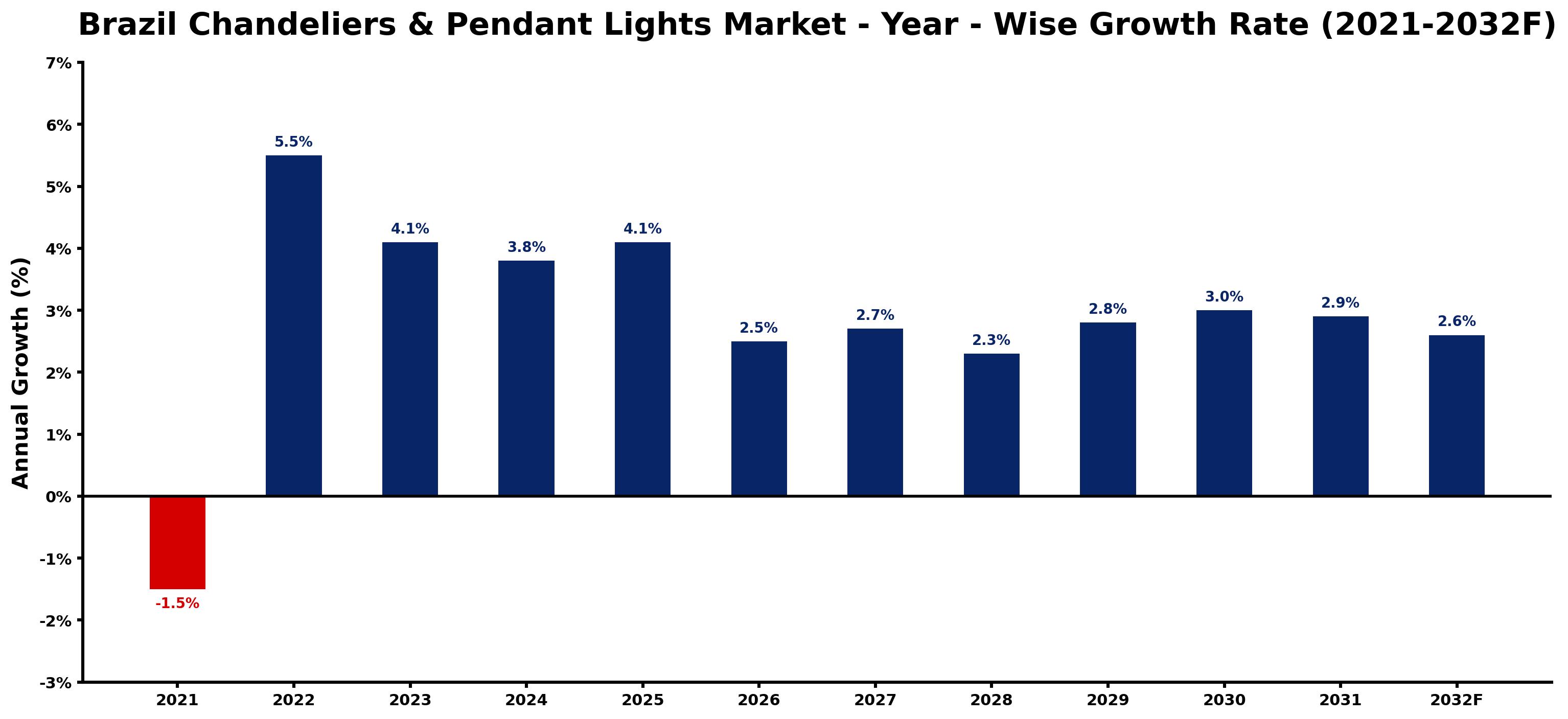
The table below presents the year wise growth rates along with the key drivers influencing the market
| Year | Growth Rate | Major Drivers |
| 2021 | -1.5% | Economic uncertainties and reduced disposable income led to decreased consumer spending on decorative lighting. |
| 2022 | 5.5% | Luxury real estate developments sparked greater demand for high-end lighting fixtures nationwide. |
| 2023 | 4.1% | Interior design trends shifted towards minimalist styles, influencing pendant light preferences significantly. |
| 2024 | 3.8% | Local artisans began gaining popularity, boosting sales of handcrafted lighting solutions. |
| 2025 | 4.1% | Sustainability concerns prompted consumers to seek energy-efficient lighting options extensively. |
| 2026 | 2.5% | E-commerce growth enhanced accessibility of diverse chandelier selections throughout Brazil. |
| 2027 | 2.7% | Cultural events and festivals increased public interest in vibrant lighting displays and aesthetics. |
| 2028 | 2.3% | The renovation boom in residential properties led to heightened chandelier customization opportunities. |
| 2029 | 2.8% | Collaborations with international designers introduced innovative lighting concepts to the Brazilian market. |
| 2030 | 3.0% | Urbanization trends resulted in more upscale commercial spaces prioritizing elegant lighting solutions. |
| 2031 | 2.9% | Enhanced consumer awareness regarding lighting's impact on mood influenced purchasing decisions markedly. |
| 2032 | 2.6% | Technological innovations allowed for smart chandelier integration, elevating market engagement significantly. |
Note - Market size estimations and growth projections presented in this report are based on 6Wresearch's advanced forecasting approach, validated with industry datasets as of June 2026.
Brazil Chandeliers & Pendant Lights Market Synopsis
The Brazil Chandeliers Pendant Lights Market is projected to reach 2.5% and witness significant growth during the forecast period (2026-2032). This expansion can be attributed to various factors, including an increasing consumer preference for energy-efficient lighting solutions, a growing awareness of stylish and elegant interior decorations, and a rise in disposable incomes among the Brazilian populace. These elements are fostering a more sophisticated consumer base that seeks to enhance their living spaces.
Brazil Chandeliers & Pendant Lights Market Growth Drivers
Several key drivers are propelling the Brazil Chandeliers & Pendant Lights Market forward. Firstly, the demand for energy-efficient lighting options plays a crucial role, as more consumers prioritize sustainability. Secondly, with a burgeoning middle class, households are increasingly investing in home decor, leading to a rise in the purchase of decorative lighting fixtures. Thirdly, advancements in LED technology are making these products more accessible and appealing due to their longer lifespan and lower energy consumption. Additionally, the availability of cost-effective materials sourced from overseas manufacturers encourages innovation in design and affordability. Lastly, the growing trend of smart home automation has further stimulated the sales of chandeliers and pendant lights, integrating them into modern living environments.
Brazil Chandeliers & Pendant Lights Market Trends and Opportunities
The Brazil Chandeliers & Pendant Lights Market is undergoing various trends that signify growth opportunities. A noteworthy trend is the increasing preference for custom-designed lighting solutions, which reflect individual styles and home aesthetics. Moreover, there is an emerging market for smart lighting solutions that can be controlled via smartphone applications, appealing to tech-savvy consumers. Additionally, the trend of minimalist and contemporary designs is gaining traction, as consumers look for pieces that fit into sleek, modern interiors. Alongside this, sustainability is driving interest in eco-friendly products, pushing manufacturers to develop chandeliers and pendant lights using recyclable materials. Lastly, online retail platforms are expanding their reach, making it easier for consumers to access a wide range of products.
Brazil Chandeliers & Pendant Lights Market Challenges and Restraints
Despite the positive outlook for the Brazil Chandeliers & Pendant Lights Market, certain challenges may impede growth. The high initial investment required for top-tier decorative lighting can deter cost-sensitive consumers, especially in a fluctuating economic landscape. Additionally, stringent regulations regarding energy efficiency and materials used in lighting products can pose challenges for manufacturers. The market is also impacted by competition from alternative lighting solutions such as recessed lighting and fluorescent fixtures, which may offer lower upfront costs. Moreover, fluctuating currency exchange rates can affect the prices of imported materials and components, thereby influencing production costs. Lastly, supply chain disruptions, particularly in the wake of global events, can impact market stability and product availability.
Brazil Chandeliers & Pendant Lights Market Regional Analysis
The Brazil Chandeliers & Pendant Lights Market exhibits regional variances that reflect differing consumer preferences and economic conditions. Urban centers such as São Paulo and Rio de Janeiro exhibit a higher demand for luxurious and intricately designed lighting fixtures due to a larger population of affluent consumers. In contrast, rural areas may lean towards more functional and cost-effective options. Moreover, the northeastern region is experiencing growth as infrastructure development increases disposable incomes and fosters demand for improved home furnishings. The central and southern regions are also witnessing demand driven by an increase in home constructions and renovations. As the market evolves, understanding these regional dynamics will be crucial for manufacturers aiming to target specific consumer segments.
Brazil Chandeliers & Pendant Lights Market Government Investment and Initiatives
The Brazilian government is actively investing in initiatives aimed at promoting energy-efficient lighting solutions, which directly benefits the Chandeliers & Pendant Lights Market. Policies designed to encourage the adoption of sustainable technologies are being prioritized, with public spending directed towards infrastructure and housing projects that incorporate modern lighting solutions. Additionally, government incentives for businesses focusing on energy-efficient products are stimulating innovation within the market. By facilitating partnerships between public and private sectors, the government aims to enhance the overall quality and accessibility of lighting products. These efforts are aimed at not only reducing energy consumption but also enhancing the aesthetic appeal of homes and commercial spaces across Brazil.
Brazil Chandeliers & Pendant Lights Market Latest Developments (May 2025 - June 2026)
In the period from May 2025 to June 2026, the Brazil Chandeliers & Pendant Lights Market has witnessed several notable developments. Manufacturers are increasingly focusing on incorporating smart technology into their lighting designs, allowing consumers to control lighting through mobile devices or home automation systems. Additionally, sustainability trends have led to the rise of products made from recycled and eco-friendly materials. As consumer awareness grows, manufacturers are adapting to these preferences by offering a broader range of energy-efficient options. Furthermore, a surge in online retail has made chandeliers and pendant lights more accessible, granting consumers a wider selection and competitive pricing. Lastly, industry collaborations have sparked innovation, leading to unique designs tailored to diverse consumer needs.
Brazil Chandeliers & Pendant Lights Market - Key Attractiveness of the Report
- 10 Years of Market Numbers
- Historical Data Starting from 2022 to 2025
- Base Year: 2025
- Forecast Data until 2032
- Key Performance Indicators Impacting the Market
- Major Upcoming Developments and Projects
Key Highlights of the Report:
- Brazil Chandeliers & Pendant Lights Market Outlook
- Market Size of Brazil Chandeliers & Pendant Lights Market, 2025
- Forecast of Brazil Chandeliers & Pendant Lights Market, 2032
- Historical Data and Forecast of Brazil Chandeliers & Pendant Lights Revenues & Volume for the Period 2022-2032
- Brazil Chandeliers & Pendant Lights Market Trend Evolution
- Brazil Chandeliers & Pendant Lights Market Drivers and Challenges
- Brazil Chandeliers & Pendant Lights Price Trends
- Brazil Chandeliers & Pendant Lights Porter's Five Forces
- Brazil Chandeliers & Pendant Lights Industry Life Cycle
- Historical Data and Forecast of Brazil Chandeliers & Pendant Lights Market Revenues & Volume By Product Type for the Period 2022-2032
- Historical Data and Forecast of Brazil Chandeliers & Pendant Lights Market Revenues & Volume By Traditional for the Period 2022-2032
- Historical Data and Forecast of Brazil Chandeliers & Pendant Lights Market Revenues & Volume By Transitional for the Period 2022-2032
- Historical Data and Forecast of Brazil Chandeliers & Pendant Lights Market Revenues & Volume By Modern for the Period 2022-2032
- Historical Data and Forecast of Brazil Chandeliers & Pendant Lights Market Revenues & Volume By Applications for the Period 2022-2032
- Historical Data and Forecast of Brazil Chandeliers & Pendant Lights Market Revenues & Volume By Commercial for the Period 2022-2032
- Historical Data and Forecast of Brazil Chandeliers & Pendant Lights Market Revenues & Volume By Residential for the Period 2022-2032
- Historical Data and Forecast of Brazil Chandeliers & Pendant Lights Market Revenues & Volume By Distribution Channel for the Period 2022-2032
- Historical Data and Forecast of Brazil Chandeliers & Pendant Lights Market Revenues & Volume By Online for the Period 2022-2032
- Historical Data and Forecast of Brazil Chandeliers & Pendant Lights Market Revenues & Volume By Offline for the Period 2022-2032
- Brazil Chandeliers & Pendant Lights Import Export Trade Statistics
- Market Opportunity Assessment By Product Type
- Market Opportunity Assessment By Applications
- Market Opportunity Assessment By Distribution Channel
- Brazil Chandeliers & Pendant Lights Top Companies Market Share
- Brazil Chandeliers & Pendant Lights Competitive Benchmarking By Technical and Operational Parameters
- Brazil Chandeliers & Pendant Lights Company Profiles
- Brazil Chandeliers & Pendant Lights Key Strategic Recommendations






































