Brazil Cloud Mobile Backend as a Service (BaaS) Market Size & Growth Rate (2026-2032)
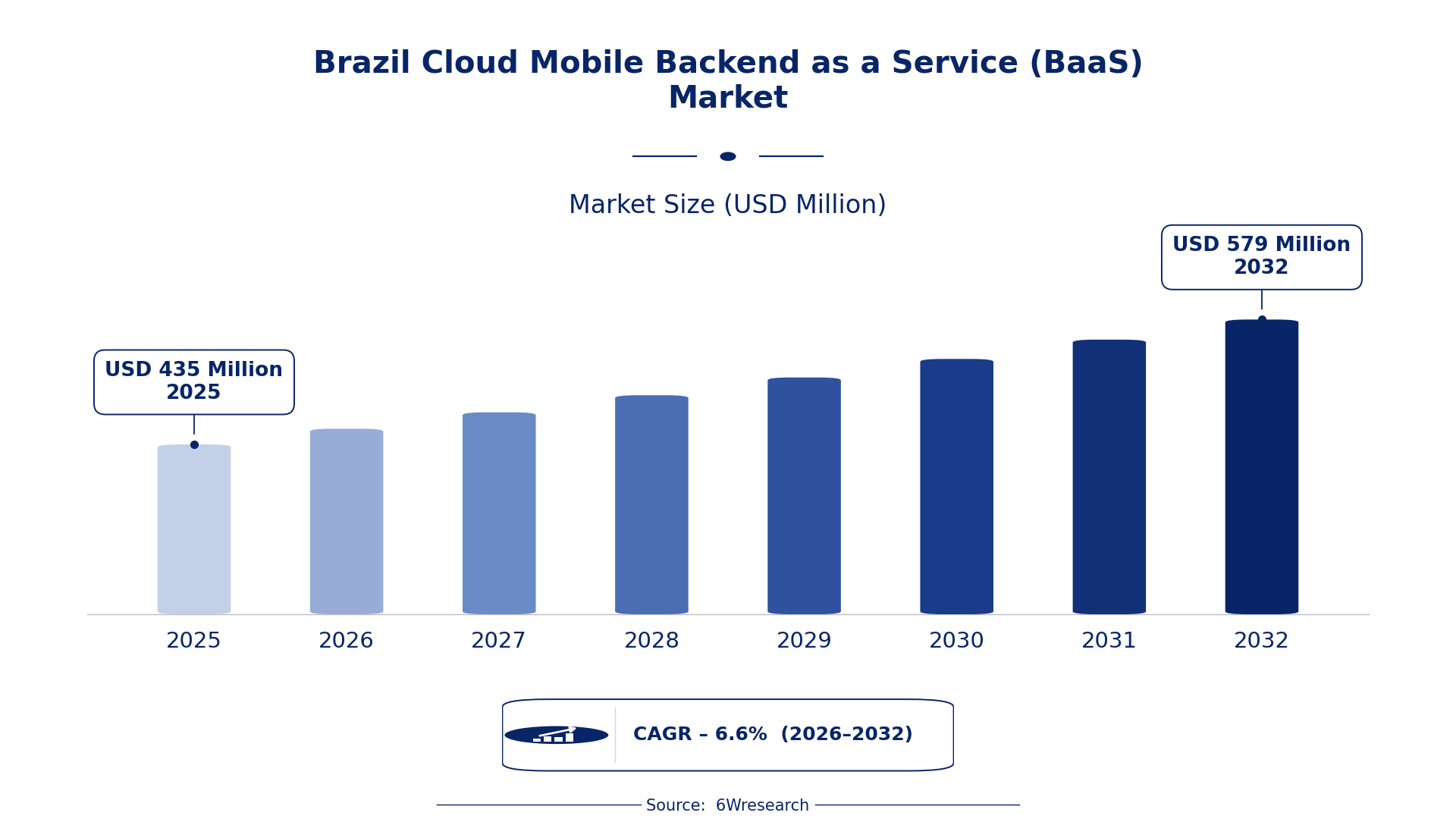
The Brazil Cloud Mobile Backend as a Service (BaaS) Market was estimated at USD 435 Million in 2025 and is projected to reach USD 579 Million by 2032, growing at a CAGR of 6.6% from 2026 to 2032.
Brazil Cloud Mobile Backend as a Service (BaaS) Market Synopsis
The increasing demand for mobile applications is the strongest force shaping the Brazil Cloud Mobile Backend as a Service (BaaS) market right now. As developers strive to create scalable and feature-rich applications, BaaS solutions are becoming indispensable for streamlining backend processes.
In Brazil, the rapid proliferation of mobile devices and evolving consumer expectations are pushing businesses to adopt cloud-based services. These solutions not only enhance user experiences but also allow developers to focus on innovation rather than backend complexities.
Brazil Cloud Mobile Backend as a Service (BaaS) Market Year-wise Growth Rate and Key Drivers
This graph illustrates the annual growth rates of the Brazil Cloud Mobile Backend as a Service (BaaS) Market from 2021 to 2032, highlighting a steady upward trajectory and projected expansion over the forecast period.
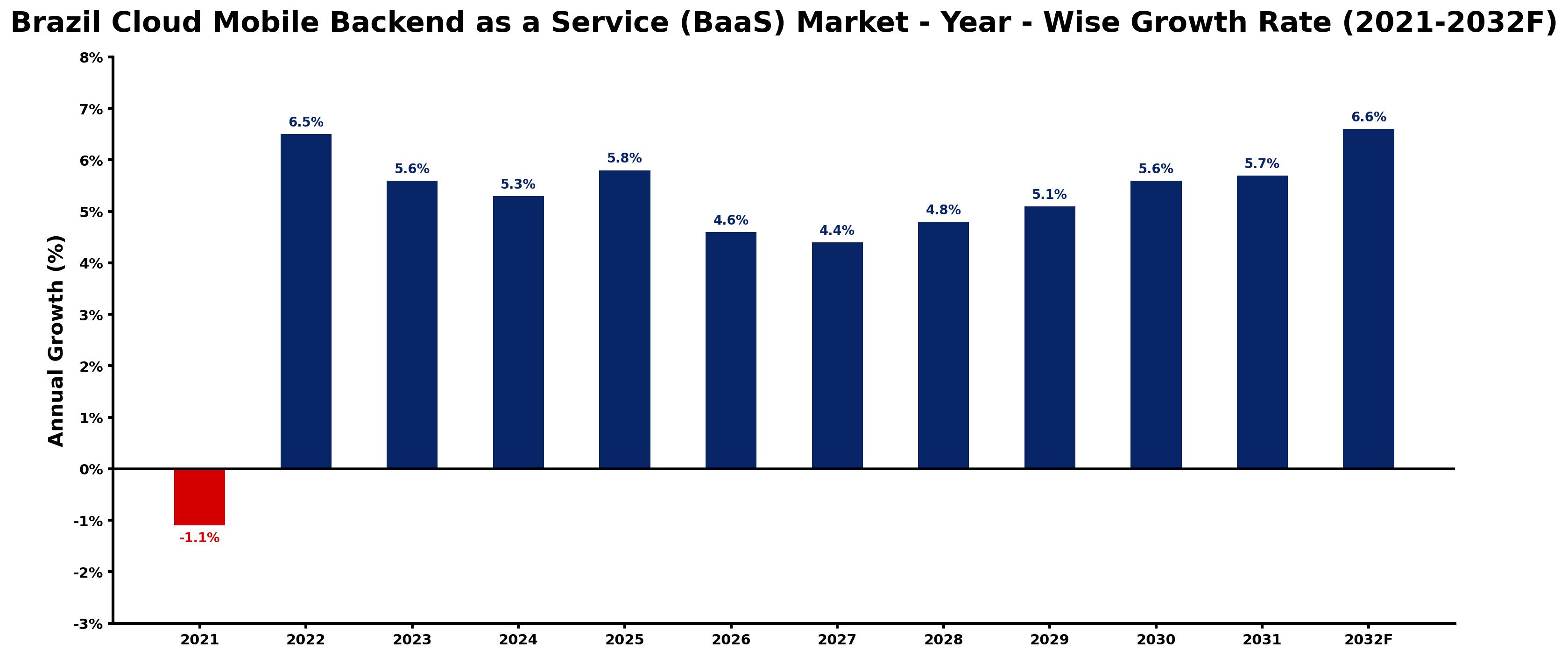
The table below presents the year‑wise growth rates along with the key drivers influencing the market
| Year | Growth Rate | Major Drivers |
| 2021 | -1.1% | Lack of local data centers hindered cloud adoption. |
| 2022 | 6.5% | Increased mobile app development among Brazilian entrepreneurs. |
| 2023 | 5.6% | Rising consumer demand for on-demand streaming services. |
| 2024 | 5.3% | Local tech hubs fostering BaaS innovation collaborations. |
| 2025 | 5.8% | Surge in cloud-native application deployments across Brazil. |
| 2026 | 4.6% | Growing interest in IoT solutions among Brazilian businesses. |
| 2027 | 4.4% | Development of local data protection regulations enhancing BaaS need. |
| 2028 | 4.8% | Investment in digital health applications necessitating backend services. |
| 2029 | 5.1% | Enhanced support from local government for tech incubation. |
| 2030 | 5.6% | Adoption of remote work driving cloud service requirements. |
| 2031 | 5.7% | Expanding urban population increasing mobile usage statistics. |
| 2032 | 6.6% | Technological partnerships boosting BaaS ecosystem in Brazil. |
Note: Market size estimations and growth projections presented in this report are based on 6Wresearch's proprietary forecasting methodology, utilizing the latest available industry data, government publications, and primary research inputs.
Brazil Cloud Mobile Backend as a Service (BaaS) Market Key Takeaways
Below are some of the specific key takeaways from the market, including:
- The demand for BaaS solutions is driven by the need for efficient backend management.
- Data privacy and security concerns continue to challenge BaaS adoption.
- Government initiatives are encouraging the growth of mobile app development.
- Organizations are increasingly focused on compliance with local regulations.
- Integration with existing mobile development frameworks remains a critical need.
Evaluation of Restraints in Brazil Cloud Mobile Backend as a Service (BaaS) Market
Despite the promising growth trajectory, the Brazil Cloud Mobile Backend as a Service (BaaS) market faces notable restraints. Data privacy and security issues are at the forefront, as many mobile apps gather sensitive user information. Additionally, BaaS providers struggle with ensuring smooth integration with various mobile app development frameworks, which can hinder the overall user experience. These challenges necessitate ongoing innovation and adaptation within the sector.
Brazil Cloud Mobile Backend as a Service (BaaS) Market Trends
Emerging trends in the Brazil BaaS market reflect a shift towards enhanced automation and artificial intelligence integration. Developers are increasingly seeking tools that offer advanced analytics and real-time data processing capabilities. on top of that, the rise of microservices architecture is prompting businesses to adopt more modular backend solutions that can scale efficiently. These trends indicate a clear movement towards more flexible and responsive backend services.
Brazil Cloud Mobile Backend as a Service (BaaS) Market Opportunities
There are significant growth opportunities within the Brazil BaaS market. As businesses pivot towards digital transformation, investing in tailored BaaS solutions can drive operational efficiency. on top of that, companies that can navigate compliance with Brazil’s regulatory environment will find a lucrative avenue for expansion. The increasing appetite for innovative mobile applications positions BaaS providers to capture a larger share of the market.
Government Initiatives in the Brazil Cloud Mobile Backend as a Service (BaaS) Market
Government policies in Brazil are actively shaping the Cloud Mobile Backend as a Service (BaaS) market, emphasizing the importance of mobile app development and digital innovation. Regulatory frameworks are being established to bolster security and compliance, making BaaS solutions more attractive for businesses. This supportive environment is crucial for fostering technological advancement and encouraging investment in cloud services.
- A regulatory framework introduced in 2025 mandating data privacy standards for mobile applications.
- A national digital infrastructure upgrade programme now in its rollout phase to enhance connectivity.
- Ongoing initiatives aimed at providing financial incentives for tech startups focusing on mobile app development.
- A planned public-private partnership expected to enhance cloud computing infrastructure by 2028.
Future Insights of the Brazil Cloud Mobile Backend as a Service (BaaS) Market
Looking ahead to 2026-2032, the Brazil Cloud Mobile Backend as a Service (BaaS) market is set to experience substantial growth driven by increasing mobile app adoption across various sectors. Businesses are expected to prioritize agility and innovation, pushing for more advanced BaaS solutions. As cloud technologies continue to evolve, those who can offer tailored services that align with local regulatory requirements will lead the market. The emphasis on data security will also shape future developments, guiding investments and strategic partnerships.
Brazil Cloud Mobile Backend as a Service (BaaS) Market Latest Developments
Recent activity in the Brazil Cloud Mobile Backend as a Service (BaaS) market indicates a growing focus on enhancing service offerings and expanding market presence. Providers are responding to market demands by innovating their platforms and forging strategic partnerships to enhance capabilities.
- An initiative that began in mid-2025 and remains underway to enhance data analytics capabilities in existing BaaS solutions.
- A major technology vendor launched a new suite of tools aimed at simplifying backend integration for developers in early 2025.
- A partnership between two regional operators to improve cloud infrastructure access, expected to be fully operational by late 2025.
- A rollout of advanced security features planned for mid-2026 to address data privacy concerns.
Brazil Cloud Mobile Backend as a Service (BaaS) Market - Key Attractiveness of the Report
- 10 Years of Market Numbers
- Historical Data Starting from 2022 to 2025
- Base Year: 2025
- Forecast Data until 2032
- Key Performance Indicators Impacting the Market
- Major Upcoming Developments and Projects
Key Highlights of the Report:
- Brazil Cloud Mobile Backend as a Service (BaaS) Market Outlook
- Market Size of Brazil Cloud Mobile Backend as a Service (BaaS) Market, 2025
- Forecast of Brazil Cloud Mobile Backend as a Service (BaaS) Market, 2032
- Historical Data and Forecast of Brazil Cloud Mobile Backend as a Service (BaaS) Revenues & Volume for the Period 2022-2032F
- Brazil Cloud Mobile Backend as a Service (BaaS) Market Trend Evolution
- Brazil Cloud Mobile Backend as a Service (BaaS) Market Drivers and Challenges
- Brazil Cloud Mobile Backend as a Service (BaaS) Price Trends
- Brazil Cloud Mobile Backend as a Service (BaaS) Porter's Five Forces
- Brazil Cloud Mobile Backend as a Service (BaaS) Industry Life Cycle
- Historical Data and Forecast of Brazil Cloud Mobile Backend as a Service (BaaS) Market Revenues & Volume By Application for the Period 2022-2032F
- Historical Data and Forecast of Brazil Cloud Mobile Backend as a Service (BaaS) Market Revenues & Volume By Cloud storage and Backup for the Period 2022-2032F
- Historical Data and Forecast of Brazil Cloud Mobile Backend as a Service (BaaS) Market Revenues & Volume By User authentication for the Period 2022-2032F
- Historical Data and Forecast of Brazil Cloud Mobile Backend as a Service (BaaS) Market Revenues & Volume By Database Management for the Period 2022-2032F
- Historical Data and Forecast of Brazil Cloud Mobile Backend as a Service (BaaS) Market Revenues & Volume By Push Notifications for the Period 2022-2032F
- Historical Data and Forecast of Brazil Cloud Mobile Backend as a Service (BaaS) Market Revenues & Volume By Others for the Period 2022-2032F
- Historical Data and Forecast of Brazil Cloud Mobile Backend as a Service (BaaS) Market Revenues & Volume By Platform for the Period 2022-2032F
- Historical Data and Forecast of Brazil Cloud Mobile Backend as a Service (BaaS) Market Revenues & Volume By Android for the Period 2022-2032F
- Historical Data and Forecast of Brazil Cloud Mobile Backend as a Service (BaaS) Market Revenues & Volume By iOS for the Period 2022-2032F
- Historical Data and Forecast of Brazil Cloud Mobile Backend as a Service (BaaS) Market Revenues & Volume By others for the Period 2022-2032F
- Historical Data and Forecast of Brazil Cloud Mobile Backend as a Service (BaaS) Market Revenues & Volume By Vertical for the Period 2022-2032F
- Historical Data and Forecast of Brazil Cloud Mobile Backend as a Service (BaaS) Market Revenues & Volume By BFSI for the Period 2022-2032F
- Historical Data and Forecast of Brazil Cloud Mobile Backend as a Service (BaaS) Market Revenues & Volume By IT and ITeS for the Period 2022-2032F
- Historical Data and Forecast of Brazil Cloud Mobile Backend as a Service (BaaS) Market Revenues & Volume By Manufacturing for the Period 2022-2032F
- Historical Data and Forecast of Brazil Cloud Mobile Backend as a Service (BaaS) Market Revenues & Volume By Healthcare and pharmaceuticals for the Period 2022-2032F
- Historical Data and Forecast of Brazil Cloud Mobile Backend as a Service (BaaS) Market Revenues & Volume By Retail and eCommerce for the Period 2022-2032F
- Historical Data and Forecast of Brazil Cloud Mobile Backend as a Service (BaaS) Market Revenues & Volume By Media, entertainment for the Period 2022-2032F
- Historical Data and Forecast of Brazil Cloud Mobile Backend as a Service (BaaS) Market Revenues & Volume By Gaming for the Period 2022-2032F
- Historical Data and Forecast of Brazil Cloud Mobile Backend as a Service (BaaS) Market Revenues & Volume By Telecommunications for the Period 2022-2032F
- Historical Data and Forecast of Brazil Cloud Mobile Backend as a Service (BaaS) Market Revenues & Volume By Enterprise Size for the Period 2022-2032F
- Historical Data and Forecast of Brazil Cloud Mobile Backend as a Service (BaaS) Market Revenues & Volume By Small and Medium-sized Enterprises (SMEs) for the Period 2022-2032F
- Historical Data and Forecast of Brazil Cloud Mobile Backend as a Service (BaaS) Market Revenues & Volume By Large Enterprises for the Period 2022-2032F
- Brazil Cloud Mobile Backend as a Service (BaaS) Import Export Trade Statistics
- Market Opportunity Assessment By Application
- Market Opportunity Assessment By Platform
- Market Opportunity Assessment By Vertical
- Market Opportunity Assessment By Enterprise Size
- Brazil Cloud Mobile Backend as a Service (BaaS) Top Companies Market Share
- Brazil Cloud Mobile Backend as a Service (BaaS) Competitive Benchmarking By Technical and Operational Parameters
- Brazil Cloud Mobile Backend as a Service (BaaS) Company Profiles
- Brazil Cloud Mobile Backend as a Service (BaaS) Key Strategic Recommendations






































