Brazil Clutch Housing Market Size, Share & Growth Rate
The Brazil Clutch Housing Market was estimated at USD 225 Million in 2025 and is projected to reach USD 267 Million by 2032, growing at a CAGR of 2.5% from 2026 to 2032. This growth trajectory is primarily driven by the burgeoning automotive sector in Brazil, characterized by increasing production and sales of both passenger and commercial vehicles. As manufacturers strive for enhanced performance and reliability, the demand for high-quality clutch housing components is expected to rise significantly.
Brazil Clutch Housing Market Year-wise Growth Rate and Key Drivers
This graph highlights how the Brazil Clutch Housing Market has steadily grown over the years, supported by major growth factors.
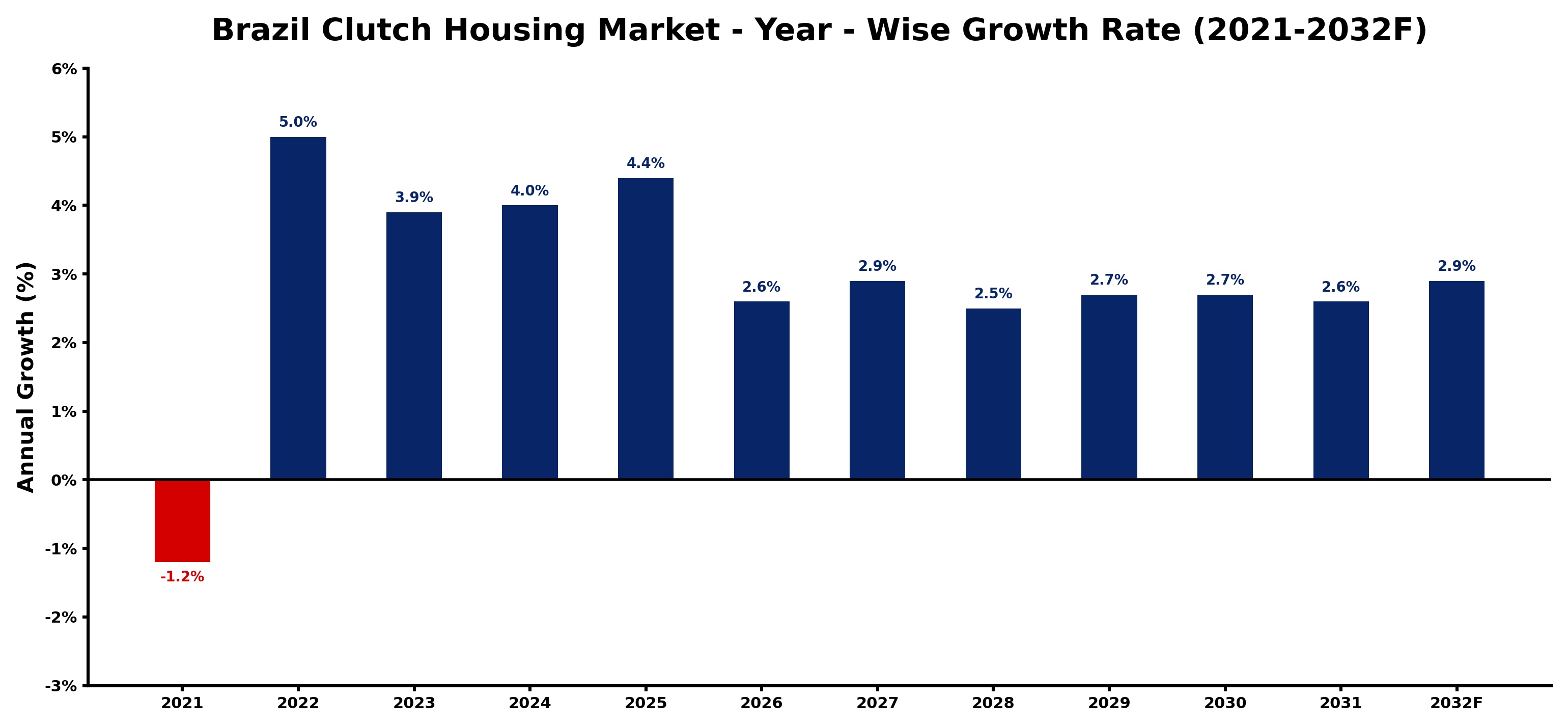
The table below presents the year‑wise growth rates along with the key drivers influencing the market
| Year | Growth Rate | Major Drivers |
| 2021 | -1.2% | Reduced investment in manufacturing infrastructure weakened clutch housing production |
| 2022 | 5.0% | Domestic foundry modernization boosts efficiency in clutch housing production |
| 2023 | 3.9% | Foundry modernization boosted capacity utilization in clutch housing production |
| 2024 | 4.0% | Export driven foundry modernization boosted clutch housing production efficiency |
| 2025 | 4.4% | Foundry modernization drives increased output of clutch housing components |
| 2026 | 2.6% | Foundry modernization drives competitiveness in Brazil's clutch housing production |
| 2027 | 2.9% | Foundry modernization initiatives boost production efficiency for clutch housing |
| 2028 | 2.5% | Foundry modernization projects boost domestic clutch housing production capacity |
| 2029 | 2.7% | Foundry modernization projects enhance domestic clutch housing production efficiency |
| 2030 | 2.7% | Foundry modernization initiatives boosted domestic clutch housing manufacturing capacity |
| 2031 | 2.6% | Local foundries modernized operations, boosting clutch housing production efficiency |
| 2032 | 2.9% | Domestic foundry modernization enhanced efficiency in clutch housing production |
Note - Market size estimations and growth projections presented in this report are based on 6Wresearch’s advanced forecasting approach, validated with industry datasets as of June 2026.
Brazil Clutch Housing Market Synopsis
Recently, the Brazil Clutch Housing Market has experienced considerable momentum, benefiting from a robust automotive industry. However, as market dynamics evolve, there is a need for manufacturers to adapt to technological advancements and changing consumer preferences. This adaptation is crucial for sustaining growth and ensuring product relevance in an increasingly competitive landscape.
Looking ahead, the market is poised for steady growth as manufacturers invest in innovation to meet stringent regulatory demands and consumer expectations. A focus on the durability and sustainability of clutch housing materials is likely to become a significant factor influencing market dynamics in the coming years.
Brazil Clutch Housing Market Key Takeaways
- The Brazil Clutch Housing Market is positioned for consistent growth driven by the automotive sector's expansion.
- Technological advancements in materials and manufacturing processes are critical to meeting market demands.
- Stringent government regulations and environmental standards are shaping product development strategies.
- Research and development investments are essential for manufacturers to remain competitive in this evolving market.
- A growing emphasis on fuel efficiency and eco-friendly materials is influencing consumer preferences.
Evaluation of Restraints in Brazil Clutch Housing Market
Despite the promising outlook, the Brazil Clutch Housing Market faces certain constraints that could hinder its growth. The volatility within the automotive industry poses a risk to steady demand, as market fluctuations can impact production rates and component orders. Moreover, the ongoing shift toward alternative automotive technologies, including electric and hybrid vehicles, introduces competition that may challenge traditional clutch housing products. Manufacturers must continuously innovate to overcome these hurdles and cater to evolving market needs.
Brazil Clutch Housing Market Trends
Several current and emerging trends are shaping the Brazil Clutch Housing Market. Notably, the integration of advanced materials that enhance durability and performance is gaining traction among manufacturers. Additionally, the rise of automated and electric vehicles is creating new opportunities for the development of specialized clutch systems. Furthermore, sustainability is becoming a key focus, with many companies exploring eco-friendly materials and production techniques to meet regulatory requirements and consumer expectations.
Brazil Clutch Housing Market Opportunities
The Brazil Clutch Housing Market offers significant growth and investment opportunities. As the demand for more fuel-efficient and environmentally friendly vehicles continues to rise, manufacturers who adapt to these trends will likely see increased market share. There is also potential for partnerships and collaborations between manufacturers and technology firms focused on innovation in clutch systems. By investing in research and development, companies can create solutions that not only comply with current regulations but also anticipate future market needs.
Government Initiatives in the Brazil Clutch Housing Market
Government policies in Brazil significantly influence the clutch housing market, particularly regulations pertaining to emissions and fuel efficiency. The Brazilian government is actively promoting initiatives to incentivize the automotive industry's shift towards more sustainable practices. These initiatives often include tax incentives for manufacturers utilizing eco-friendly materials and technologies. Consequently, compliance with these regulations is becoming crucial for businesses aiming to thrive in this evolving market landscape.
Future Insights of the Brazil Clutch Housing Market
Looking ahead to 2026-2032, the Brazil Clutch Housing Market is expected to experience gradual yet steady growth. With the automotive sector emphasizing performance and sustainability, manufacturers who embrace innovation and adapt to regulatory changes will be well-positioned for success. Anticipated advancements in clutch technology will likely enhance the efficiency and reliability of automotive components, thereby driving consumer confidence and demand in the years to come.
Brazil Clutch Housing Market Latest Developments (May 2025 - June 2026)
Recent developments in the Brazil Clutch Housing Market indicate a strong push towards technological advancements and sustainable practices. Manufacturers are increasingly investing in new material technologies and innovative production methods. Additionally, industry stakeholders are exploring collaborative ventures aimed at enhancing product performance and reducing environmental impact. As the automotive industry continues to evolve, these developments reflect a commitment to meeting both regulatory standards and consumer expectations.
Brazil Clutch Housing Market - Key Attractiveness of the Report
- 10 Years of Market Numbers
- Historical Data Starting from 2022 to 2025
- Base Year: 2025
- Forecast Data until 2032
- Key Performance Indicators Impacting the Market
- Major Upcoming Developments and Projects
Key Highlights of the Report:
- Brazil Clutch Housing Market Outlook
- Market Size of Brazil Clutch Housing Market, 2025
- Forecast of Brazil Clutch Housing Market, 2032
- Historical Data and Forecast of Brazil Clutch Housing Revenues & Volume for the Period 2022-2032F
- Brazil Clutch Housing Market Trend Evolution
- Brazil Clutch Housing Market Drivers and Challenges
- Brazil Clutch Housing Price Trends
- Brazil Clutch Housing Porter's Five Forces
- Brazil Clutch Housing Industry Life Cycle
- Historical Data and Forecast of Brazil Clutch Housing Market Revenues & Volume By Type for the Period 2022-2032F
- Historical Data and Forecast of Brazil Clutch Housing Market Revenues & Volume By Heavy Clutch Housing for the Period 2022-2032F
- Historical Data and Forecast of Brazil Clutch Housing Market Revenues & Volume By Large Clutch Housing for the Period 2022-2032F
- Historical Data and Forecast of Brazil Clutch Housing Market Revenues & Volume By Small Clutch Housing for the Period 2022-2032F
- Historical Data and Forecast of Brazil Clutch Housing Market Revenues & Volume By Application for the Period 2022-2032F
- Historical Data and Forecast of Brazil Clutch Housing Market Revenues & Volume By OEM(Original Equipment Manufacturers) for the Period 2022-2032F
- Historical Data and Forecast of Brazil Clutch Housing Market Revenues & Volume By Aftermarket for the Period 2022-2032F
- Historical Data and Forecast of Brazil Clutch Housing Market Revenues & Volume By Material Type for the Period 2022-2032F
- Historical Data and Forecast of Brazil Clutch Housing Market Revenues & Volume By Cast Iron for the Period 2022-2032F
- Historical Data and Forecast of Brazil Clutch Housing Market Revenues & Volume By Aluminium for the Period 2022-2032F
- Historical Data and Forecast of Brazil Clutch Housing Market Revenues & Volume By Others for the Period 2022-2032F
- Brazil Clutch Housing Import Export Trade Statistics
- Market Opportunity Assessment By Type
- Market Opportunity Assessment By Application
- Market Opportunity Assessment By Material Type
- Brazil Clutch Housing Top Companies Market Share
- Brazil Clutch Housing Competitive Benchmarking By Technical and Operational Parameters
- Brazil Clutch Housing Company Profiles
- Brazil Clutch Housing Key Strategic Recommendations






































