Brazil Coated Fabric Market Size, Share & Growth Rate
The Brazil Coated Fabric Market was estimated at USD 87 Million in 2025 and is projected to reach USD 103 Million by 2032, growing at a CAGR of 2.4% from 2026 to 2032. This growth is primarily fueled by the rising demand for coated fabrics across critical sectors like automotive, furniture, and fashion, where the need for durability and aesthetic appeal is paramount. Additionally, innovations in coating technologies, such as flame-retardant and water-resistant options, are enhancing the value proposition of coated fabrics, positioning them as an essential component in multiple applications.
Brazil Coated Fabric Market Growth Rate Analysis (2021-2032)
The Brazilian coated fabric market has shown a notable recovery following a decline of 1.6% in 2021, spurred by increased demand across various sectors. By 2022, growth rebounded to 4.9% and continued to show resilience with rates of 4.1% in 2023 and 3.9% in 2024. This upward trend can be attributed to heightened consumer demand driven by industries such as automotive and construction, alongside significant investments in infrastructure and digitalization. Moving forward, while growth rates may moderate to around 2.6% by 2030, the persistent focus on energy transition and innovative technologies suggests a steady market trajectory emanating from evolving industrial needs and adaptability to market dynamics.
Brazil Coated Fabric Market Year-wise Growth Rate and Key Drivers
This graph highlights how the Brazil Coated Fabric Market has steadily grown over the past five years, supported by major growth factors.
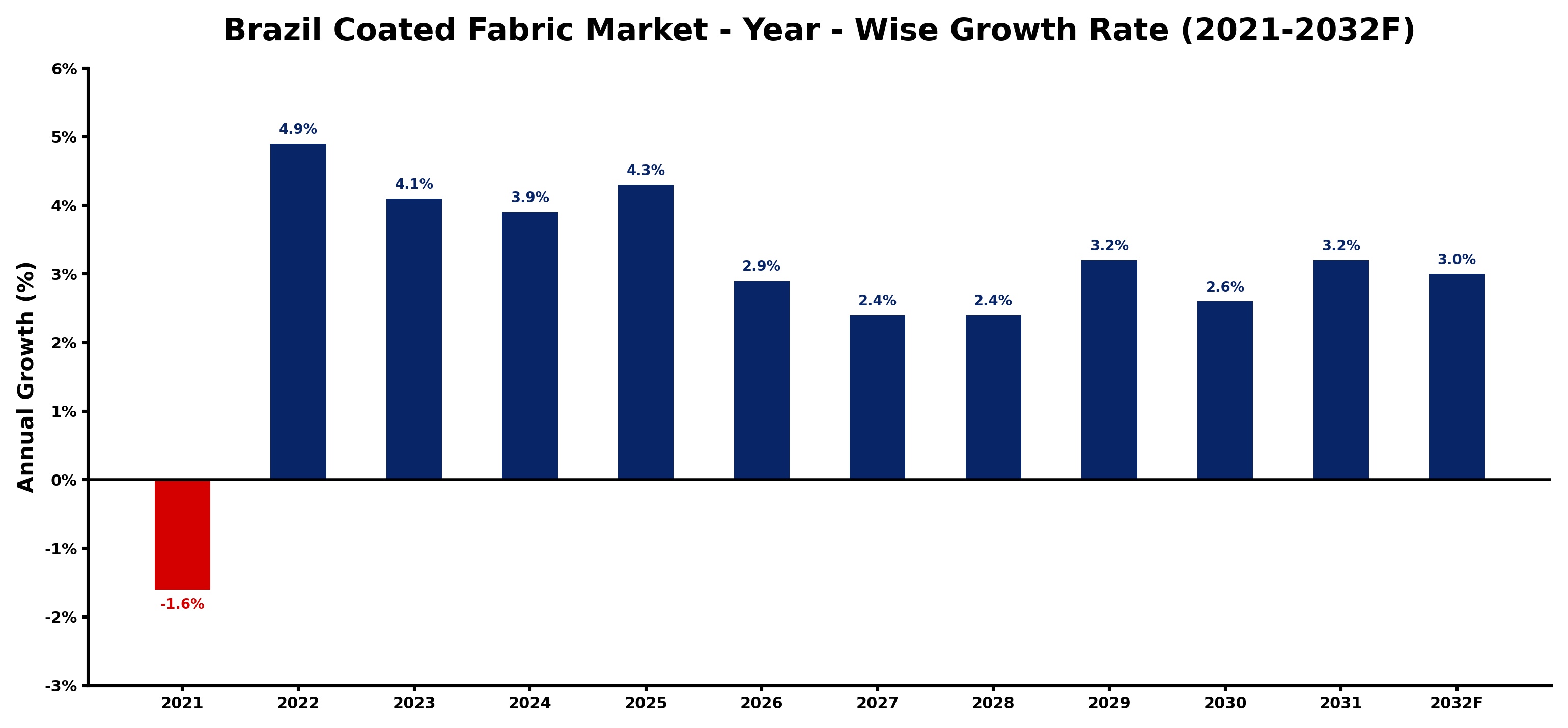
The table below presents the year‑wise growth rates along with the key drivers influencing the market
| Year | Growth Rate | Major Drivers |
| 2021 | -1.6% | Increasing smart city development projects |
| 2022 | 4.9% | Expansion of transportation and logistics networks |
| 2023 | 4.1% | Increasing smart city development projects |
| 2024 | 3.9% | Expansion of transportation and logistics networks |
| 2025 | 4.3% | Expansion of commercial construction activities |
| 2026 | 2.9% | Expansion of manufacturing activities |
| 2027 | 2.4% | Increasing industrial infrastructure investments |
| 2028 | 2.4% | Rising electricity demand across industries |
| 2029 | 3.2% | Increasing industrial infrastructure investments |
| 2030 | 2.6% | Increasing smart city development projects |
| 2031 | 3.2% | Growing urbanization and commercial development |
| 2032 | 3.0% | Expansion of manufacturing activities |
Note - Market size estimations and growth projections presented in this report are based on 6Wresearch’s advanced forecasting approach, validated with industry datasets as of June 2026.
Brazil Coated Fabric Market Synopsis
The most significant force currently shaping the Brazil Coated Fabric Market is the strong demand stemming from the automotive industry. As Brazil continues to strengthen its automotive manufacturing capabilities, coated fabrics play a pivotal role in providing not just functionality but also design elements that appeal to consumers.
In addition to automotive applications, the furniture and fashion sectors are rapidly adopting coated fabrics due to their versatility and enhanced protective qualities. With consumer preferences leaning towards sustainable and innovative materials, companies are increasingly investing in research and development to align their offerings with emerging market trends.
Brazil Coated Fabric Market Key Takeaways
- Substantial growth is expected from 2024 to 2030 due to diverse applications in key industries.
- Innovations in coating technologies significantly enhance product appeal and market potential.
- Strict environmental regulations necessitate sustainable manufacturing practices across the sector.
- The automotive and fashion industries are leading demand drivers within the market.
- Price fluctuations in raw materials present challenges that require strategic management.
Evaluation of Restraints in Brazil Coated Fabric Market
Despite the promising growth trajectory of the Brazil Coated Fabric Market, several restraints are impacting its potential. The volatility in raw material prices can significantly affect production costs, thereby impacting profitability. Furthermore, adherence to stringent quality standards is crucial, as non-compliance can lead to product recalls and reputational damage. Additionally, the need for sustainable manufacturing processes is growing; companies that fail to innovate in this area may find themselves at a competitive disadvantage in a rapidly evolving market landscape.
Brazil Coated Fabric Market Trends
One of the most compelling trends in the Brazil Coated Fabric Market is the increasing focus on sustainability. Consumers and businesses alike are prioritizing eco-friendly materials, prompting manufacturers to explore bio-based coatings and recyclable fabrics. Furthermore, the integration of smart textiles is gaining traction, providing enhanced functionality such as temperature regulation and moisture management, thus broadening the applications of coated fabrics.
Brazil Coated Fabric Market Opportunities
Opportunities in the Brazil Coated Fabric Market lie particularly in sectors that emphasize innovation and sustainability. The rise of electric vehicles and green building initiatives offers substantial potential for coated fabrics designed for specific applications, such as lightweight and durable materials for automotive interiors and eco-friendly upholstery for furniture. By leveraging advancements in technology, manufacturers can unlock new revenue streams and cater to niche markets.
Government Initiatives in the Brazil Coated Fabric Market
The Brazilian government is actively promoting policies aimed at enhancing industrial sustainability and technological innovation. Initiatives designed to support the development of eco-friendly materials are paving the way for growth in the coated fabric sector. Additionally, public spending on infrastructure projects is likely to drive demand for coated fabrics in construction applications, aligning with governmental efforts to boost the economy while adhering to environmental standards.
Future Insights of the Brazil Coated Fabric Market
Looking ahead to the period between 2026 and 2032, the Brazil Coated Fabric Market is expected to continue on its upward trajectory. The interplay of technological advancements and evolving consumer preferences will define future market dynamics. Companies that strategically invest in sustainable practices and innovative coating solutions will likely capture a larger share of the market, positioning themselves advantageously as the demand for quality, performance, and eco-friendly options continues to rise.
Brazil Coated Fabric Market Latest Developments (May 2025 - June 2026)
The coated fabric industry is witnessing a wave of activity, particularly in the realms of technological innovation and sustainability initiatives. Recent developments include enhanced partnerships among manufacturers and research institutions aimed at creating advanced fabric solutions. Moreover, there is an increasing emphasis on green certifications and compliance with environmental regulations, driving manufacturers to adopt more sustainable practices in their production processes.
Brazil Coated Fabric Market - Key Attractiveness of the Report
- 10 Years of Market Numbers
- Historical Data Starting from 2022 to 2025
- Base Year: 2025
- Forecast Data until 2032
- Key Performance Indicators Impacting the Market
- Major Upcoming Developments and Projects
Key Highlights of the Report:
- Brazil Coated Fabric Market Outlook
- Market Size of Brazil Coated Fabric Market, 2025
- Forecast of Brazil Coated Fabric Market, 2032
- Historical Data and Forecast of Brazil Coated Fabric Revenues & Volume for the Period 2022-2032F
- Brazil Coated Fabric Market Trend Evolution
- Brazil Coated Fabric Market Drivers and Challenges
- Brazil Coated Fabric Price Trends
- Brazil Coated Fabric Porter's Five Forces
- Brazil Coated Fabric Industry Life Cycle
- Historical Data and Forecast of Brazil Coated Fabric Market Revenues & Volume By Product for the Period 2022-2032F
- Historical Data and Forecast of Brazil Coated Fabric Market Revenues & Volume By Polymer-coated Fabric for the Period 2022-2032F
- Historical Data and Forecast of Brazil Coated Fabric Market Revenues & Volume By Rubber-coated Fabric for the Period 2022-2032F
- Historical Data and Forecast of Brazil Coated Fabric Market Revenues & Volume By Fabric-backed Wall Coverings for the Period 2022-2032F
- Historical Data and Forecast of Brazil Coated Fabric Market Revenues & Volume By Application for the Period 2022-2032F
- Historical Data and Forecast of Brazil Coated Fabric Market Revenues & Volume By Transportation for the Period 2022-2032F
- Historical Data and Forecast of Brazil Coated Fabric Market Revenues & Volume By Protective Clothing for the Period 2022-2032F
- Historical Data and Forecast of Brazil Coated Fabric Market Revenues & Volume By Industrial for the Period 2022-2032F
- Historical Data and Forecast of Brazil Coated Fabric Market Revenues & Volume By Roofing, Awnings & Canopies for the Period 2022-2032F
- Historical Data and Forecast of Brazil Coated Fabric Market Revenues & Volume By Furniture & Seating for the Period 2022-2032F
- Historical Data and Forecast of Brazil Coated Fabric Market Revenues & Volume By Others for the Period 2022-2032F
- Brazil Coated Fabric Import Export Trade Statistics
- Market Opportunity Assessment By Product
- Market Opportunity Assessment By Application
- Brazil Coated Fabric Top Companies Market Share
- Brazil Coated Fabric Competitive Benchmarking By Technical and Operational Parameters
- Brazil Coated Fabric Company Profiles
- Brazil Coated Fabric Key Strategic Recommendations






































