Brazil Coffee Beans Market Summary
The brazil coffee beans market was estimated at USD 500 Million in 2025 and is projected to reach USD 597 Million by 2032, growing at a CAGR of 2.8% from 2026 to 2032.
Brazil Coffee Beans Market Year-wise Growth Rate and Key Drivers
This graph highlights how the Brazil Coffee Beans Market has steadily grown over the past five years, supported by major growth factors.
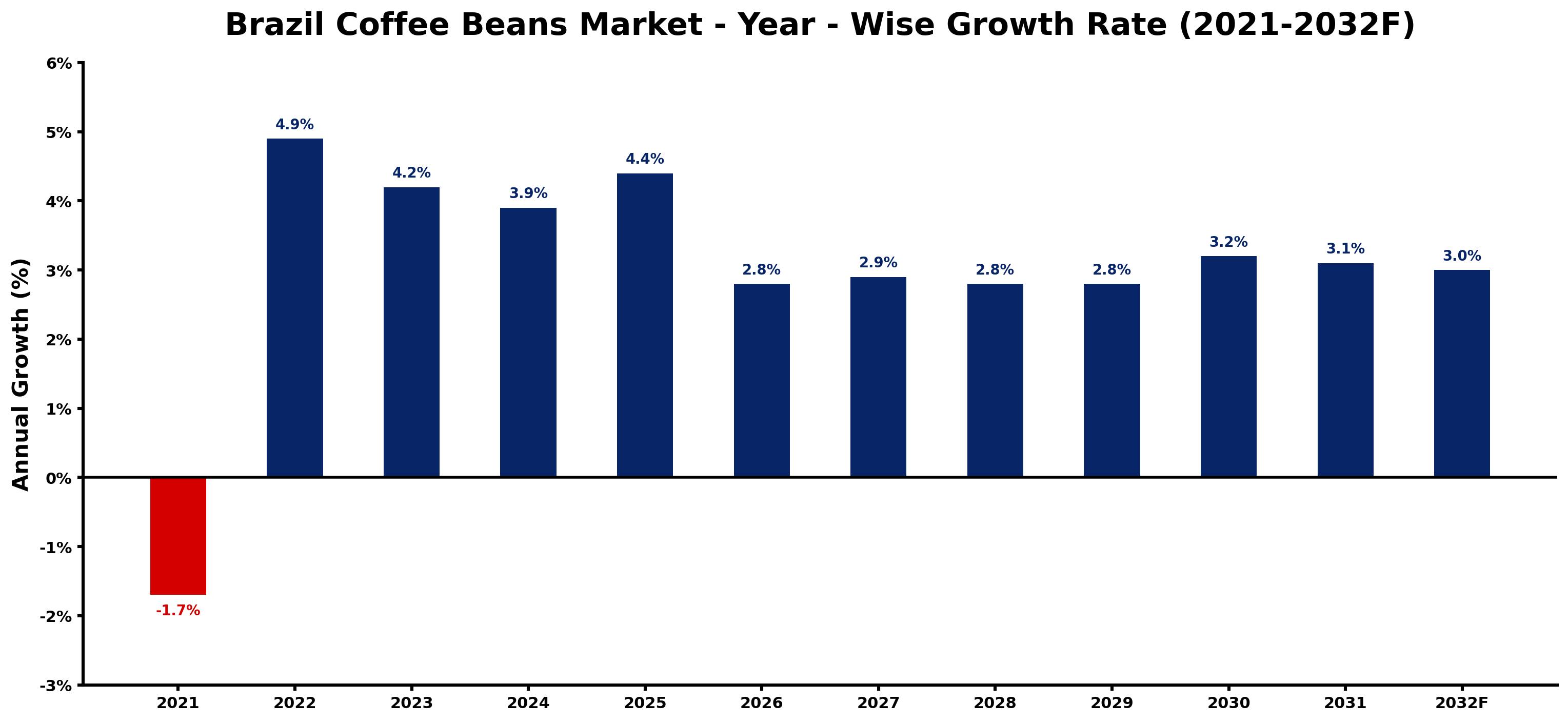
The table below presents the year wise growth rates along with the key drivers influencing the market
| Year | Growth Rate | Major Drivers |
| 2021 | -1.7% | Unfavorable weather conditions severely impacted crop yields, leading to supply shortages and rising prices. |
| 2022 | 4.9% | Emerging consumer preferences for specialty coffee stimulate local production investments and innovations. |
| 2023 | 4.2% | Sustainable farming practices attract environmentally conscious consumers willing to pay premium prices. |
| 2024 | 3.9% | Urbanization trends shift Brazilian coffee consumption towards convenient point-of-sale options. |
| 2025 | 4.4% | Technological advancements in coffee processing enhance quality and efficiency for local farmers. |
| 2026 | 2.8% | E-commerce platforms enable small-scale producers to reach international markets directly. |
| 2027 | 2.9% | Collaborative efforts among cooperatives improve supply chain transparency and quality control. |
| 2028 | 2.8% | Regional coffee festivals gain popularity, showcasing Brazilian varieties and boosting local tourism. |
| 2029 | 2.8% | Growing health consciousness leads consumers to favor organic and fair-trade coffee products. |
| 2030 | 3.2% | Global coffee price fluctuations prompt Brazilian farmers to diversify their crop selections. |
| 2031 | 3.1% | Increased investment in research and development enhances Brazil's competitive edge in coffee genetics. |
| 2032 | 3.0% | Collaborations between universities and industry players drive innovative coffee cultivation techniques. |
Note - Market size estimations and growth projections presented in this report are based on 6Wresearch's advanced forecasting approach, validated with industry datasets as of June 2026.
Brazil Coffee Beans Market Synopsis
The Brazil Coffee Beans Market is projected to reach 2.8% and witness significant growth during the forecast period (2026-2032). This expansion is primarily driven by rising disposable incomes, an increasing trend towards health consciousness, and a growing demand for specialty coffees. The unique attributes of Brazilian coffee, renowned for its quality and flavor, are aligning perfectly with consumer preferences, further propelling the market. Additionally, ongoing initiatives by the government aimed at enhancing the specialty coffee industry have made notable contributions to this growth. Urbanization and evolving lifestyle patterns are also significantly influencing consumption habits across various demographics in Brazil.
Brazil Coffee Beans Market Growth Drivers
The growth trajectory of the Brazil Coffee Beans Market is underpinned by several key drivers:
- Increasing disposable incomes among Brazilian consumers have led to heightened expenditure on high-quality coffee products, particularly specialty varieties that offer unique flavor profiles.
- The rising health consciousness among consumers has been linked to a growing preference for coffee due to its perceived health benefits, including antioxidants and cognitive enhancements.
- Government initiatives aimed at promoting the specialty coffee sector have provided essential funding and resources that help local farmers improve production quality and diversify offerings.
- An upward trend in urbanization is influencing coffee consumption, with consumers in urban areas seeking convenient access to premium coffee options, thereby boosting market demand.
- Improvements in production processes, especially concerning quality control and sustainable practices, have increased yields, enabling exporters to gain a competitive edge in the global market.
Brazil Coffee Beans Market Trends and Opportunities
The Brazil Coffee Beans Market is currently experiencing several notable trends:
- There is a rising trend towards artisanal and specialty coffee, which is creating opportunities for small-scale producers to thrive in niche markets.
- Consumer preferences are shifting towards organic and sustainably produced coffee, providing a platform for farmers utilizing eco-friendly practices to differentiate their products.
- Digital platforms and e-commerce are emerging as important channels for coffee distribution, enabling producers to reach a broader audience and cater to changing consumer buying behaviors.
- Innovative brewing technologies and coffee experiences, such as cold brew and nitro coffee, are growing in popularity, appealing to younger consumers seeking diverse coffee experiences.
- Collaboration between local farmers and global distributors is on the rise, facilitating knowledge transfer and better market access for Brazilian coffee producers.
Brazil Coffee Beans Market Government Investment and Initiatives
The Brazilian government has been proactive in fostering growth within the coffee beans market through various investment initiatives and policies:
- Government programs focused on improving agricultural practices have been key in ensuring higher quality output and sustainability, creating an environment conducive for specialty coffee growth.
- Financial incentives and subsidies for producers who adopt environmentally friendly practices are being implemented to encourage sustainable cultivation methods.
- The establishment of research institutions dedicated to coffee production aims to innovate and enhance quality control measures across the sector.
- Public spending on infrastructure enhancements, particularly in rural areas where coffee farming predominates, is making a significant impact on logistics and market accessibility.
- Collaboration with international organizations to promote Brazilian coffee on a global scale has been prioritized, enhancing the market's visibility and export potential.
Brazil Coffee Beans Market Latest Developments (May 2025 - June 2026)
Recent developments in the Brazil Coffee Beans Market highlight a dynamic industry adapting to global trends:
- Efforts to diversify coffee cultivars continue, with a focus on sustaining quality amidst climate change challenges affecting coffee production.
- Collaborative projects between farmers and research institutions have been initiated, focusing on developing improved pest-resistant coffee plants that can thrive under varying conditions.
- Increased consumer interest in traceability has led to several initiatives aimed at promoting transparency in sourcing and production, enhancing consumer trust in Brazilian coffee products.
- The specialty coffee sector has seen advancements in marketing strategies, with producers engaging in storytelling to highlight their unique processes and the heritage of their coffee.
- Emergence of local coffee events and festivals has been noted, fostering community engagement and further promoting Brazilian coffee culture on both regional and international stages.
Brazil Coffee Beans Market - Key Attractiveness of the Report
- 10 Years of Market Numbers
- Historical Data Starting from 2022 to 2025
- Base Year: 2025
- Forecast Data until 2032
- Key Performance Indicators Impacting the Market
- Major Upcoming Developments and Projects
Key Highlights of the Report:
- Brazil Coffee Beans Market Outlook
- Market Size of Brazil Coffee Beans Market, 2025
- Forecast of Brazil Coffee Beans Market, 2032F
- Historical Data and Forecast of Brazil Coffee Beans Revenues & Volume for the Period 2022-2032F
- Brazil Coffee Beans Market Trend Evolution
- Brazil Coffee Beans Market Drivers and Challenges
- Brazil Coffee Beans Price Trends
- Brazil Coffee Beans Porter's Five Forces
- Brazil Coffee Beans Industry Life Cycle
- Historical Data and Forecast of Brazil Coffee Beans Market Revenues & Volume By Product Type for the Period 2022-2032F
- Historical Data and Forecast of Brazil Coffee Beans Market Revenues & Volume By Arabica for the Period 2022-2032F
- Historical Data and Forecast of Brazil Coffee Beans Market Revenues & Volume By Robusta for the Period 2022-2032F
- Historical Data and Forecast of Brazil Coffee Beans Market Revenues & Volume By Others for the Period 2022-2032F
- Historical Data and Forecast of Brazil Coffee Beans Market Revenues & Volume By Applications for the Period 2022-2032F
- Historical Data and Forecast of Brazil Coffee Beans Market Revenues & Volume By Personal Care for the Period 2022-2032F
- Historical Data and Forecast of Brazil Coffee Beans Market Revenues & Volume By Food for the Period 2022-2032F
- Historical Data and Forecast of Brazil Coffee Beans Market Revenues & Volume By Pharmaceutical for the Period 2022-2032F
- Brazil Coffee Beans Import Export Trade Statistics
- Market Opportunity Assessment By Product Type
- Market Opportunity Assessment By Applications
- Brazil Coffee Beans Top Companies Market Share
- Brazil Coffee Beans Competitive Benchmarking By Technical and Operational Parameters
- Brazil Coffee Beans Company Profiles
- Brazil Coffee Beans Key Strategic Recommendations






































