Brazil Computer Software Market Size, Share & Growth Rate
The Brazil Computer Software Market was estimated at USD 131 Million in 2025 and is projected to reach USD 156 Million by 2032, growing at a CAGR of 2.5% from 2026 to 2032. This growth trajectory is largely propelled by the accelerated digital transformation efforts across Brazilian industries, where organizations increasingly recognize the importance of innovative software solutions to enhance operational efficiency. Furthermore, the rise in cloud computing adoption and the demand for tailored software solutions to meet specific industry needs are solidifying the market's foundation.
Brazil Computer Software Market Year-wise Growth Rate and Key Drivers
This graph highlights how the Brazil Computer Software Market has steadily grown over the years, supported by major growth factors.
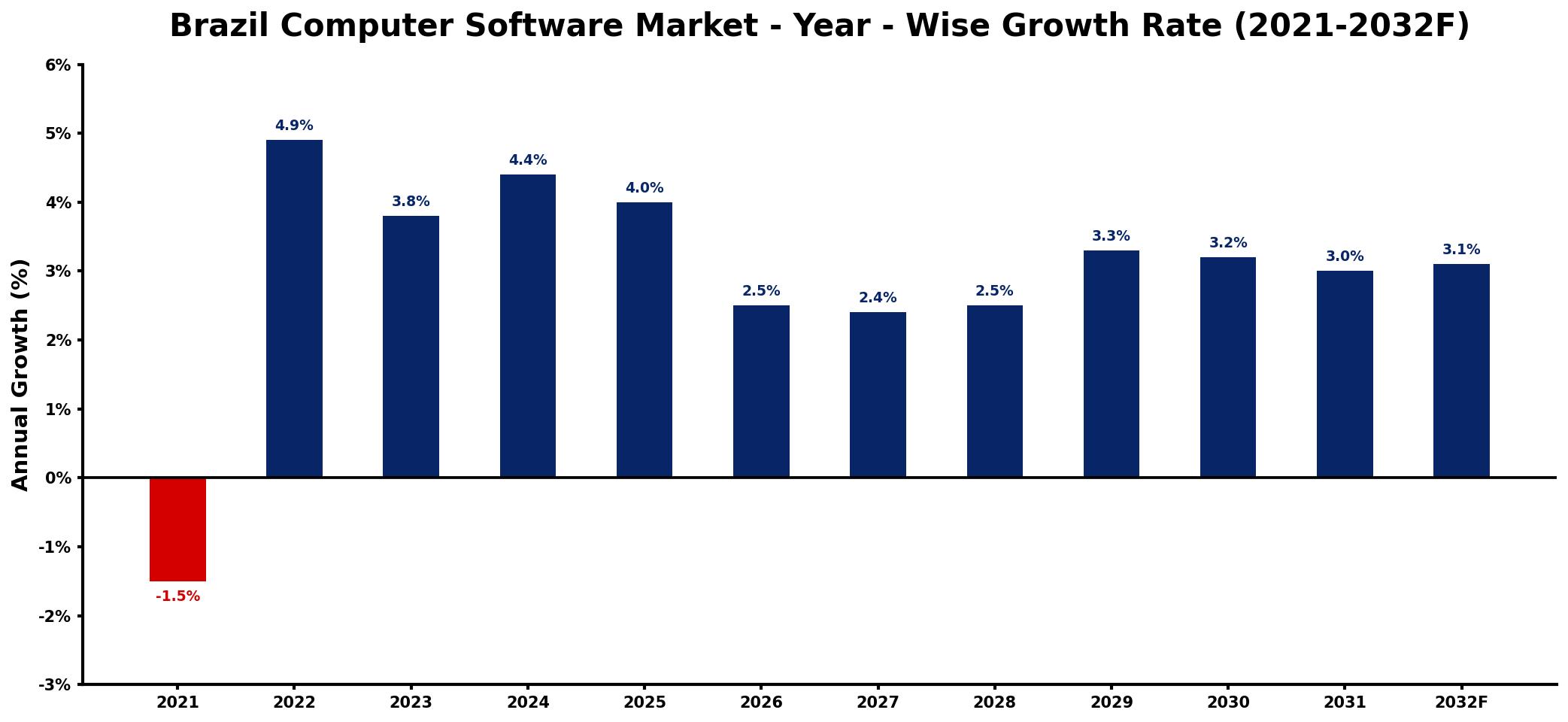
The table below presents the year‑wise growth rates along with the key drivers influencing the market
| Year | Growth Rate | Major Drivers |
| 2021 | -1.5% | decreased demand for technology investments |
| 2022 | 4.9% | increased digital transformation initiatives |
| 2023 | 3.8% | expansion in cloud computing adoption |
| 2024 | 4.4% | growth in e-commerce platforms usage |
| 2025 | 4.0% | rising cybersecurity investments across sectors |
| 2026 | 2.5% | enhanced automation in business processes |
| 2027 | 2.4% | increased pharmaceutical industry usage |
| 2028 | 2.5% | increased mobile application development |
| 2029 | 3.3% | growing interest in artificial intelligence |
| 2030 | 3.2% | expansion of remote work technologies |
| 2031 | 3.0% | increased integration of IoT systems |
| 2032 | 3.1% | growing downstream application demand |
Note: Market size estimations and growth projections presented in this report are based on 6Wresearch's proprietary forecasting methodology, utilizing the latest available industry data, government publications, and primary research inputs.
Brazil Computer Software Market Synopsis
The strongest force currently shaping the Brazil Computer Software Market is the widespread push towards digital transformation. Businesses are increasingly seeking advanced software solutions, such as enterprise resource planning (ERP) and customer relationship management (CRM) systems, to optimize their processes and improve customer engagement.
Additionally, the growing prevalence of mobile applications and cybersecurity software is significantly impacting market dynamics. As consumers and businesses alike become more connected, the demand for robust and versatile software solutions continues to surge, presenting both challenges and opportunities for developers in this vibrant market.
Brazil Computer Software Market Key Takeaways
- The market is experiencing steady growth, driven by digital transformation and industry-specific software solutions.
- Cloud computing and SaaS models are redefining how businesses approach software procurement and usage.
- Government initiatives aimed at promoting digitalization are further catalyzing market expansion.
- Cybersecurity remains a critical focus area as businesses face increasing threats.
- Emerging technologies such as AI and blockchain are set to revolutionize software applications across sectors.
Evaluation of Restraints in Brazil Computer Software Market
Despite its growth potential, the Brazil Computer Software Market faces several restraints that may hinder progress. One significant challenge is the prevalence of software piracy, which not only affects revenue streams but also diminishes incentives for software innovation. Furthermore, cybersecurity threats pose a serious risk, as businesses become more dependent on digital solutions. Rapidly evolving technology trends can lead to compatibility issues and user dissatisfaction, adding another layer of complexity for software developers in the region. Lastly, competition from international providers can challenge local companies to continuously innovate and offer competitive solutions.
Brazil Computer Software Market Trends
Current trends in the Brazil Computer Software Market indicate a strong shift towards Software-as-a-Service (SaaS) models, allowing businesses to access software solutions without the need for substantial upfront investment. Additionally, there is a significant focus on integrating artificial intelligence and machine learning capabilities into existing applications, enhancing automation and data analytics. Cloud-based solutions are also gaining traction, as they provide flexibility and scalability, addressing the diverse needs of various industries.
Brazil Computer Software Market Opportunities
The Brazil Computer Software Market presents considerable growth opportunities, particularly in sectors such as healthcare, finance, and logistics. Custom software development tailored to meet specific industry requirements is an area ripe for investment. Furthermore, as businesses seek to improve their cybersecurity measures, there is a growing demand for advanced cybersecurity solutions. The integration of AI and blockchain technologies will also open new avenues for innovation, positioning companies that embrace these technologies for long-term success.
Government Initiatives in the Brazil Computer Software Market
The Brazilian government is actively promoting digitalization through various policies and initiatives aimed at enhancing the software ecosystem. Regulatory measures concerning intellectual property rights and data privacy are being strengthened to ensure compliance and protect consumer interests. Additionally, government-backed programs that support innovation in technology and software development are emerging, providing incentives for businesses to invest in new solutions while fostering a more secure and competitive market environment.
Future Insights of the Brazil Computer Software Market
Looking ahead to the years 2026-2032, the Brazil Computer Software Market is poised for continued growth driven by the ongoing digital transformation across industries. Companies will increasingly focus on developing integrated, user-friendly solutions that cater to evolving consumer demands. As technologies like AI and blockchain mature, we can anticipate enhanced software capabilities that will further disrupt traditional business models. The collaborative nature of software development, alongside government support for innovation, will ensure a dynamic and competitive market landscape moving forward.
Brazil Computer Software Market Latest Developments (2025 - 2026)
Recent trends in the Brazil Computer Software Market have seen a notable increase in collaborations between tech companies and educational institutions aimed at fostering a skilled workforce. Public and private sectors are increasingly recognizing the need for a robust pipeline of talent as digital skills become essential. Furthermore, various initiatives focused on enhancing cybersecurity measures are gaining traction, driven by the heightened awareness of data protection among businesses and consumers alike.
Brazil Computer Software Market - Key Attractiveness of the Report
- 10 Years of Market Numbers
- Historical Data Starting from 2022 to 2025
- Base Year: 2025
- Forecast Data until 2032
- Key Performance Indicators Impacting the Market
- Major Upcoming Developments and Projects
Key Highlights of the Report:
- Brazil Computer Software Market Outlook
- Market Size of Brazil Computer Software Market, 2025
- Forecast of Brazil Computer Software Market, 2032
- Historical Data and Forecast of Brazil Computer Software Revenues & Volume for the Period 2022-2032F
- Brazil Computer Software Market Trend Evolution
- Brazil Computer Software Market Drivers and Challenges
- Brazil Computer Software Price Trends
- Brazil Computer Software Porter's Five Forces
- Brazil Computer Software Industry Life Cycle
- Historical Data and Forecast of Brazil Computer Software Market Revenues & Volume By Type for the Period 2022-2032F
- Historical Data and Forecast of Brazil Computer Software Market Revenues & Volume By Operating Systems & Productivity Software Publishing for the Period 2022-2032F
- Historical Data and Forecast of Brazil Computer Software Market Revenues & Volume By Database, Storage & Backup Software Publishing for the Period 2022-2032F
- Historical Data and Forecast of Brazil Computer Software Market Revenues & Volume By Business Analytics & Enterprise Software for the Period 2022-2032F
- Historical Data and Forecast of Brazil Computer Software Market Revenues & Volume By Video Game Software for the Period 2022-2032F
- Historical Data and Forecast of Brazil Computer Software Market Revenues & Volume By Design for the Period 2022-2032F
- Historical Data and Forecast of Brazil Computer Software Market Revenues & Volume By Editing & Rendering Software for the Period 2022-2032F
- Historical Data and Forecast of Brazil Computer Software Market Revenues & Volume By Application for the Period 2022-2032F
- Historical Data and Forecast of Brazil Computer Software Market Revenues & Volume By Personal for the Period 2022-2032F
- Historical Data and Forecast of Brazil Computer Software Market Revenues & Volume By Business/Commercial for the Period 2022-2032F
- Historical Data and Forecast of Brazil Computer Software Market Revenues & Volume By Industrial for the Period 2022-2032F
- Historical Data and Forecast of Brazil Computer Software Market Revenues & Volume By Industry Verticals for the Period 2022-2032F
- Historical Data and Forecast of Brazil Computer Software Market Revenues & Volume By BFSI for the Period 2022-2032F
- Historical Data and Forecast of Brazil Computer Software Market Revenues & Volume By Media & Entertainment for the Period 2022-2032F
- Historical Data and Forecast of Brazil Computer Software Market Revenues & Volume By IT & Telecommunications for the Period 2022-2032F
- Historical Data and Forecast of Brazil Computer Software Market Revenues & Volume By Energy & Utilities for the Period 2022-2032F
- Historical Data and Forecast of Brazil Computer Software Market Revenues & Volume By Government & Public Sector for the Period 2022-2032F
- Historical Data and Forecast of Brazil Computer Software Market Revenues & Volume By Retail & Consumer Goods for the Period 2022-2032F
- Historical Data and Forecast of Brazil Computer Software Market Revenues & Volume By Manufacturing for the Period 2022-2032F
- Historical Data and Forecast of Brazil Computer Software Market Revenues & Volume By Others for the Period 2022-2032F
- Brazil Computer Software Import Export Trade Statistics
- Market Opportunity Assessment By Type
- Market Opportunity Assessment By Application
- Market Opportunity Assessment By Industry Verticals
- Brazil Computer Software Top Companies Market Share
- Brazil Computer Software Competitive Benchmarking By Technical and Operational Parameters
- Brazil Computer Software Company Profiles
- Brazil Computer Software Key Strategic Recommendations






































