Brazil Concrete Aggregate Market Size, Share & Growth Rate
The Brazil Concrete Aggregate Market was estimated at USD 85 Million in 2025 and is projected to reach USD 101 Million by 2032, growing at a CAGR of 2.5% from 2026 to 2032. This anticipated growth trajectory is underpinned by significant investment in infrastructure, coupled with the accelerating pace of urbanization across the nation. As Brazil continues to enhance its construction capabilities, the demand for high-quality aggregates, such as sand, gravel, and crushed stone, will play a pivotal role in supporting ambitious projects in transportation and urban development.
Brazil Concrete Aggregate Market Year-wise Growth Rate and Key Drivers
This graph highlights how the Brazil Concrete Aggregate Market has steadily grown over the years, supported by major growth factors.
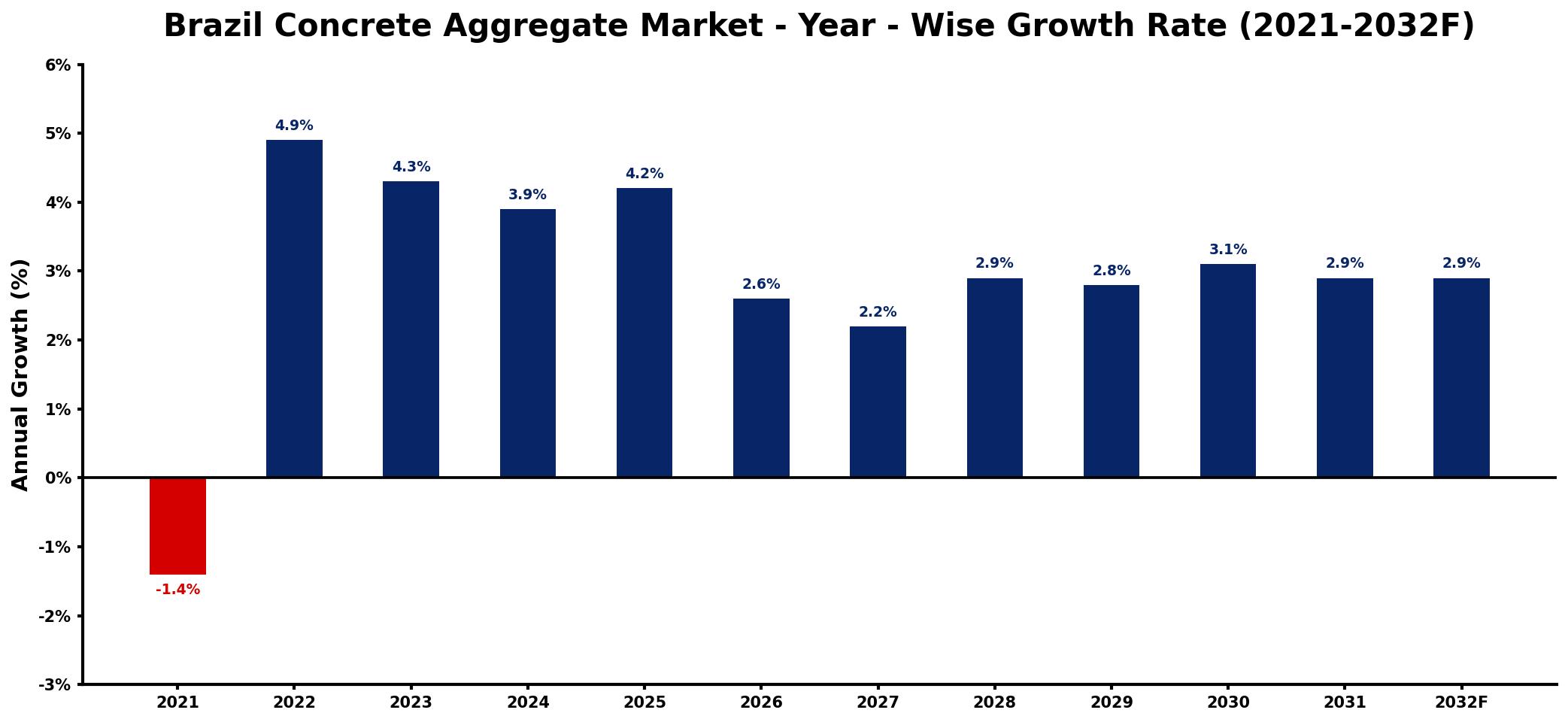
The table below presents the year‑wise growth rates along with the key drivers influencing the market
| Year | Growth Rate | Major Drivers |
| 2021 | -1.4% | construction activity faced downturn |
| 2022 | 4.9% | infrastructure projects gained momentum |
| 2023 | 4.3% | renewable energy investments increased |
| 2024 | 3.9% | urban development projects expanded rapidly |
| 2025 | 4.2% | government funding for infrastructure |
| 2026 | 2.6% | residential sector saw growth |
| 2027 | 2.2% | commercial construction activity rose |
| 2028 | 2.9% | transportation networks underwent upgrades |
| 2029 | 2.8% | expanding manufacturing base activity |
| 2030 | 3.1% | sustainability initiatives gained traction |
| 2031 | 2.9% | regional development projects advanced |
| 2032 | 2.9% | technological innovations enhanced efficiency |
Note: Market size estimations and growth projections presented in this report are based on 6Wresearch's proprietary forecasting methodology, utilizing the latest available industry data, government publications, and primary research inputs.
Brazil Concrete Aggregate Market Synopsis
Recently, the Brazilian concrete aggregate market has experienced a surge in activity, fueled by government initiatives and private sector investments aimed at improving infrastructure. However, as the nation navigates towards a more sustainable model, a shift in focus towards responsible sourcing and environmental conservation is becoming increasingly critical.
Looking ahead, the market is poised for steady growth as urban development projects gain momentum, reflecting the larger economic strategies of Brazil. This evolving landscape presents both challenges and opportunities that will shape the dynamics of the concrete aggregate supply chain.
Brazil Concrete Aggregate Market Key Takeaways
- The market is experiencing a notable uptrend, driven by the construction and infrastructure sectors.
- Demand for concrete aggregates is anticipated to rise significantly due to urbanization trends.
- Sustainable practices are becoming paramount in the extraction and processing of aggregates.
- Government regulations significantly influence operational standards and product quality.
- Environmental sustainability is increasingly impacting operational strategies within the market.
Evaluation of Restraints in Brazil Concrete Aggregate Market
Despite the optimistic growth projections, the Brazil Concrete Aggregate market faces several restraints that could hinder its potential. Environmental concerns surrounding quarrying activities and the associated land use regulations pose significant challenges. Additionally, transportation logistics can complicate the supply chain, particularly in remote areas where infrastructure may not yet be fully developed. These factors necessitate a concerted effort towards sustainable sourcing practices that prioritize environmental stewardship while addressing community concerns and resource management.
Brazil Concrete Aggregate Market Trends
Current trends indicate a strong pivot towards sustainable construction practices, where concrete aggregates sourced responsibly are gaining favor among builders and contractors. Furthermore, advancements in technology are streamlining the processing and delivery of aggregates, enabling more efficient operations. As demand for eco-friendly construction materials increases, recycled aggregates are likely to play a more significant role in the market, aligning with broader sustainability goals.
Brazil Concrete Aggregate Market Opportunities
The Brazil Concrete Aggregate market presents several investment opportunities, particularly in sustainable extraction technologies and alternative materials. As municipalities seek to meet ambitious infrastructure goals, there is ample room for innovative solutions that prioritize environmental and social governance. Companies that can adapt to these shifts, while enhancing operational efficiencies, are likely to capitalize on the burgeoning demand for quality aggregates.
Government Initiatives in the Brazil Concrete Aggregate Market
The Brazilian government has implemented various initiatives aimed at boosting infrastructure development while ensuring adherence to environmental standards. Policies governing the extraction and processing of concrete aggregates are set to evolve, reflecting the need for improved sustainability practices. Additionally, increased public spending on transportation and urban development projects indicates a robust pipeline for demand in the aggregates sector, driving growth and modernization across the industry.
Future Insights of the Brazil Concrete Aggregate Market
As the Brazil Concrete Aggregate market progresses toward 2032, it is expected to evolve in alignment with global sustainability trends and local development needs. The demand for high-quality aggregates will remain strong, particularly as urban areas expand and infrastructure projects ramp up. Companies that prioritize innovative practices in aggregate sourcing and processing will likely find themselves well-positioned in a competitive landscape that increasingly values environmental responsibility and community engagement.
Brazil Concrete Aggregate Market Latest Developments (2025 - 2026)
In the latest phase of market development, significant shifts are occurring as companies adapt to increased regulatory oversight and environmental standards. There's a growing emphasis on collaborative efforts between industry stakeholders and local governments to ensure sustainable practices are integrated into aggregate extraction processes. Moreover, advancements in technology are enabling more efficient operations, paving the way for improved logistics and supply chain management.
Brazil Concrete Aggregate Market - Key Attractiveness of the Report
- 10 Years of Market Numbers
- Historical Data Starting from 2022 to 2025
- Base Year: 2025
- Forecast Data until 2032
- Key Performance Indicators Impacting the Market
- Major Upcoming Developments and Projects
Key Highlights of the Report:
- Brazil Concrete Aggregate Market Outlook
- Market Size of Brazil Concrete Aggregate Market, 2025
- Forecast of Brazil Concrete Aggregate Market, 2032
- Historical Data and Forecast of Brazil Concrete Aggregate Revenues & Volume for the Period 2022-2032F
- Brazil Concrete Aggregate Market Trend Evolution
- Brazil Concrete Aggregate Market Drivers and Challenges
- Brazil Concrete Aggregate Price Trends
- Brazil Concrete Aggregate Porter's Five Forces
- Brazil Concrete Aggregate Industry Life Cycle
- Historical Data and Forecast of Brazil Concrete Aggregate Market Revenues & Volume By Production for the Period 2022-2032F
- Historical Data and Forecast of Brazil Concrete Aggregate Market Revenues & Volume By Natural for the Period 2022-2032F
- Historical Data and Forecast of Brazil Concrete Aggregate Market Revenues & Volume By Artificial for the Period 2022-2032F
- Historical Data and Forecast of Brazil Concrete Aggregate Market Revenues & Volume By Processed for the Period 2022-2032F
- Historical Data and Forecast of Brazil Concrete Aggregate Market Revenues & Volume By Glass Ceramics for the Period 2022-2032F
- Historical Data and Forecast of Brazil Concrete Aggregate Market Revenues & Volume By Manufactured Marbles for the Period 2022-2032F
- Historical Data and Forecast of Brazil Concrete Aggregate Market Revenues & Volume By Bulk Density for the Period 2022-2032F
- Historical Data and Forecast of Brazil Concrete Aggregate Market Revenues & Volume By ASTM C33 for the Period 2022-2032F
- Historical Data and Forecast of Brazil Concrete Aggregate Market Revenues & Volume By mechanical properties for the Period 2022-2032F
- Historical Data and Forecast of Brazil Concrete Aggregate Market Revenues & Volume By Abrasive power for the Period 2022-2032F
- Historical Data and Forecast of Brazil Concrete Aggregate Market Revenues & Volume By Particle Size for the Period 2022-2032F
- Historical Data and Forecast of Brazil Concrete Aggregate Market Revenues & Volume By Fine Aggregates for the Period 2022-2032F
- Historical Data and Forecast of Brazil Concrete Aggregate Market Revenues & Volume By Coarse Aggregate for the Period 2022-2032F
- Brazil Concrete Aggregate Import Export Trade Statistics
- Market Opportunity Assessment By Production
- Market Opportunity Assessment By Bulk Density
- Market Opportunity Assessment By mechanical properties
- Market Opportunity Assessment By Particle Size
- Brazil Concrete Aggregate Top Companies Market Share
- Brazil Concrete Aggregate Competitive Benchmarking By Technical and Operational Parameters
- Brazil Concrete Aggregate Company Profiles
- Brazil Concrete Aggregate Key Strategic Recommendations






































