Brazil Condensed, Evaporated and Dry Milk Market Summary
The brazil condensed, evaporated and dry milk market was estimated at USD 384 Million in 2025 and is projected to reach USD 520 Million by 2032, growing at a CAGR of 4.9% from 2026 to 2032.
Brazil Condensed, Evaporated and Dry Milk Market Year-wise Growth Rate and Key Drivers
This graph highlights how the Brazil Condensed, Evaporated and Dry Milk Market has steadily grown over the past five years, supported by major growth factors.
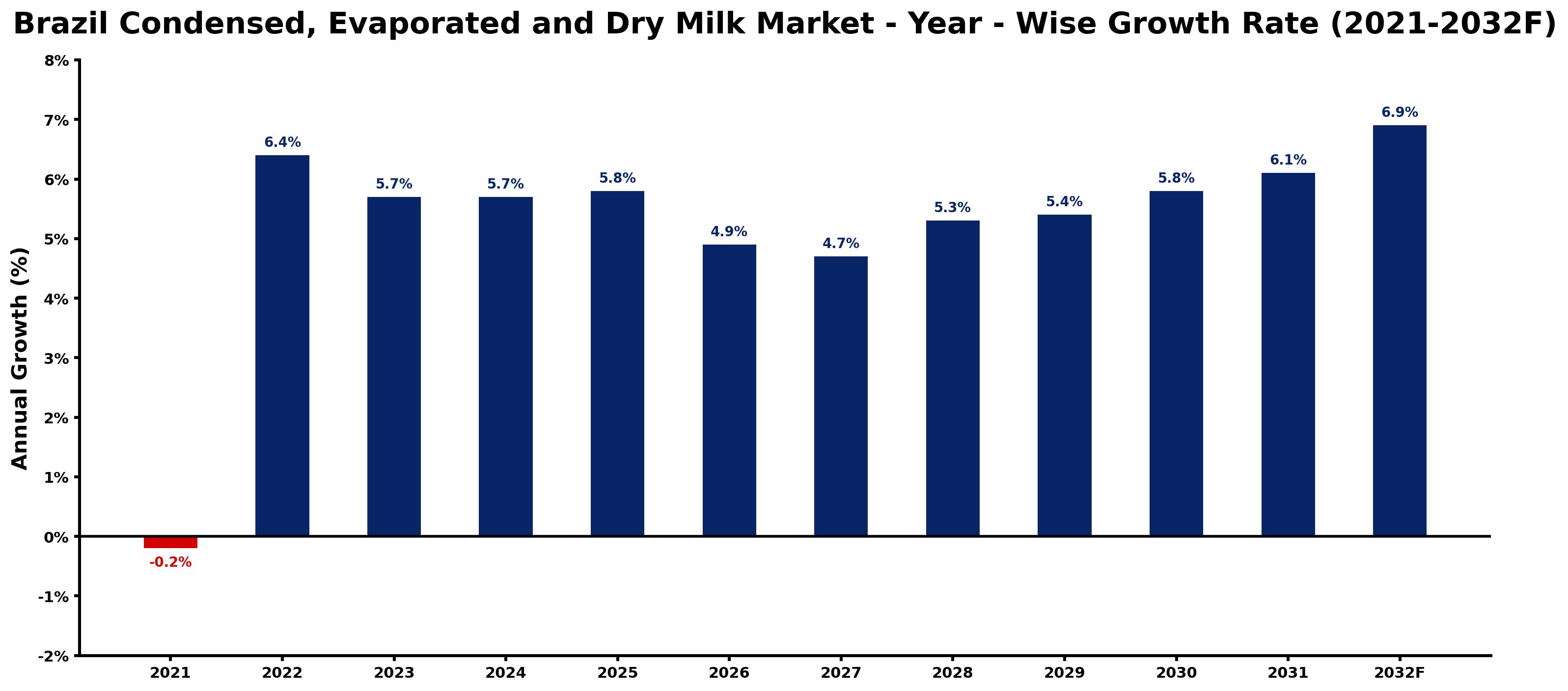
The table below presents the year wise growth rates along with the key drivers influencing the market
| Year | Growth Rate | Major Drivers |
| 2021 | -0.2% | Heightened competition from alternative dairy products diminished market share for traditional milk segments. |
| 2022 | 6.4% | Consumer preferences shift towards plant-based alternatives, affecting traditional dairy sales. |
| 2023 | 5.7% | Urbanization trends increase demand for convenient and ready-to-use dairy products. |
| 2024 | 5.7% | Rising health consciousness leads to greater demand for organic dairy options. |
| 2025 | 5.8% | Export opportunities emerge with new trade agreements boosting international sales. |
| 2026 | 4.9% | E-commerce platforms expand, providing new market access for dairy companies. |
| 2027 | 4.7% | Innovative packaging solutions appeal to environmentally conscious consumers. |
| 2028 | 5.3% | Brand loyalty develops as local producers emphasize regional sourcing and quality. |
| 2029 | 5.4% | Sustainability practices grow, influencing production methods and consumer choices. |
| 2030 | 5.8% | Rural development initiatives improve logistics and distribution networks for dairy supply. |
| 2031 | 6.1% | Technological advancements streamline production processes, reducing costs and waste. |
| 2032 | 6.9% | Collaboration among stakeholders enhances market stability and fosters innovation. |
Note - Market size estimations and growth projections presented in this report are based on 6Wresearch's advanced forecasting approach, validated with industry datasets as of June 2026.
Brazil Condensed, Evaporated and Dry Milk Market Synopsis
The Brazil Condensed, Evaporated and Dry Milk Market is projected to reach 4.9% and witness significant growth during the forecast period (2026-2032). This market reflects the robust preferences of Brazilian consumers for dairy products, further amplified by economic dynamics and emerging consumption patterns. The increasing trend towards urbanization and evolving lifestyles has created a fertile ground for the market's expansion, aligning with the convenience-oriented culture that many Brazilians embrace.
Brazil Condensed, Evaporated and Dry Milk Market Growth Drivers
Numerous factors are propelling the growth of the Brazil Condensed, Evaporated and Dry Milk Market. A key driver is the nation's rising population, which creates a greater demand for various dairy products. As more individuals move to urban areas, the need for convenient and shelf-stable products becomes increasingly pronounced. Additionally, the expanding middle class is driving consumption patterns that favor both quality and accessibility, further enhancing product appeal.
- The increasing awareness of the nutritional benefits associated with dairy consumption promotes demand for condensed, evaporated, and dry milk products.
- Innovations within the dairy industry, including new product formulations, are effectively capturing consumer interest and driving potential sales.
- Consumer preference for longer shelf-life products is strengthening market demand, as these products offer convenience for busy lifestyles.
- Changes in dietary habits, with a greater focus on incorporating dairy into meals, enhance the overall consumption of dairy products, including condensed and evaporated varieties.
- Marketing initiatives emphasizing the versatility and usage of these milk products in culinary applications are gaining traction among consumers.
Brazil Condensed, Evaporated and Dry Milk Market Challenges and Restraints
Despite its growth trajectory, the Brazil Condensed, Evaporated and Dry Milk Market faces a range of challenges. Fluctuations in milk production due to environmental conditions and agricultural factors can lead to supply inconsistencies. Furthermore, shifting consumer preferences toward health and wellness, alongside rising concerns about the nutritional content of dairy products, are reshaping market dynamics.
- Competition from alternative dairy products and plant-based milk substitutes is becoming more pronounced, attracting health-conscious consumers away from traditional milk products.
- Health concerns regarding the consumption of certain dairy products lead to increased scrutiny and demand for transparency regarding ingredients and processing methods.
- Supply chain disruptions, influenced by both climatic events and economic factors, pose risks to consistent product availability.
- Sustainable practices in dairy farming are becoming critical, as both consumers and producers seek environmentally responsible solutions.
- Regulatory scrutiny around food safety and quality standards adds complexity for producers navigating the market.
Brazil Condensed, Evaporated and Dry Milk Market Government Investment and Initiatives
The Brazilian government has implemented various policies aimed at supporting the condensed, evaporated, and dry milk market. These initiatives focus heavily on ensuring food safety and maintaining high-quality standards across the industry. Government actions include establishing production standards that ensure consistency and safety in dairy product offerings.
- Regulatory measures are in place to enhance labeling requirements, providing consumers with clear information on product contents and nutritional value.
- Policymaking aimed at preventing adulteration and fraud in the dairy industry is becoming increasingly stringent, thereby instilling consumer confidence.
- Government incentives for sustainable dairy farming practices are designed to promote environmentally friendly approaches while ensuring the welfare of livestock.
- Investment in agricultural research and technology is being prioritized to improve milk production efficiency and quality in response to market demands.
- Public sector efforts to strengthen the supply chain for dairy products aim to minimize disruptions and ensure product availability across the nation.
Brazil Condensed, Evaporated and Dry Milk Market Latest Developments (May 2025 - June 2026)
Recent developments in the Brazil Condensed, Evaporated, and Dry Milk Market indicate a strong alignment with evolving consumer preferences. Over the period from May 2025 to June 2026, the market has seen heightened innovation from manufacturers aiming to adapt to the growing demand for health-conscious and sustainable products.
- There is an observed increase in product diversification, with companies launching new flavors and nutritional enhancements to existing product lines.
- Collaborations between dairy producers and health organizations have emerged to promote the benefits of dairy consumption in a balanced diet.
- Ongoing discussions about sustainable practices in dairy production are leading to initiatives aimed at reducing carbon footprints and improving animal welfare.
- Consumer education campaigns focused on the benefits of condensed and evaporated milk have gained momentum, aiming to re-establish their presence in homes across Brazil.
- Market players are increasingly harnessing digital platforms for marketing strategies, allowing them to engage with consumers more effectively and respond to their feedback and preferences.
Brazil Condensed, Evaporated and Dry Milk Market - Key Attractiveness of the Report
- 10 Years of Market Numbers
- Historical Data Starting from 2022 to 2025
- Base Year: 2025
- Forecast Data until 2032
- Key Performance Indicators Impacting the Market
- Major Upcoming Developments and Projects
Key Highlights of the Report:
- Brazil Condensed, Evaporated and Dry Milk Market Outlook
- Market Size of Brazil Condensed, Evaporated and Dry Milk Market, 2025
- Forecast of Brazil Condensed, Evaporated and Dry Milk Market, 2032
- Historical Data and Forecast of Brazil Condensed, Evaporated and Dry Milk Revenues & Volume for the Period 2022-2032F
- Brazil Condensed, Evaporated and Dry Milk Market Trend Evolution
- Brazil Condensed, Evaporated and Dry Milk Market Drivers and Challenges
- Brazil Condensed, Evaporated and Dry Milk Price Trends
- Brazil Condensed, Evaporated and Dry Milk Porter's Five Forces
- Brazil Condensed, Evaporated and Dry Milk Industry Life Cycle
- Historical Data and Forecast of Brazil Condensed, Evaporated and Dry Milk Market Revenues & Volume By Product Type for the Period 2022-2032F
- Historical Data and Forecast of Brazil Condensed, Evaporated and Dry Milk Market Revenues & Volume By Dry Milk Product for the Period 2022-2032F
- Historical Data and Forecast of Brazil Condensed, Evaporated and Dry Milk Market Revenues & Volume By Condensed Milk Product for the Period 2022-2032F
- Historical Data and Forecast of Brazil Condensed, Evaporated and Dry Milk Market Revenues & Volume By Evaporated Milk Product for the Period 2022-2032F
- Historical Data and Forecast of Brazil Condensed, Evaporated and Dry Milk Market Revenues & Volume By Applications for the Period 2022-2032F
- Historical Data and Forecast of Brazil Condensed, Evaporated and Dry Milk Market Revenues & Volume By Food for the Period 2022-2032F
- Historical Data and Forecast of Brazil Condensed, Evaporated and Dry Milk Market Revenues & Volume By Beverages for the Period 2022-2032F
- Historical Data and Forecast of Brazil Condensed, Evaporated and Dry Milk Market Revenues & Volume By Intermediate Products for the Period 2022-2032F
- Historical Data and Forecast of Brazil Condensed, Evaporated and Dry Milk Market Revenues & Volume By Condiments for the Period 2022-2032F
- Historical Data and Forecast of Brazil Condensed, Evaporated and Dry Milk Market Revenues & Volume By Other for the Period 2022-2032F
- Brazil Condensed, Evaporated and Dry Milk Import Export Trade Statistics
- Market Opportunity Assessment By Product Type
- Market Opportunity Assessment By Applications
- Brazil Condensed, Evaporated and Dry Milk Top Companies Market Share
- Brazil Condensed, Evaporated and Dry Milk Competitive Benchmarking By Technical and Operational Parameters
- Brazil Condensed, Evaporated and Dry Milk Company Profiles
- Brazil Condensed, Evaporated and Dry Milk Key Strategic Recommendations






































