Brazil Cooking Appliances Market Summary
The brazil cooking appliances market was estimated at USD 500 Million in 2025 and is projected to reach USD 597 Million by 2032, growing at a CAGR of 2.7% from 2026 to 2032.
Brazil Cooking Appliances Market Year-wise Growth Rate and Key Drivers
This graph highlights how the Brazil Cooking Appliances Market has steadily grown over the past five years, supported by major growth factors.
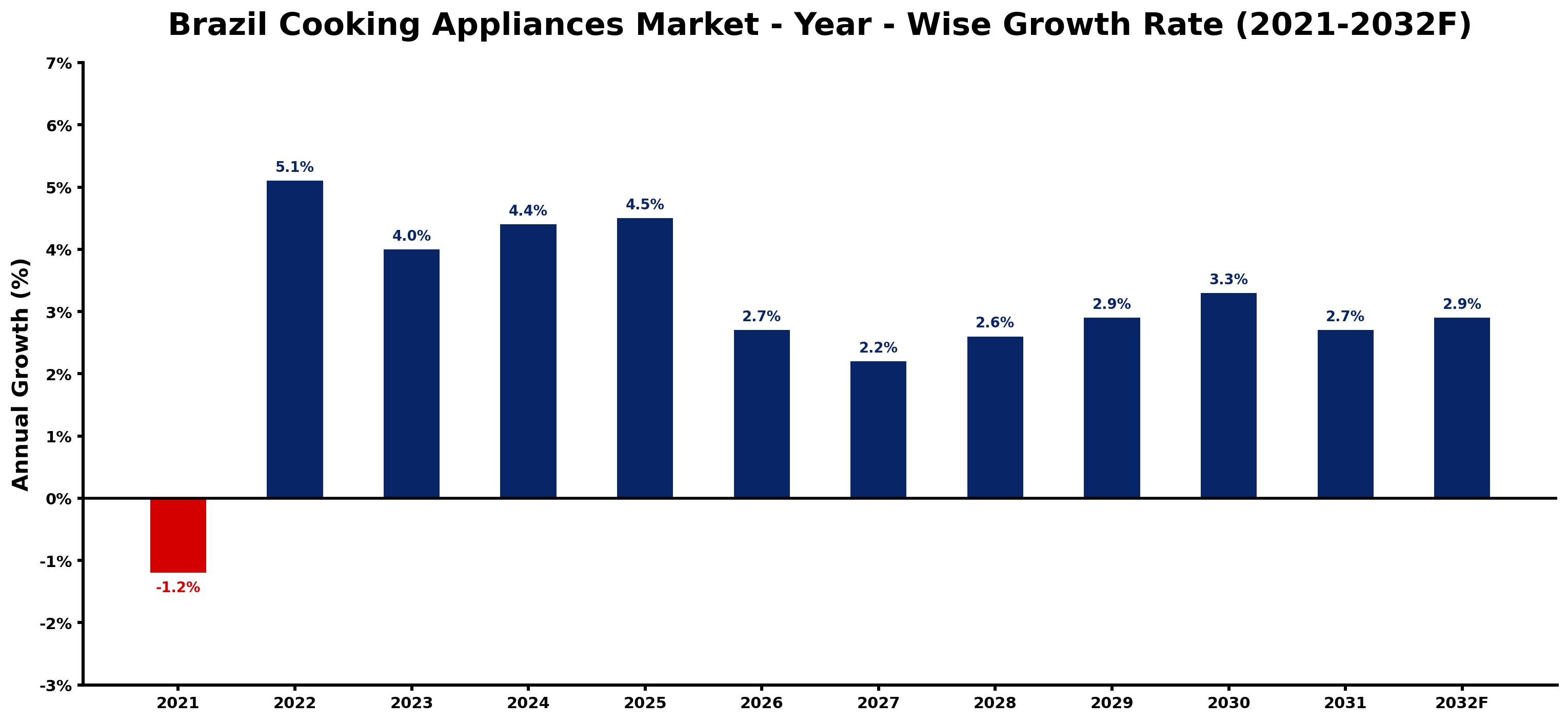
The table below presents the year wise growth rates along with the key drivers influencing the market
| Year | Growth Rate | Major Drivers |
| 2021 | -1.2% | Diminished disposable income due to economic downturn led to reduced investments in new kitchen appliances. |
| 2022 | 5.1% | Home cooking trends flourish as families prioritize healthy meal preparation options. |
| 2023 | 4.0% | E-commerce channels expand, making cooking appliances more accessible to urban dwellers. |
| 2024 | 4.4% | Sustainability becomes a key purchasing factor, influencing product design and features. |
| 2025 | 4.5% | Innovative smart appliances gain popularity, offering enhanced convenience and connectivity. |
| 2026 | 2.7% | Local manufacturers pivot to meet demand for affordable, high-quality cooking solutions. |
| 2027 | 2.2% | Emerging culinary influencers boost interest in advanced cooking techniques and gadgets. |
| 2028 | 2.6% | Consumer preferences shift towards multifunctional appliances that save space and time. |
| 2029 | 2.9% | Health consciousness drives demand for specialized appliances like air fryers and steamers. |
| 2030 | 3.3% | Urbanization trends lead to increased kitchen remodels, spurring higher appliance sales. |
| 2031 | 2.7% | Import tariffs fluctuate, prompting local brands to strengthen their market presence. |
| 2032 | 2.9% | Culinary tourism impacts market dynamics, encouraging the exploration of international cooking styles. |
Note - Market size estimations and growth projections presented in this report are based on 6Wresearch's advanced forecasting approach, validated with industry datasets as of June 2026.
Brazil Cooking Appliances Market Synopsis
The Brazil Cooking Appliances Market is projected to reach 2.7% and witness significant growth during the forecast period (2026-2032). With an anticipated compound annual growth rate (CAGR) of 4.5%, this market demonstrates strong potential driven by several factors. Increasing disposable income among Brazilian consumers, alongside the ongoing urbanization trends and evolving lifestyle preferences, are propelling the demand for a variety of cooking appliances. However, challenges such as high prices and a lack of product knowledge among consumers are somewhat restraining market growth, necessitating further education and strategic positioning by stakeholders.
Brazil Cooking Appliances Market Growth Drivers
The growth of the Brazil cooking appliances market is influenced by several key drivers. Foremost among these is the rise in disposable income, which empowers consumers to invest in modern cooking technologies that enhance convenience and efficiency. Urbanization is also playing a pivotal role; as more Brazilians move to urban areas, there is an increasing demand for modern cooking solutions that accommodate smaller living spaces and busy lifestyles.
- Enhanced consumer awareness regarding energy-efficient appliances is driving demand, as households seek to reduce utility costs while remaining environmentally conscious.
- The impact of social media and digital marketing is significant, as consumers are becoming exposed to innovative cooking appliances through various online platforms, leading to increased interest and purchases.
- Changing dietary preferences, including a growing emphasis on health and wellness, are spurring demand for specialized cooking appliances that cater to these evolving consumer needs.
- Government campaigns promoting sustainability and energy efficiency in households are encouraging consumers to invest in advanced cooking technologies.
- Increased penetration of e-commerce platforms is making it easier for consumers to access a wider range of cooking appliances, thus broadening market reach.
Brazil Cooking Appliances Market Challenges and Restraints
Despite the promising growth trajectory, the Brazil cooking appliances market faces certain inherent challenges. High prices of advanced cooking appliances can deter potential buyers, particularly in lower-income demographics. Additionally, consumer knowledge regarding the benefits and functionalities of modern appliances remains limited, which can impact purchasing decisions.
- Market players need to adopt innovative marketing strategies to educate consumers on the long-term benefits of investing in cooking appliances, including energy savings and improved cooking efficiency.
- The perception of cooking appliances as luxury items rather than necessities can limit their market penetration, especially in economically sensitive regions.
- Supply chain disruptions may affect product availability and pricing, making it crucial for businesses to establish robust logistics frameworks.
- Fluctuations in raw material costs could lead to pricing instability, which may further hinder market growth.
- Regional disparities in economic development can create unequal access to advanced cooking appliances across Brazil, impacting overall market performance.
Brazil Cooking Appliances Market Investment Opportunities
The evolving landscape of the Brazil cooking appliances market presents numerous investment opportunities that stakeholders can capitalize on. As disposable incomes rise and urbanization continues, there is a growing market for both innovative and traditional cooking appliances. Investors should consider targeting regions with high urban growth rates, as these areas are likely to see increasing demand for modern cooking solutions.
- Investing in research and development can lead to the introduction of energy-efficient and smart cooking appliances, which are becoming increasingly popular among tech-savvy consumers.
- Partnerships with local distributors can enhance market penetration and improve product availability across diverse geographic areas.
- Developing educational campaigns can improve consumer awareness and drive demand by informing potential buyers about the features and benefits of advanced appliances.
- Exploring alternative distribution channels, such as online marketplaces, can expand reach and accessibility for consumers looking to purchase cooking appliances.
- Targeting niche markets, such as health-conscious consumers or gourmet cooking enthusiasts, may yield additional growth opportunities within the broader cooking appliances sector.
Brazil Cooking Appliances Market Government Investment and Initiatives
Government investment and initiatives play a crucial role in shaping the Brazil cooking appliances market. Authorities are increasingly focused on promoting energy efficiency and sustainable practices within households. Various programs are aimed at providing incentives for the adoption of energy-efficient cooking appliances, thereby reducing overall energy consumption.
- Government campaigns that promote the benefits of modern cooking appliances are encouraging consumers to consider upgrades from traditional options.
- Public spending on infrastructure improvements, particularly in urban areas, supports the growth of retail and distribution networks for cooking appliances.
- Incentives for local manufacturers to invest in advanced technologies can enhance the competitiveness of the domestic market.
- Regulatory frameworks aimed at improving energy efficiency standards are likely to lead to innovations in product design and functionality, benefiting consumers.
- Collaboration between government agencies and industry stakeholders could drive education initiatives, raising awareness and increasing consumer confidence in modern cooking appliances.
Brazil Cooking Appliances Market Latest Developments (May 2025 - June 2026)
The Brazil cooking appliances market is witnessing dynamic developments characterized by shifts in consumer preferences and technological advancements. Over the period from May 2025 to June 2026, there has been a noticeable uptick in demand for smart kitchen appliances, attributed to the rise of connected home technologies and consumer interest in energy-saving features. Additionally, manufacturers are increasingly focusing on sustainability, with many introducing eco-friendly product lines to align with government initiatives aimed at reducing environmental impact.
- Market players are launching promotional campaigns highlighting energy-efficient appliances to attract environmentally conscious consumers.
- Innovations in appliance connectivity and smart home integration are becoming focal points of product development and marketing strategies.
- The COVID-19 pandemic has continued to influence consumer buying habits, with many seeking reliable appliances that enhance convenience in home cooking.
- Retail strategies are evolving, with a greater emphasis on online sales channels to meet changing consumer purchasing behaviors.
- Collaborations and partnerships within the industry are emerging to foster knowledge sharing and drive innovations in appliance technology.
Brazil Cooking Appliances Market - Key Attractiveness of the Report
- 10 Years of Market Numbers
- Historical Data Starting from 2022 to 2025
- Base Year: 2025
- Forecast Data until 2032
- Key Performance Indicators Impacting the Market
- Major Upcoming Developments and Projects
Key Highlights of the Report:
- Brazil Cooking Appliances Market Outlook
- Market Size of Brazil Cooking Appliances Market, 2025
- Forecast of Brazil Cooking Appliances Market, 2032
- Historical Data and Forecast of Brazil Cooking Appliances Revenues & Volume for the Period 2022-2032
- Brazil Cooking Appliances Market Trend Evolution
- Brazil Cooking Appliances Market Drivers and Challenges
- Brazil Cooking Appliances Price Trends
- Brazil Cooking Appliances Porter's Five Forces
- Brazil Cooking Appliances Industry Life Cycle
- Historical Data and Forecast of Brazil Cooking Appliances Market Revenues & Volume By Types for the Period 2022-2032
- Historical Data and Forecast of Brazil Cooking Appliances Market Revenues & Volume By Microwaves for the Period 2022-2032
- Historical Data and Forecast of Brazil Cooking Appliances Market Revenues & Volume By Ovens for the Period 2022-2032
- Historical Data and Forecast of Brazil Cooking Appliances Market Revenues & Volume By Cooktops for the Period 2022-2032
- Historical Data and Forecast of Brazil Cooking Appliances Market Revenues & Volume By Range Hoods for the Period 2022-2032
- Historical Data and Forecast of Brazil Cooking Appliances Market Revenues & Volume By Small Appliances for the Period 2022-2032
- Historical Data and Forecast of Brazil Cooking Appliances Market Revenues & Volume By Parts & Accessories for the Period 2022-2032
- Historical Data and Forecast of Brazil Cooking Appliances Market Revenues & Volume By Applications for the Period 2022-2032
- Historical Data and Forecast of Brazil Cooking Appliances Market Revenues & Volume By Household for the Period 2022-2032
- Historical Data and Forecast of Brazil Cooking Appliances Market Revenues & Volume By Commercial for the Period 2022-2032
- Historical Data and Forecast of Brazil Cooking Appliances Market Revenues & Volume By Fuel Type for the Period 2022-2032
- Historical Data and Forecast of Brazil Cooking Appliances Market Revenues & Volume By Cooking gas for the Period 2022-2032
- Historical Data and Forecast of Brazil Cooking Appliances Market Revenues & Volume By Electricity for the Period 2022-2032
- Historical Data and Forecast of Brazil Cooking Appliances Market Revenues & Volume By Distribution Channel for the Period 2022-2032
- Historical Data and Forecast of Brazil Cooking Appliances Market Revenues & Volume By Online for the Period 2022-2032
- Historical Data and Forecast of Brazil Cooking Appliances Market Revenues & Volume By Offline for the Period 2022-2032
- Brazil Cooking Appliances Import Export Trade Statistics
- Market Opportunity Assessment By Types
- Market Opportunity Assessment By Applications
- Market Opportunity Assessment By Fuel Type
- Market Opportunity Assessment By Distribution Channel
- Brazil Cooking Appliances Top Companies Market Share
- Brazil Cooking Appliances Competitive Benchmarking By Technical and Operational Parameters
- Brazil Cooking Appliances Company Profiles
- Brazil Cooking Appliances Key Strategic Recommendations






































