Brazil Data Classification Market Size & Growth Rate (2026-2032)
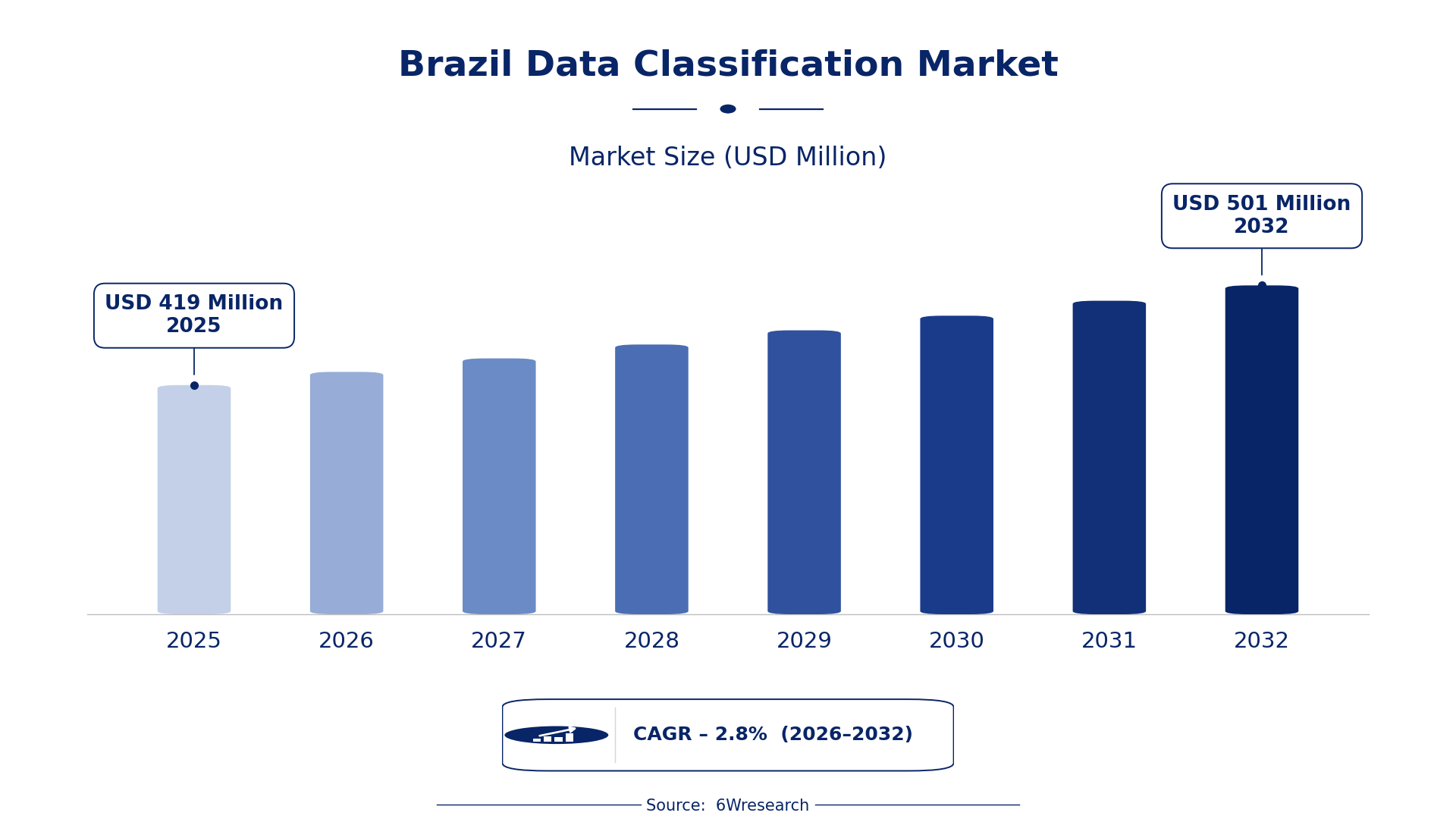
The Brazil Data Classification Market was estimated at USD 419 Million in 2025 and is projected to reach USD 501 Million by 2032, growing at a CAGR of 2.8% from 2026 to 2032.
Brazil Data Classification Market Synopsis
The Brazil Data Classification market has emerged as a vital component for businesses seeking to manage their growing data needs. Organizations are increasingly aware of the necessity to categorize sensitive information to enhance data protection and compliance efforts. This awareness is not just a trend; it has become essential for strategic decision-making.
Several industries are now prioritizing data classification as part of their broader data governance frameworks. Regulatory pressures, coupled with escalating concerns around data privacy, are pushing companies to invest in automated classification tools. This shift marks a significant transition as organizations aim to secure sensitive information while also streamlining their data management processes.
Brazil Data Classification Market Year-wise Growth Rate and Key Drivers
This graph illustrates the annual growth rates of the Brazil Data Classification Market from 2021 to 2032, highlighting a steady upward trajectory and projected expansion over the forecast period.
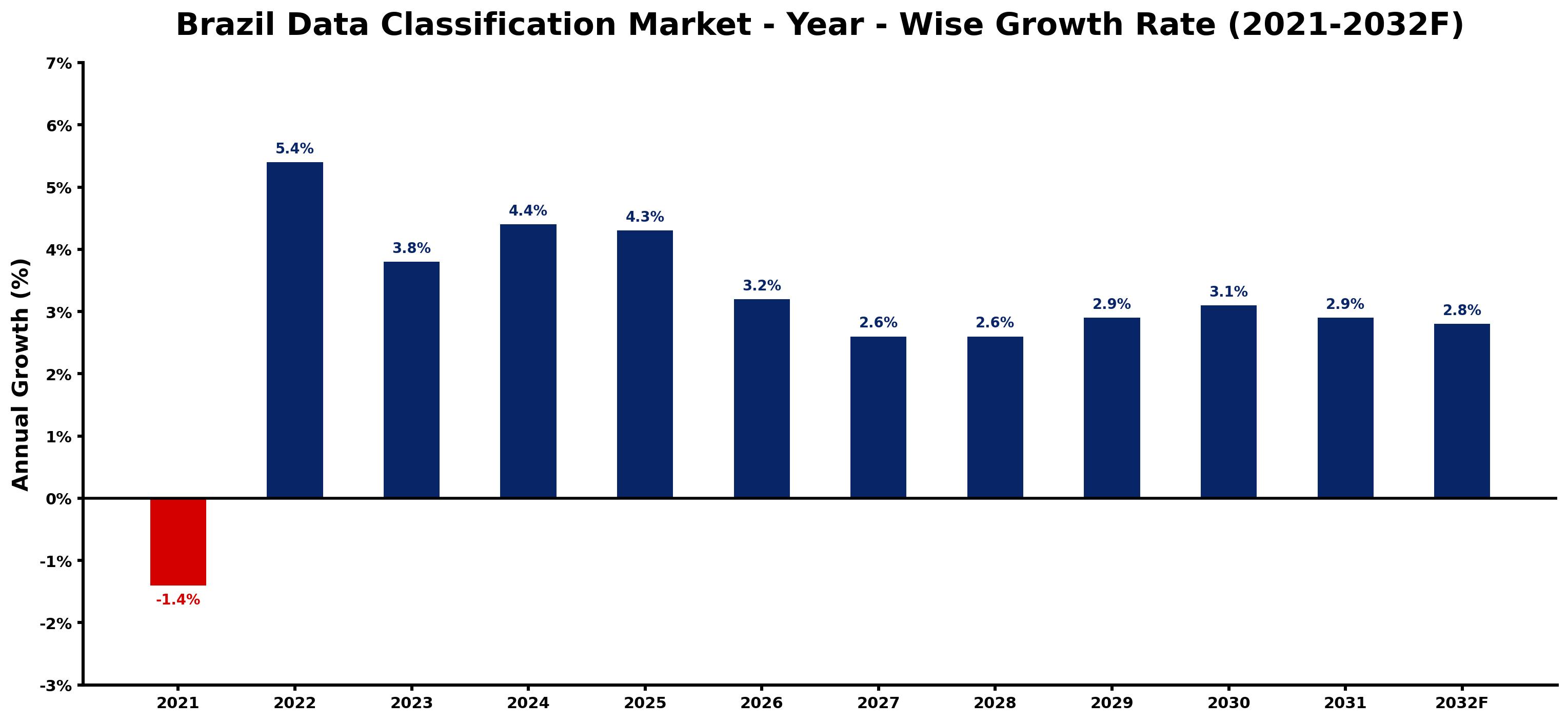
The table below presents the year‑wise growth rates along with the key drivers influencing the market
| Year | Growth Rate | Major Drivers |
| 2021 | -1.4% | LGPD implementation caused operational uncertainties for businesses. |
| 2022 | 5.4% | LGPD enforcement drives compliance for data handling standards. |
| 2023 | 3.8% | Rise in cyber threats boosts demand for data protection. |
| 2024 | 4.4% | Increased remote work accelerates need for secure data access. |
| 2025 | 4.3% | Economic growth spurs investment in data management solutions. |
| 2026 | 3.2% | Regulatory updates necessitate advanced data classification tools. |
| 2027 | 2.6% | Healthcare sector reforms require stringent data privacy measures. |
| 2028 | 2.6% | Expanding fintech sector demands robust data governance frameworks. |
| 2029 | 2.9% | Educational institutions adopt advanced data classification technologies. |
| 2030 | 3.1% | Growing awareness of data privacy drives market adoption. |
| 2031 | 2.9% | Cloud migration trends require enhanced classification protocols. |
| 2032 | 2.8% | Public sector digitization initiatives increase data compliance needs. |
Note: Market size estimations and growth projections presented in this report are based on 6Wresearch's proprietary forecasting methodology, utilizing the latest available industry data, government publications, and primary research inputs.
Brazil Data Classification Market Key Takeaways
Below are some of the specific key takeaways from the market, including:
- Organizations are prioritizing data classification solutions to ensure compliance with evolving regulations.
- There is a growing emphasis on automation in data classification to handle diverse data types efficiently.
- Businesses are seeking solutions that integrate seamlessly across various data repositories.
- Privacy concerns and the need for robust data protection strategies are key market drivers.
- The market exhibits steady growth, reflecting increasing investments in data governance initiatives.
Evaluation of Restraints in Brazil Data Classification Market
Several factors hinder the growth of the Brazil Data Classification market. The primary concern revolves around the automation of the classification process. Many organizations struggle with integrating these tools across diverse platforms, which complicates consistent data categorization. on top of that, the challenge of managing various data types can result in inefficiencies, leading to potential security gaps. Addressing these issues requires innovative solutions that prioritize accuracy and flexibility in classification efforts.
Brazil Data Classification Market Trends
The landscape of the Brazil Data Classification market is witnessing transformative trends. Notably, the integration of machine learning algorithms is gaining traction, allowing for smarter and more adaptive classification processes. Companies are increasingly opting for cloud-based solutions, which provide scalability and ease of access. on top of that, the rise in privacy regulations is pushing organizations to not just comply but to enhance their data governance frameworks actively. This trend towards proactive data management is expected to shape the future of the market significantly.
Brazil Data Classification Market Opportunities
The demand for effective data classification solutions presents various growth opportunities. Organizations looking to comply with stringent data protection regulations will invest in innovative classification tools, paving the way for startups and established players in this sector. Additionally, sectors like healthcare and finance, which handle sensitive information, are expected to lead the charge in adopting advanced classification strategies. The focus on automated and integrated solutions represents a significant investment avenue for tech developers and service providers alike.
Government Initiatives in the Brazil Data Classification Market
Government policies are shaping the Brazil Data Classification market significantly. With an increasing emphasis on data privacy and security, Brazil's regulatory environment is becoming more stringent. Organizations are now required to comply with various data protection laws, driving the demand for effective data classification solutions. The government's proactive stance on data governance is crucial for businesses aiming to adapt to changing compliance landscapes.
- A national digital infrastructure upgrade programme launched in early 2023 aims to enhance data security across various sectors.
- Currently, a regulatory review process is underway to update compliance requirements for data protection laws, expected to conclude by late 2024.
- A planned public-private initiative scheduled for 2026 aims to foster innovation in data classification technologies.
- Recent consultations have led to the introduction of guidelines in 2023, mandating data classification practices across government agencies.
- A pilot program focused on data protection training for businesses launched in mid-2023 and is set to expand nationally by 2025.
Future Insights of the Brazil Data Classification Market
From 2026 to 2032, the Brazil Data Classification market is likely to evolve rapidly, driven by technological advancements and regulatory imperatives. As organizations embrace digital transformation, the integration of AI and machine learning in classification processes will become more common. This evolution will not only enhance accuracy but also optimize data management strategies across various sectors. Additionally, the focus on compliance with increasing regulations will continue to serve as a catalyst for market growth.
Brazil Data Classification Market Latest Developments
In the past year, the Brazil Data Classification market has seen notable developments that reflect the urgency for enhanced data management solutions. Companies are increasingly launching initiatives to update their classification processes, fueled by regulatory changes. This momentum indicates a heightened focus on data security and compliance across different industries.
- A major technology vendor announced the rollout of a new automated classification tool in Q1 2024, aimed at simplifying compliance efforts for organizations.
- A leading regional operator is currently enhancing its data classification services, with an ongoing pilot program expected to conclude by mid-2025.
- A new partnership between tech firms was formed in late 2023 to develop specialized solutions for the finance sector's data classification needs, set to launch in 2025.
- In early 2024, a government initiative will begin aimed at providing resources for small businesses to implement effective data classification strategies.
- A recent technology upgrade in early 2024 is set to improve data integration capabilities for classification tools across multiple platforms.
Brazil Data Classification Market - Key Attractiveness of the Report
- 10 Years of Market Numbers
- Historical Data Starting from 2022 to 2025
- Base Year: 2025
- Forecast Data until 2032
- Key Performance Indicators Impacting the Market
- Major Upcoming Developments and Projects
Key Highlights of the Report:
- Brazil Data Classification Market Outlook
- Market Size of Brazil Data Classification Market, 2025
- Forecast of Brazil Data Classification Market, 2032
- Historical Data and Forecast of Brazil Data Classification Revenues & Volume for the Period 2022-2032F
- Brazil Data Classification Market Trend Evolution
- Brazil Data Classification Market Drivers and Challenges
- Brazil Data Classification Price Trends
- Brazil Data Classification Porter's Five Forces
- Brazil Data Classification Industry Life Cycle
- Historical Data and Forecast of Brazil Data Classification Market Revenues & Volume By Component for the Period 2022-2032F
- Historical Data and Forecast of Brazil Data Classification Market Revenues & Volume By Solutions (Standalone and Integrated) for the Period 2022-2032F
- Historical Data and Forecast of Brazil Data Classification Market Revenues & Volume By Services for the Period 2022-2032F
- Historical Data and Forecast of Brazil Data Classification Market Revenues & Volume By Application for the Period 2022-2032F
- Historical Data and Forecast of Brazil Data Classification Market Revenues & Volume By Access Control for the Period 2022-2032F
- Historical Data and Forecast of Brazil Data Classification Market Revenues & Volume By GRC for the Period 2022-2032F
- Historical Data and Forecast of Brazil Data Classification Market Revenues & Volume By Web for the Period 2022-2032F
- Historical Data and Forecast of Brazil Data Classification Market Revenues & Volume By Mobile & Email Protection for the Period 2022-2032F
- Historical Data and Forecast of Brazil Data Classification Market Revenues & Volume By Centralized Management for the Period 2022-2032F
- Historical Data and Forecast of Brazil Data Classification Market Revenues & Volume By Methodology for the Period 2022-2032F
- Historical Data and Forecast of Brazil Data Classification Market Revenues & Volume By Content-based Classification for the Period 2022-2032F
- Historical Data and Forecast of Brazil Data Classification Market Revenues & Volume By Context-based Classification for the Period 2022-2032F
- Historical Data and Forecast of Brazil Data Classification Market Revenues & Volume By User-based Classification for the Period 2022-2032F
- Historical Data and Forecast of Brazil Data Classification Market Revenues & Volume By Vertical for the Period 2022-2032F
- Historical Data and Forecast of Brazil Data Classification Market Revenues & Volume By BFSI for the Period 2022-2032F
- Historical Data and Forecast of Brazil Data Classification Market Revenues & Volume By Healthcare and Lifesciences for the Period 2022-2032F
- Historical Data and Forecast of Brazil Data Classification Market Revenues & Volume By Government and Defense for the Period 2022-2032F
- Historical Data and Forecast of Brazil Data Classification Market Revenues & Volume By Education for the Period 2022-2032F
- Historical Data and Forecast of Brazil Data Classification Market Revenues & Volume By Telecom for the Period 2022-2032F
- Historical Data and Forecast of Brazil Data Classification Market Revenues & Volume By Media and Entertainment for the Period 2022-2032F
- Historical Data and Forecast of Brazil Data Classification Market Revenues & Volume By Others (Retail and Ecommerce, Manufacturing, and Energy and Utilities) for the Period 2022-2032F
- Brazil Data Classification Import Export Trade Statistics
- Market Opportunity Assessment By Component
- Market Opportunity Assessment By Application
- Market Opportunity Assessment By Methodology
- Market Opportunity Assessment By Vertical
- Brazil Data Classification Top Companies Market Share
- Brazil Data Classification Competitive Benchmarking By Technical and Operational Parameters
- Brazil Data Classification Company Profiles
- Brazil Data Classification Key Strategic Recommendations






































