Brazil Decorative tile Market Summary
The brazil decorative tile market was estimated at USD 325 Million in 2025 and is projected to reach USD 391 Million by 2032, growing at a CAGR of 3.0% from 2026 to 2032.
Brazil Decorative tile Market Year-wise Growth Rate and Key Drivers
This graph highlights how the Brazil Decorative tile Market has steadily grown over the past five years, supported by major growth factors.
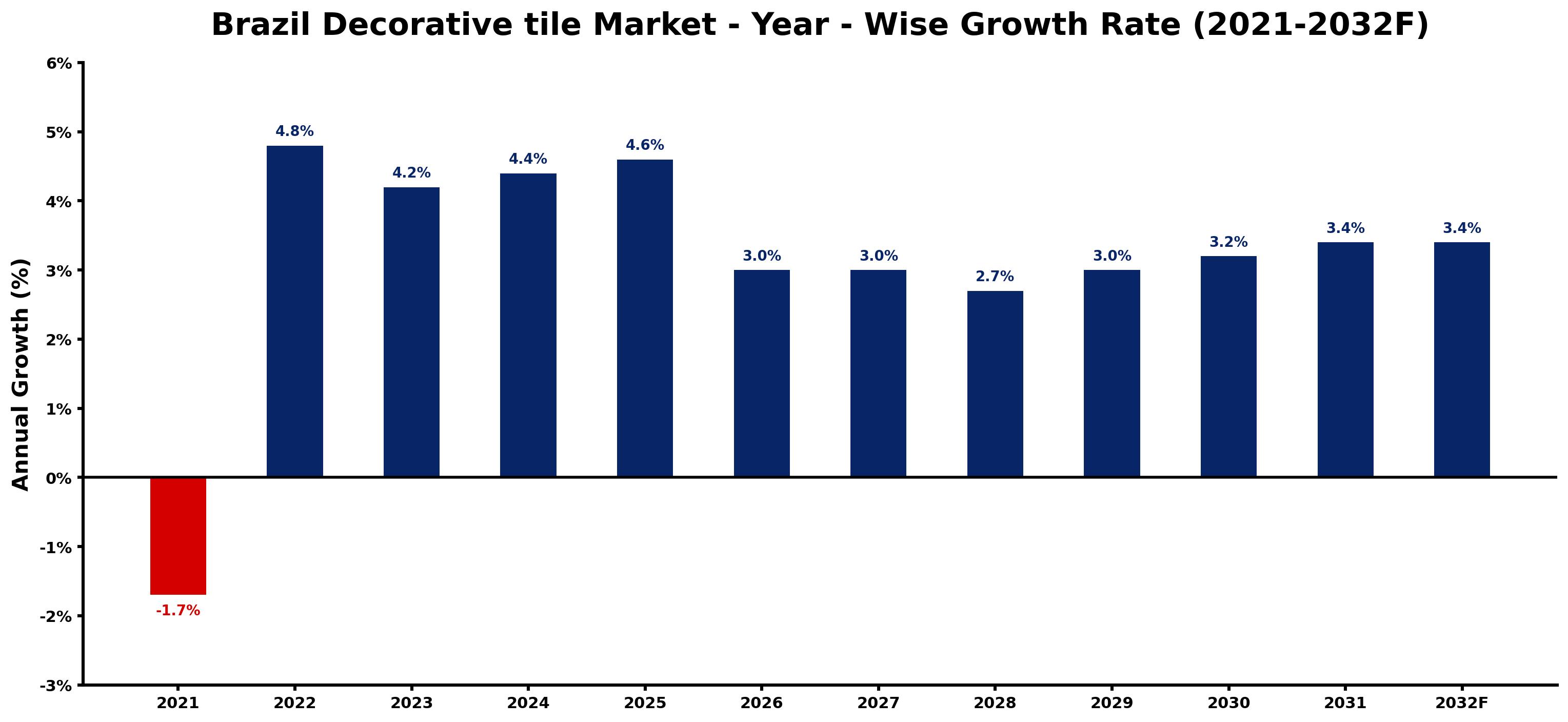
The table below presents the year wise growth rates along with the key drivers influencing the market
| Year | Growth Rate | Major Drivers |
| 2021 | -1.7% | Economic downturn led to reduced discretionary spending on home renovation projects, impacting decorative tile sales. |
| 2022 | 4.8% | Sustainable materials gained traction among consumers prioritizing eco-friendly home design choices. |
| 2023 | 4.2% | Innovative tile designs attracted attention as homeowners sought unique interior aesthetics. |
| 2024 | 4.4% | Construction sector recovery led to increased demand for decorative tiles in new builds. |
| 2025 | 4.6% | Consumer preferences shifted towards customizable tile solutions for personalized home spaces. |
| 2026 | 3.0% | Local artisans emerged, offering handcrafted tiles that appealed to niche market segments. |
| 2027 | 3.0% | Technological advances in tile manufacturing improved production efficiency and reduced costs. |
| 2028 | 2.7% | Urbanization trends drove a surge in decorative tile installations in metropolitan areas. |
| 2029 | 3.0% | E-commerce platforms became essential for tile distribution, enhancing market accessibility for consumers. |
| 2030 | 3.2% | Architectural firms started integrating decorative tiles into eco-friendly building designs. |
| 2031 | 3.4% | Increased tourism in Brazil highlighted the importance of tiles in cultural and heritage sites. |
| 2032 | 3.4% | Rising disposable incomes allowed consumers to invest more in premium decorative tile options. |
Note - Market size estimations and growth projections presented in this report are based on 6Wresearch's advanced forecasting approach, validated with industry datasets as of June 2026.
Brazil Decorative tile Market Synopsis
The Brazil Decorative tile Market is projected to reach 3.0% and witness significant growth during the forecast period (2026-2032). This segment of the construction and interior design industry is characterized by its vibrant offerings, driven by evolving consumer preferences, emerging architectural trends, and cultural influences that resonate within the local context. As home design continues to prioritize aesthetic appeal, decorative tiles are increasingly recognized for their capacity to enhance residential and commercial spaces.
Brazil Decorative tile Market Growth Drivers
Several factors are propelling the expansion of the Brazil Decorative tile Market, primarily due to the robust growth of the construction and real estate sectors. The ongoing urbanization and increasing investments in both residential and commercial construction are significantly impacting demand. Some of the key growth drivers include:
- The rising preference among consumers for homes that reflect personal style and uniqueness has amplified the demand for decorative tiles. Homeowners and designers alike are turning to tiles that offer not only functionality but also artistic expression.
- Innovations in tile manufacturing are paving the way for new designs, patterns, and materials. The introduction of eco-friendly options and technologically advanced manufacturing processes is enhancing the attractiveness of decorative tiles.
- Cultural significance plays a vital role in shaping preferences in the Brazil Decorative tile Market. The traditional use of vibrant and artistic tiles in architecture highlights the importance of cultural heritage, leading consumers to seek tiles that celebrate this aspect.
- Economic growth and rising disposable incomes are enabling consumers to invest in higher-quality home improvements, including decorative tiles, thereby increasing market potential.
- The increasing focus on sustainability and eco-friendly construction practices is driving demand for decorative tiles made from recycled or sustainable materials, aligning with global trends in environmental consciousness.
Brazil Decorative tile Market Challenges and Restraints
While the Brazil Decorative tile Market shows promising growth, it is not without challenges. The market faces several restraints that could impede its expansion, including:
- The cyclical nature of the construction industry can lead to fluctuations in demand. Economic downturns often result in reduced consumer spending on home improvements, which can adversely affect decorative tile sales.
- Intense competition from alternative materials, such as vinyl and laminate flooring, presents a significant challenge. These materials often provide cost-effective solutions for consumers, necessitating that decorative tile manufacturers distinguish their offerings.
- Potential delays in construction projects can impact demand for decorative tiles, particularly if they are viewed as non-essential elements in the building process.
- Supply chain disruptions and fluctuations in the prices of raw materials can create uncertainties for manufacturers, affecting pricing strategies and profit margins.
- Consumer preferences are ever-evolving, leading to the need for continuous innovation and adaptation in product offerings to match changing aesthetic trends and needs.
Brazil Decorative tile Market Government Investment and Initiatives
The Brazil Decorative tile Market is significantly influenced by various government policies aimed at fostering sustainable urban development and cultural heritage preservation. The Brazilian government supports initiatives that encourage the use of eco-friendly materials in construction, which has a direct impact on the decorative tile sector. Regulations that promote safety standards and sustainability are becoming increasingly stringent, urging manufacturers to innovate responsibly.
Furthermore, government incentives for local artisans and tile manufacturers are instrumental in preserving traditional craftsmanship. These programs not only bolster the decorative tile industry but also enhance the cultural significance of ceramics in Brazil, ensuring that heritage craftsmanship continues to thrive in modern applications.
Brazil Decorative tile Market Latest Developments (May 2025 - June 2026)
Recent developments within the Brazil Decorative tile Market from May 2025 to June 2026 indicate a continued emphasis on innovation and sustainability. Manufacturers are increasingly adopting advanced technologies to create unique designs and sustainable production processes. Additionally, collaborations between designers and local artisans are gaining popularity, resulting in collections that reflect Brazil's rich cultural heritage while appealing to modern tastes. A growing awareness of the environmental impact of construction materials is prompting manufacturers to explore eco-friendly options, further shaping market dynamics during this period.
Brazil Decorative tile Market - Key Attractiveness of the Report
- 10 Years of Market Numbers
- Historical Data Starting from 2022 to 2025
- Base Year: 2025
- Forecast Data until 2032
- Key Performance Indicators Impacting the Market
- Major Upcoming Developments and Projects
Key Highlights of the Report:
- Brazil Decorative tile Market Outlook
- Market Size of Brazil Decorative tile Market, 2025
- Forecast of Brazil Decorative tile Market, 2032
- Historical Data and Forecast of Brazil Decorative tile Revenues & Volume for the Period 2022-2032F
- Brazil Decorative tile Market Trend Evolution
- Brazil Decorative tile Market Drivers and Challenges
- Brazil Decorative tile Price Trends
- Brazil Decorative tile Porter's Five Forces
- Brazil Decorative tile Industry Life Cycle
- Historical Data and Forecast of Brazil Decorative tile Market Revenues & Volume By Type for the Period 2022-2032F
- Historical Data and Forecast of Brazil Decorative tile Market Revenues & Volume By Ceramic Wall Tiles for the Period 2022-2032F
- Historical Data and Forecast of Brazil Decorative tile Market Revenues & Volume By Vinyl Wall Tiles for the Period 2022-2032F
- Historical Data and Forecast of Brazil Decorative tile Market Revenues & Volume By Stone Wall Tiles for the Period 2022-2032F
- Historical Data and Forecast of Brazil Decorative tile Market Revenues & Volume By Other Types for the Period 2022-2032F
- Historical Data and Forecast of Brazil Decorative tile Market Revenues & Volume By End-users for the Period 2022-2032F
- Historical Data and Forecast of Brazil Decorative tile Market Revenues & Volume By Residential for the Period 2022-2032F
- Historical Data and Forecast of Brazil Decorative tile Market Revenues & Volume By Commercial for the Period 2022-2032F
- Historical Data and Forecast of Brazil Decorative tile Market Revenues & Volume By Application for the Period 2022-2032F
- Historical Data and Forecast of Brazil Decorative tile Market Revenues & Volume By Flooring for the Period 2022-2032F
- Historical Data and Forecast of Brazil Decorative tile Market Revenues & Volume By Wall Coverings for the Period 2022-2032F
- Historical Data and Forecast of Brazil Decorative tile Market Revenues & Volume By Other Applications for the Period 2022-2032F
- Brazil Decorative tile Import Export Trade Statistics
- Market Opportunity Assessment By Type
- Market Opportunity Assessment By End-users
- Market Opportunity Assessment By Application
- Brazil Decorative tile Top Companies Market Share
- Brazil Decorative tile Competitive Benchmarking By Technical and Operational Parameters
- Brazil Decorative tile Company Profiles
- Brazil Decorative tile Key Strategic Recommendations






































