Brazil Denture Cleaning Products Market Top 5 Importing Countries and Market Competition (HHI) Analysis
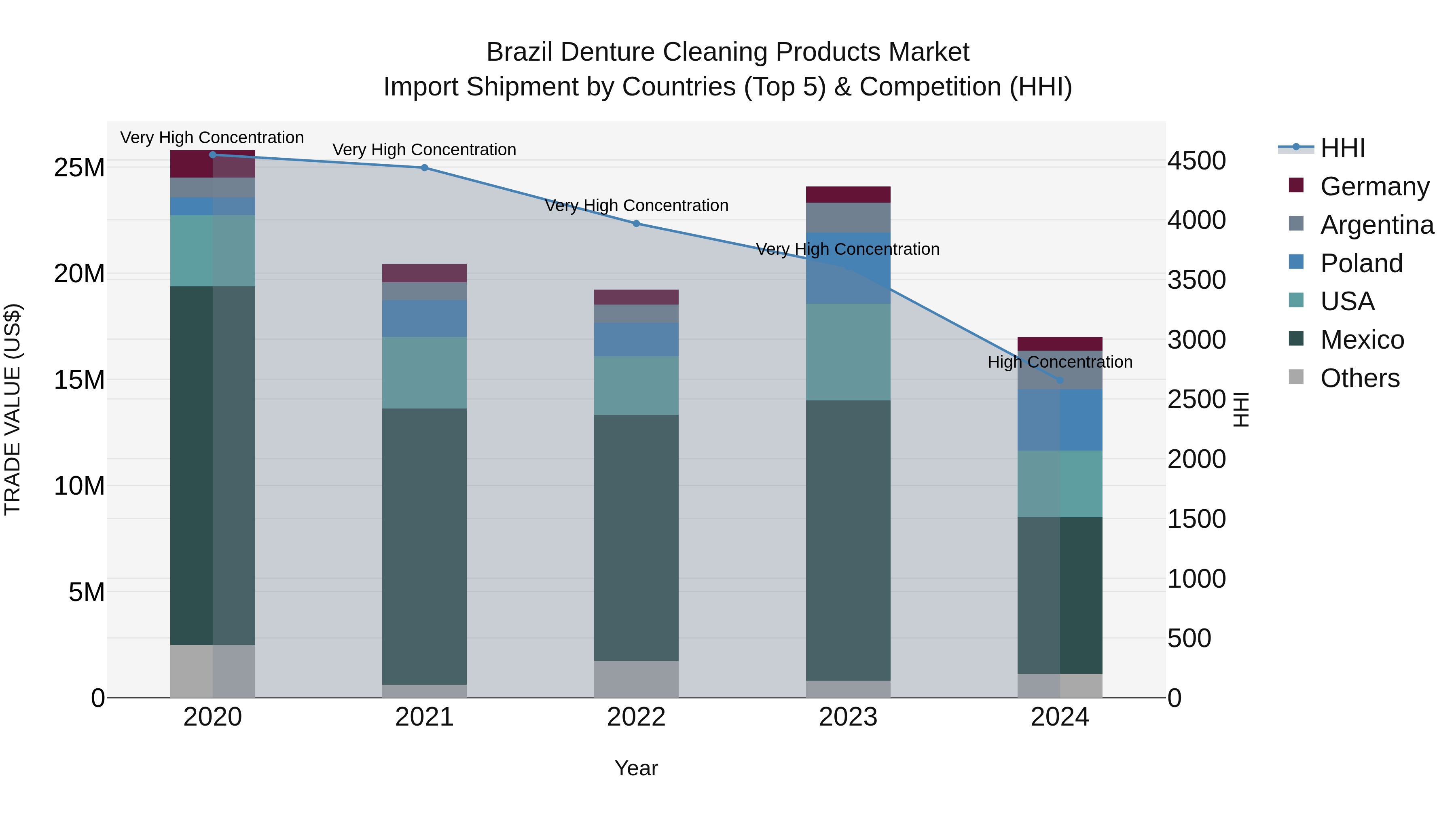
Brazil`s denture cleaning products import market saw a significant shift in 2024, with top exporting countries being Mexico, USA, Poland, Argentina, and Germany. The market concentration, as measured by the HHI, remained high, indicating a competitive landscape. However, the negative CAGR of -9.9% from 2020 to 2024 and a steep decline in growth rate of -29.41% from 2023 to 2024 demonstrate a challenging environment for denture cleaning product imports in Brazil. Stakeholders should closely monitor these trends and identify strategies to navigate the evolving market dynamics.
Brazil Denture cleaning products Market Overview
The Brazil Denture Cleaning Products market has seen increased demand due to a growing aging population and awareness of oral hygiene. The market is characterized by the presence of various cleaning solutions, tablets, and devices. Challenges include changing consumer preferences, stringent regulations on product ingredients, and the need for effective marketing strategies. Adapting to evolving consumer needs and complying with regulatory standards will be key for market players in this segment.
Drivers of the market
The Brazil Denture Cleaning Products market has experienced growth due to the aging population and the increased awareness of oral health. The demand for effective denture cleaning solutions has risen, driven by the need for convenient and efficient products. Manufacturers are focusing on innovations to address specific consumer needs, such as easy application and compatibility with various denture materials, contributing to the market`s positive momentum.
Challenges of the market
The Brazil Denture Cleaning Products market has seen increased demand with an aging population and a focus on oral health. Challenges in this market include consumer awareness, the need for effective and innovative cleaning solutions, and regulatory compliance. Overcoming these challenges requires market players to invest in research and development, education campaigns, and compliance with evolving industry standards.
Government Policy of the market
In the Brazil Denture Cleaning Products market, government regulations on health and safety standards are instrumental. Authorities often set guidelines for product formulations, labeling, and advertising to ensure consumer protection. Government policies also address issues related to the disposal of denture cleaning products, impacting environmental sustainability. Continuous monitoring and adaptation to evolving regulatory standards are essential for manufacturers in this market.
Key Highlights of the Report:
- Brazil Denture cleaning products Market Outlook
- Market Size of Brazil Denture cleaning products Market, 2024
- Forecast of Brazil Denture cleaning products Market, 2031
- Historical Data and Forecast of Brazil Denture cleaning products Revenues & Volume for the Period 2021-2031
- Brazil Denture cleaning products Market Trend Evolution
- Brazil Denture cleaning products Market Drivers and Challenges
- Brazil Denture cleaning products Price Trends
- Brazil Denture cleaning products Porter's Five Forces
- Brazil Denture cleaning products Industry Life Cycle
- Historical Data and Forecast of Brazil Denture cleaning products Market Revenues & Volume By Type for the Period 2021-2031
- Historical Data and Forecast of Brazil Denture cleaning products Market Revenues & Volume By Tablet for the Period 2021-2031
- Historical Data and Forecast of Brazil Denture cleaning products Market Revenues & Volume By Liquid for the Period 2021-2031
- Historical Data and Forecast of Brazil Denture cleaning products Market Revenues & Volume By Others for the Period 2021-2031
- Historical Data and Forecast of Brazil Denture cleaning products Market Revenues & Volume By Applications for the Period 2021-2031
- Historical Data and Forecast of Brazil Denture cleaning products Market Revenues & Volume By Dental Hospital for the Period 2021-2031
- Historical Data and Forecast of Brazil Denture cleaning products Market Revenues & Volume By Home for the Period 2021-2031
- Historical Data and Forecast of Brazil Denture cleaning products Market Revenues & Volume By Others for the Period 2021-2031
- Brazil Denture cleaning products Import Export Trade Statistics
- Market Opportunity Assessment By Type
- Market Opportunity Assessment By Applications
- Brazil Denture cleaning products Top Companies Market Share
- Brazil Denture cleaning products Competitive Benchmarking By Technical and Operational Parameters
- Brazil Denture cleaning products Company Profiles
- Brazil Denture cleaning products Key Strategic Recommendations






































