Brazil Deodorants and Anti-Perspirant Products Market Summary
The brazil deodorants and anti-perspirant products market was estimated at USD 223 Million in 2025 and is projected to reach USD 266 Million by 2032, growing at a CAGR of 2.6% from 2026 to 2032.
Brazil Deodorants and Anti-Perspirant Products Market Year-wise Growth Rate and Key Drivers
This graph highlights how the Brazil Deodorants and Anti-Perspirant Products Market has steadily grown over the past five years, supported by major growth factors.
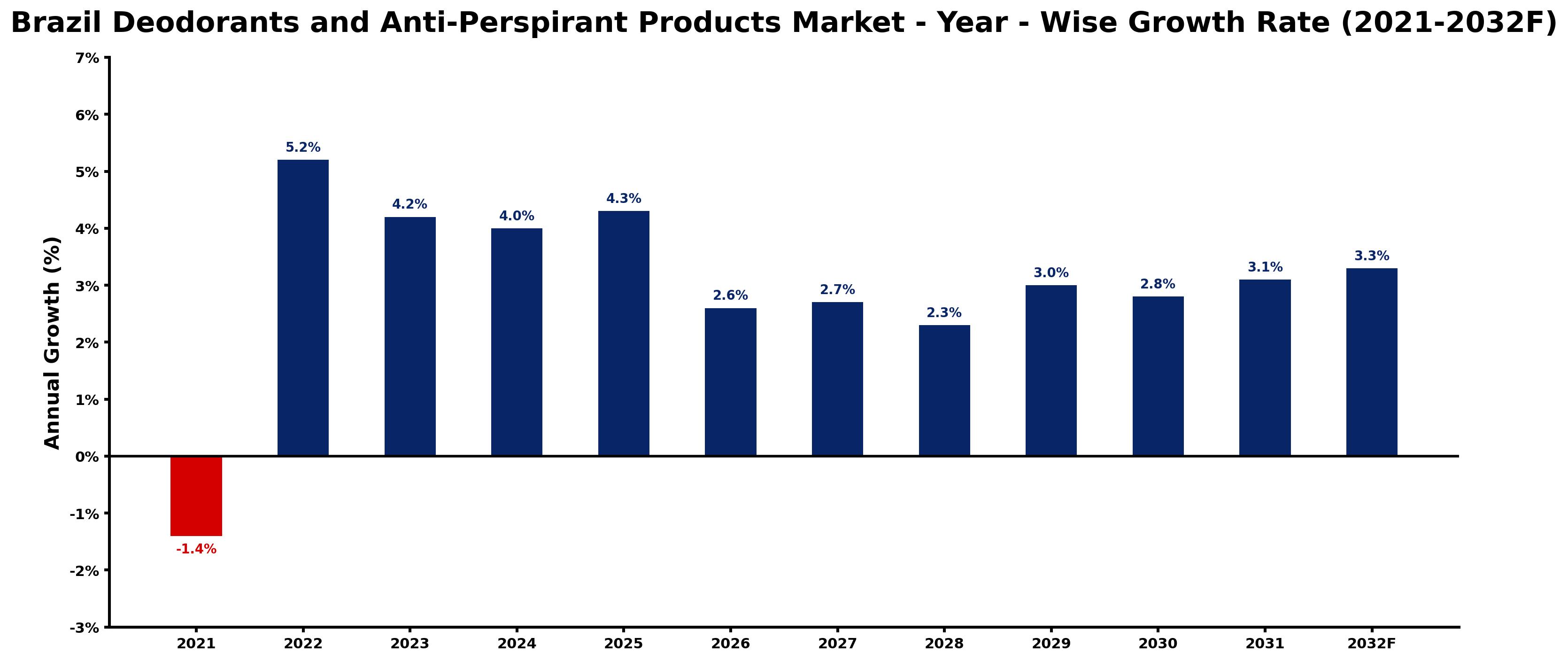
The table below presents the year wise growth rates along with the key drivers influencing the market
| Year | Growth Rate | Major Drivers |
| 2021 | -1.4% | Increased healthconscious consumer preferences shifted focus away from chemicalladen products, impacting deodorant sales in Brazil. |
| 2022 | 5.2% | Emerging local brands began to challenge traditional market leaders with innovative products. |
| 2023 | 4.2% | Increased awareness of personal hygiene led to higher sales in urban centers. |
| 2024 | 4.0% | Expansion of e-commerce platforms allowed for wider distribution and access to products. |
| 2025 | 4.3% | Marketing campaigns emphasizing sustainability gained traction among eco-conscious consumers. |
| 2026 | 2.6% | Cultural trends favored personalized beauty and grooming products tailored to individual needs. |
| 2027 | 2.7% | Young consumers showed a preference for multifunctional products combining fragrance and care. |
| 2028 | 2.3% | Social media influencers began collaborating with brands to boost product visibility. |
| 2029 | 3.0% | Economic recovery post-pandemic encouraged discretionary spending on personal care items. |
| 2030 | 2.8% | Technological innovations streamlined manufacturing processes, reducing costs and increasing availability. |
| 2031 | 3.1% | Shifts towards active lifestyles led to higher demand for long-lasting anti-perspirant solutions. |
| 2032 | 3.3% | Consumer education around health implications created demand for aluminum-free deodorant options. |
Note - Market size estimations and growth projections presented in this report are based on 6Wresearch's advanced forecasting approach, validated with industry datasets as of June 2026.
Brazil Deodorants and Anti-Perspirant Products Market Synopsis
The Brazil Deodorants and Anti-Perspirant Products Market is projected to reach 2.6% and witness significant growth during the forecast period (2026-2032). This growth is driven by an evolving consumer landscape that increasingly values personal hygiene and grooming. The ongoing evolution of product formulations, coupled with innovative marketing strategies, significantly shapes the competitive landscape of this market.
Brazil Deodorants and Anti-Perspirant Products Market Growth Drivers
The growth of the Brazil Deodorants and Anti-Perspirant Products Market is predominantly influenced by several key factors:
- The rising awareness of personal grooming and hygiene has led to an increased demand for deodorants and anti-perspirants among consumers across various demographics.
- Urbanization in Brazil is contributing to changing lifestyles, resulting in a heightened focus on personal care products that cater to these new consumer habits.
- Innovative formulations that include long-lasting fragrances and natural ingredients are attracting a broader consumer base, appealing particularly to younger, health-conscious shoppers.
- The influx of marketing strategies that emphasize the benefits of using these products boosts consumer engagement and ultimately drives sales.
- Additionally, rising disposable incomes among Brazilian households enable consumers to invest more in premium deodorant and anti-perspirant options.
Brazil Deodorants and Anti-Perspirant Products Market Challenges and Restraints
Despite the growth opportunities, the Brazil Deodorants and Anti-Perspirant Products Market faces challenges that could impede its progress:
- Consumer preferences are shifting towards natural and organic alternatives, posing threats to traditional product lines that are chemical-based.
- There exists a saturated market where numerous products compete for consumer attention, making brand differentiation increasingly difficult.
- Stringent regulatory requirements related to product formulations can hinder the innovation process and delay product launches.
- The fluctuation of raw material prices could impact production costs and, subsequently, retail pricing strategies.
- Consumer skepticism regarding the safety and efficacy of certain ingredients can adversely affect purchasing decisions and brand loyalty.
Brazil Deodorants and Anti-Perspirant Products Market Government Investment and Initiatives
In Brazil, government policies play a pivotal role in shaping the deodorants and anti-perspirant products market. Regulatory frameworks emphasizing consumer safety and product quality are fundamental. Ongoing investments in research and development initiatives by the government promote innovation within the cosmetics sector, encouraging companies to create safer and more effective products. Additionally, public spending aimed at enhancing quality control mechanisms further strengthens the regulatory landscape, ensuring compliance with strict cosmetic regulations. These policies help to diversify offerings and foster a competitive environment conducive to healthy market growth.
Brazil Deodorants and Anti-Perspirant Products Market Latest Developments (May 2025 - June 2026)
Recent developments in the Brazil Deodorants and Anti-Perspirant Products Market indicate a trend towards sustainability and the incorporation of eco-friendly ingredients. The growing consumer demand for transparency regarding ingredient sourcing has influenced many manufacturers to improve their formulations. Additionally, the rise in online retail platforms has provided a new avenue for reaching tech-savvy consumers, facilitating greater market access. Companies have been focusing on digital marketing strategies to enhance brand visibility and consumer engagement. Furthermore, recent collaborative initiatives aimed at promoting health and wellness contribute to the overall growth of this market.
Brazil Deodorants and Anti-Perspirant Products Market - Key Attractiveness of the Report
- 10 Years of Market Numbers
- Historical Data Starting from 2022 to 2025
- Base Year: 2025
- Forecast Data until 2032
- Key Performance Indicators Impacting the Market
- Major Upcoming Developments and Projects
Key Highlights of the Report:
- Brazil Deodorants and Anti-Perspirant Products Market Outlook
- Market Size of Brazil Deodorants and Anti-Perspirant Products Market, 2025
- Forecast of Brazil Deodorants and Anti-Perspirant Products Market, 2032
- Historical Data and Forecast of Brazil Deodorants and Anti-Perspirant Products Revenues & Volume for the Period 2022-2032F
- Brazil Deodorants and Anti-Perspirant Products Market Trend Evolution
- Brazil Deodorants and Anti-Perspirant Products Market Drivers and Challenges
- Brazil Deodorants and Anti-Perspirant Products Price Trends
- Brazil Deodorants and Anti-Perspirant Products Porter's Five Forces
- Brazil Deodorants and Anti-Perspirant Products Industry Life Cycle
- Historical Data and Forecast of Brazil Deodorants and Anti-Perspirant Products Market Revenues & Volume By Function for the Period 2022-2032F
- Historical Data and Forecast of Brazil Deodorants and Anti-Perspirant Products Market Revenues & Volume By Aerosol Spray for the Period 2022-2032F
- Historical Data and Forecast of Brazil Deodorants and Anti-Perspirant Products Market Revenues & Volume By Cream for the Period 2022-2032F
- Historical Data and Forecast of Brazil Deodorants and Anti-Perspirant Products Market Revenues & Volume By Roll-On for the Period 2022-2032F
- Historical Data and Forecast of Brazil Deodorants and Anti-Perspirant Products Market Revenues & Volume By Gel for the Period 2022-2032F
- Historical Data and Forecast of Brazil Deodorants and Anti-Perspirant Products Market Revenues & Volume By Ingredient for the Period 2022-2032F
- Historical Data and Forecast of Brazil Deodorants and Anti-Perspirant Products Market Revenues & Volume By Alcohol for the Period 2022-2032F
- Historical Data and Forecast of Brazil Deodorants and Anti-Perspirant Products Market Revenues & Volume By Antimicrobials for the Period 2022-2032F
- Historical Data and Forecast of Brazil Deodorants and Anti-Perspirant Products Market Revenues & Volume By Conditioner and Moisturizer for the Period 2022-2032F
- Historical Data and Forecast of Brazil Deodorants and Anti-Perspirant Products Market Revenues & Volume By Fragrances for the Period 2022-2032F
- Historical Data and Forecast of Brazil Deodorants and Anti-Perspirant Products Market Revenues & Volume By Paraben and Propellants for the Period 2022-2032F
- Historical Data and Forecast of Brazil Deodorants and Anti-Perspirant Products Market Revenues & Volume By Others for the Period 2022-2032F
- Brazil Deodorants and Anti-Perspirant Products Import Export Trade Statistics
- Market Opportunity Assessment By Function
- Market Opportunity Assessment By Ingredient
- Brazil Deodorants and Anti-Perspirant Products Top Companies Market Share
- Brazil Deodorants and Anti-Perspirant Products Competitive Benchmarking By Technical and Operational Parameters
- Brazil Deodorants and Anti-Perspirant Products Company Profiles
- Brazil Deodorants and Anti-Perspirant Products Key Strategic Recommendations






































