Brazil DevSecOps Market Size & Growth Rate (2026-2032)
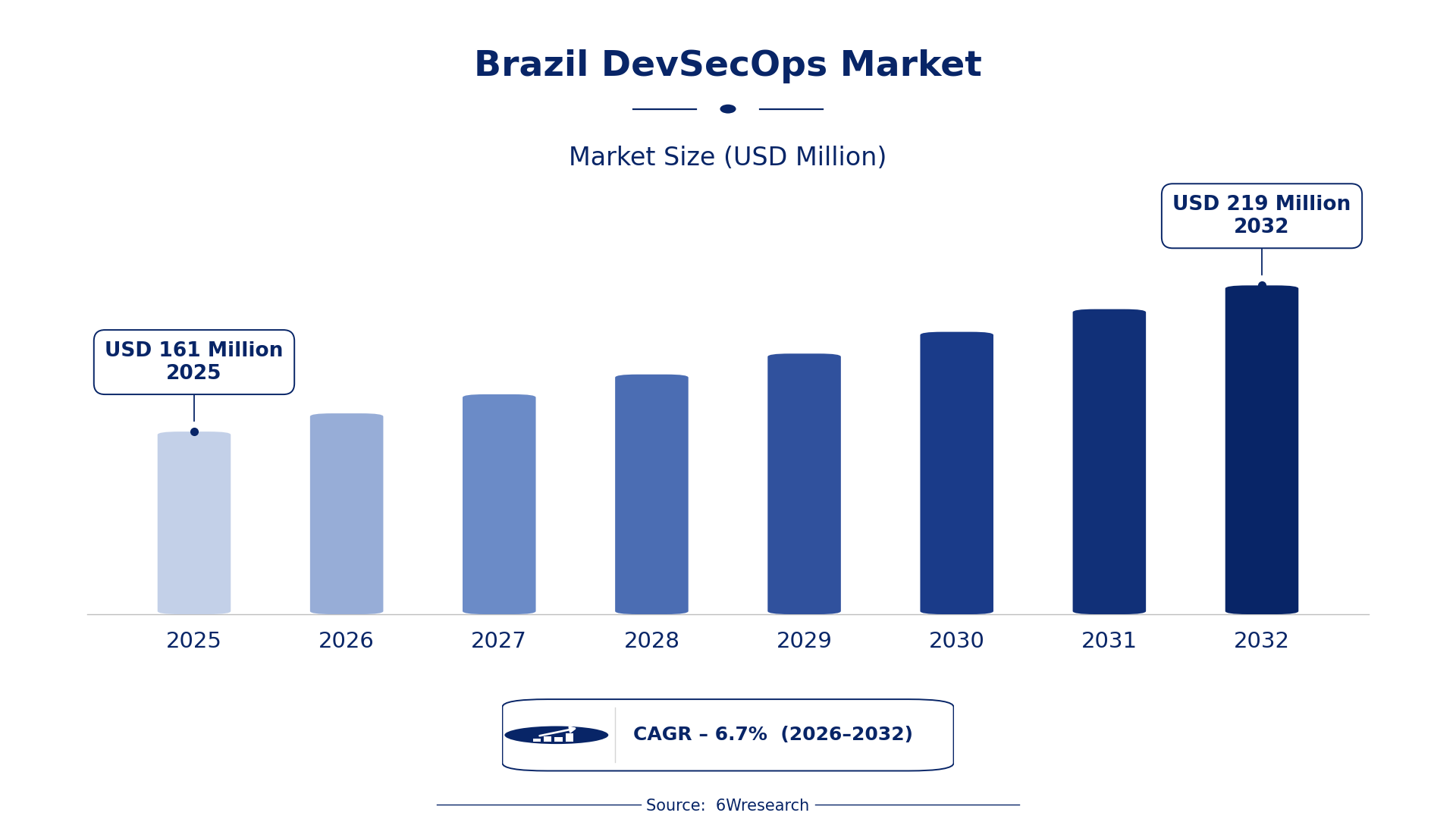
The Brazil DevSecOps Market was estimated at USD 161 Million in 2025 and is projected to reach USD 219 Million by 2032, growing at a CAGR of 6.7% from 2026 to 2032.
Brazil DevSecOps Market Synopsis
The growing emphasis on cybersecurity is the most influential factor driving the Brazil DevSecOps Market. Organizations are increasingly recognizing that integrating security into the development process is not just beneficial but essential for safeguarding their digital assets.
As Brazil's enterprises adopt agile methodologies, the demand for automated security practices is surging. This trend fosters early detection of vulnerabilities, which is crucial in an environment where cyber threats are becoming more sophisticated and frequent.
Brazil DevSecOps Market Year-wise Growth Rate and Key Drivers
This graph illustrates the annual growth rates of the Brazil DevSecOps Market from 2021 to 2032, highlighting a steady upward trajectory and projected expansion over the forecast period.
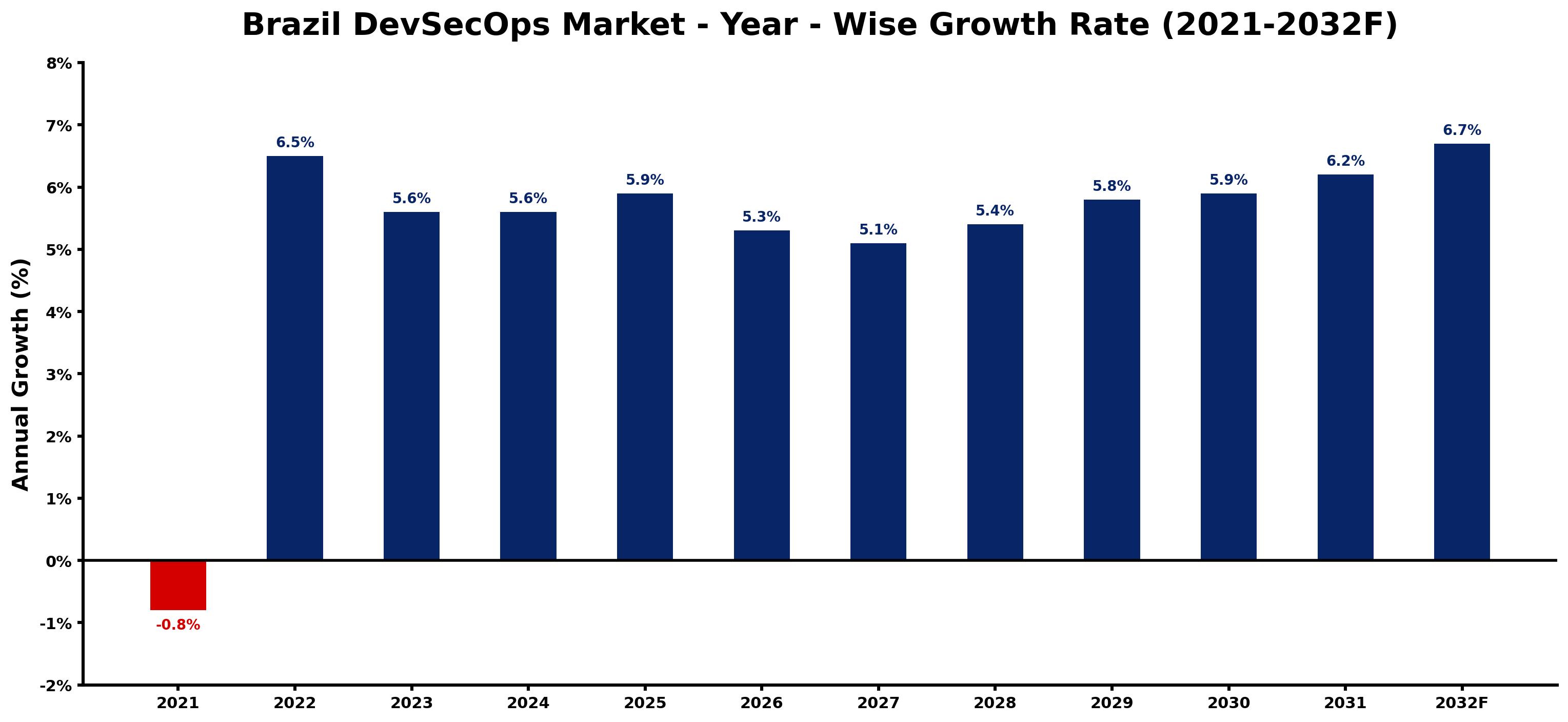
The table below presents the year‑wise growth rates along with the key drivers influencing the market
| Year | Growth Rate | Major Drivers |
| 2021 | -0.8% | National Cybersecurity Strategy delays DevSecOps adoption in Brazil. |
| 2022 | 6.5% | Brazil's General Data Protection Law enforcement increasing compliance demands. |
| 2023 | 5.6% | B3 stock exchange adopting DevSecOps for financial applications. |
| 2024 | 5.6% | Growing local startup ecosystem driving cloud security investments. |
| 2025 | 5.9% | Government digitalization strategies enhancing software development security. |
| 2026 | 5.3% | Increased focus on cybersecurity education in Brazilian universities. |
| 2027 | 5.1% | Emergence of fintechs requiring robust security practices. |
| 2028 | 5.4% | Local tech hubs fostering secure software development innovations. |
| 2029 | 5.8% | Partnerships between tech firms and universities for security research. |
| 2030 | 5.9% | Advancements in AI for automated security testing solutions. |
| 2031 | 6.2% | Regulatory pressure on data privacy driving security integration. |
| 2032 | 6.7% | Local enterprises prioritizing risk management in software projects. |
Note: Market size estimations and growth projections presented in this report are based on 6Wresearch's proprietary forecasting methodology, utilizing the latest available industry data, government publications, and primary research inputs.
Brazil DevSecOps Market Key Takeaways
Below are some of the specific key takeaways from the market, including:
- The integration of security in software development is becoming a standard practice among Brazilian enterprises.
- Regulatory compliance is increasingly driving the adoption of DevSecOps solutions.
- Automation in security testing is a key focus area for businesses aiming to streamline their development processes.
- Cyber threats are evolving, compelling organizations to invest more in security measures throughout the development lifecycle.
- Public sector initiatives are enhancing the overall cybersecurity framework, bolstering market growth.
Evaluation of Restraints in Brazil DevSecOps Market
Despite the promising growth trajectory, several limitations hinder the Brazil DevSecOps Market. A notable constraint is the prevailing skills gap in the workforce, where many professionals lack the necessary expertise to implement effective DevSecOps practices. Additionally, integration issues with legacy systems can complicate the transition to more secure development frameworks. The resistance to cultural change within organizations also poses a challenge, as shifting mindsets is essential for fully embracing DevSecOps methodologies.
Brazil DevSecOps Market Trends
One prominent trend is the shift towards continuous security integration, where organizations focus on embedding security measures throughout the software development lifecycle. The rise of cloud-native applications is also shaping the market, as these environments necessitate a more dynamic approach to security. on top of that, the increasing use of artificial intelligence and machine learning in security testing is helping to enhance detection capabilities and streamline processes.
Brazil DevSecOps Market Opportunities
Significant growth opportunities exist in sectors such as finance and healthcare, where regulatory compliance is a driving force. The need for secure software delivery is particularly pressing in these industries, making them prime targets for DevSecOps solutions. Additionally, the ongoing digital transformation across various sectors presents avenues for new entrants to innovate and offer tailored services that meet specific organizational needs.
Government Initiatives in the Brazil DevSecOps Market
Brazilian government initiatives are increasingly focused on enhancing cybersecurity through structured policies and programs. This regulatory environment is crucial for encouraging organizations to adopt DevSecOps practices, aligning with national objectives for secure software development. As the government ramps up its efforts, businesses are motivated to integrate security into their development processes, ensuring compliance and resilience against cyber threats.
- A recently completed national cybersecurity framework aims to establish clear guidelines for secure software development practices.
- Currently underway is a program to develop technology skills in cybersecurity, aimed at addressing the workforce gap in the DevSecOps field.
- A planned initiative scheduled for 2026 focuses on creating incentives for private sector investments in secure coding standards and practices.
- Ongoing partnerships between government bodies and educational institutions are aimed at enhancing cybersecurity training and awareness.
- Recent legislation mandates stricter compliance requirements for software security, impacting how organizations approach their development processes.
Future Insights of the Brazil DevSecOps Market
Looking ahead to 2026-2032, the Brazil DevSecOps Market is expected to experience steady growth as organizations continue to prioritize security in their development lifecycles. As businesses adapt to a more digital environment, the demand for integrated security solutions will only intensify. The convergence of emerging technologies with DevSecOps practices will create a fertile ground for innovation, ultimately fostering a culture of security-first development across various industries.
Brazil DevSecOps Market Latest Developments
In the past year, the Brazil DevSecOps Market has seen a surge in activity as organizations strive to enhance their security posture. The growing recognition of the importance of secure software development has led to increased investments and partnerships aimed at fortifying cybersecurity measures.
- A major technology vendor launched a new suite of DevSecOps tools in Q1 2025, focusing on automation and compliance integration.
- An initiative that began in mid-2025 is currently underway, aimed at collaborating with startups to foster innovation in cybersecurity solutions.
- A public-private partnership is expected to kick off in late 2025, aiming to enhance cybersecurity infrastructure across critical sectors.
- Ongoing pilot projects are testing advanced threat detection tools that incorporate AI, with results anticipated by early 2026.
- A rollout of enhanced training programs for developers is planned for mid-2026 to address the skills gap in the DevSecOps field.
Brazil DevSecOps Market - Key Attractiveness of the Report
- 10 Years of Market Numbers
- Historical Data Starting from 2022 to 2025
- Base Year: 2025
- Forecast Data until 2032
- Key Performance Indicators Impacting the Market
- Major Upcoming Developments and Projects
Key Highlights of the Report:
- Brazil DevSecOps Market Outlook
- Market Size of Brazil DevSecOps Market, 2025
- Forecast of Brazil DevSecOps Market, 2032
- Historical Data and Forecast of Brazil DevSecOps Revenues & Volume for the Period 2022-2032F
- Brazil DevSecOps Market Trend Evolution
- Brazil DevSecOps Market Drivers and Challenges
- Brazil DevSecOps Price Trends
- Brazil DevSecOps Porter's Five Forces
- Brazil DevSecOps Industry Life Cycle
- Historical Data and Forecast of Brazil DevSecOps Market Revenues & Volume By Component for the Period 2022-2032F
- Historical Data and Forecast of Brazil DevSecOps Market Revenues & Volume By Solution for the Period 2022-2032F
- Historical Data and Forecast of Brazil DevSecOps Market Revenues & Volume By Services for the Period 2022-2032F
- Historical Data and Forecast of Brazil DevSecOps Market Revenues & Volume By Vertical for the Period 2022-2032F
- Historical Data and Forecast of Brazil DevSecOps Market Revenues & Volume By BFSI for the Period 2022-2032F
- Historical Data and Forecast of Brazil DevSecOps Market Revenues & Volume By IT for the Period 2022-2032F
- Historical Data and Forecast of Brazil DevSecOps Market Revenues & Volume By Telecommunications for the Period 2022-2032F
- Historical Data and Forecast of Brazil DevSecOps Market Revenues & Volume By Manufacturing for the Period 2022-2032F
- Historical Data and Forecast of Brazil DevSecOps Market Revenues & Volume By Government for the Period 2022-2032F
- Historical Data and Forecast of Brazil DevSecOps Market Revenues & Volume By Public Sector for the Period 2022-2032F
- Historical Data and Forecast of Brazil DevSecOps Market Revenues & Volume By Deployment Type for the Period 2022-2032F
- Historical Data and Forecast of Brazil DevSecOps Market Revenues & Volume By On-premises for the Period 2022-2032F
- Historical Data and Forecast of Brazil DevSecOps Market Revenues & Volume By Cloud for the Period 2022-2032F
- Historical Data and Forecast of Brazil DevSecOps Market Revenues & Volume By Organization Size for the Period 2022-2032F
- Historical Data and Forecast of Brazil DevSecOps Market Revenues & Volume By SMEs for the Period 2022-2032F
- Historical Data and Forecast of Brazil DevSecOps Market Revenues & Volume By Large Enterprises for the Period 2022-2032F
- Brazil DevSecOps Import Export Trade Statistics
- Market Opportunity Assessment By Component
- Market Opportunity Assessment By Vertical
- Market Opportunity Assessment By Deployment Type
- Market Opportunity Assessment By Organization Size
- Brazil DevSecOps Top Companies Market Share
- Brazil DevSecOps Competitive Benchmarking By Technical and Operational Parameters
- Brazil DevSecOps Company Profiles
- Brazil DevSecOps Key Strategic Recommendations






































