Brazil Display Controller Market Top 5 Importing Countries and Market Competition (HHI) Analysis
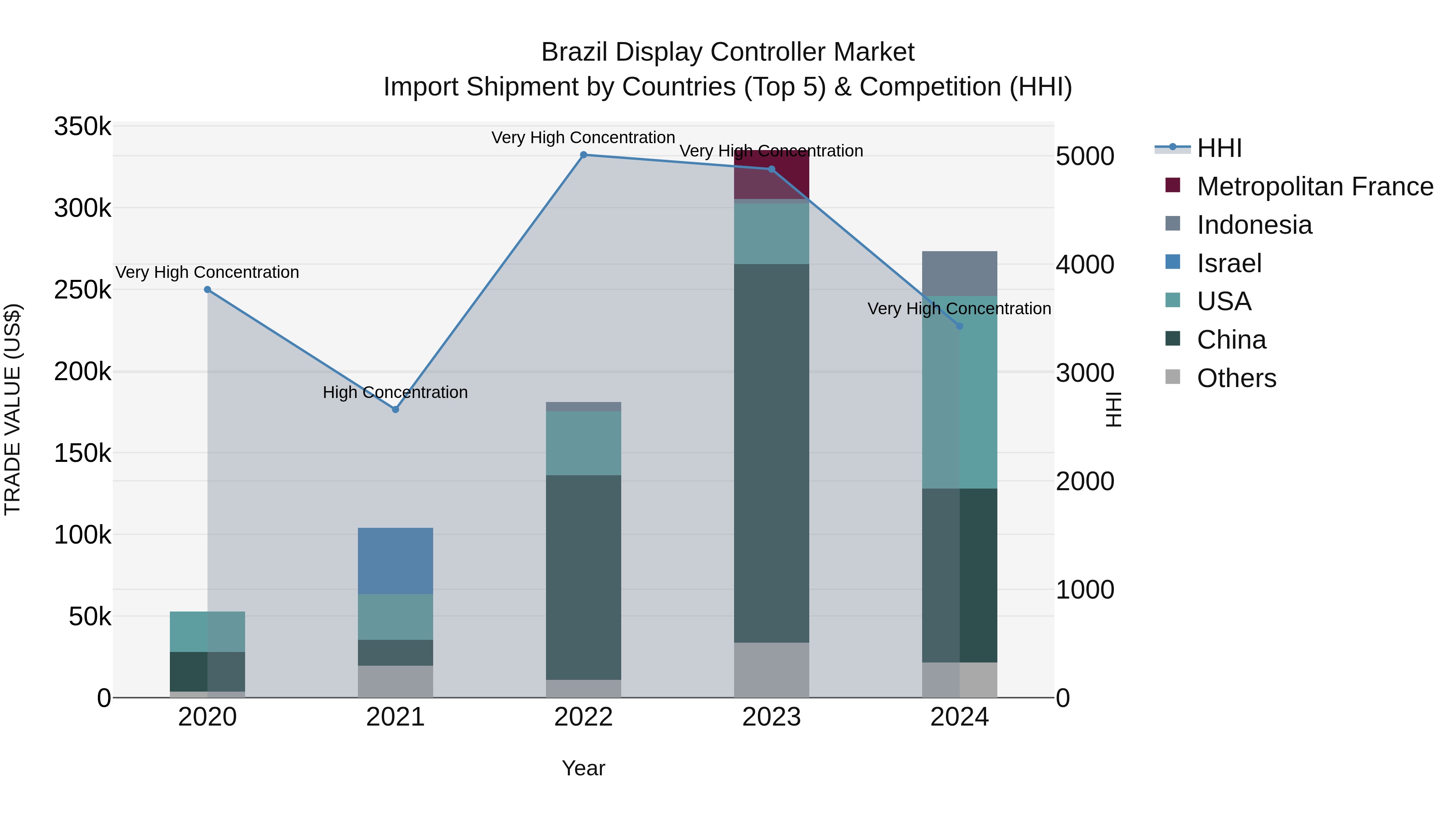
Brazil`s display controller import market in 2024 saw significant contributions from top exporting countries including the USA, China, Indonesia, Australia, and Germany. Despite high concentration with a high Herfindahl-Hirschman Index (HHI), the market demonstrated robust growth with a compound annual growth rate (CAGR) of 50.89% from 2020 to 2024. However, there was a slight decline in growth rate from 2023 to 2024, indicating a potential shift in market dynamics. The competitive landscape and evolving trends in display controller imports present opportunities for stakeholders to navigate the changing market conditions effectively.
Brazil Display Controller Market Overview
The Display Controller market in Brazil is experiencing growth propelled by the increasing demand for display processing solutions in consumer electronics, automotive infotainment, digital signage, and industrial applications. Display controllers manage the rendering, scaling, and transmission of visual content to display panels, ensuring optimal image quality, performance, and compatibility with different display interfaces and standards. With advancements in display technologies, connectivity options, and graphics processing capabilities, the display controller market in Brazil is witnessing adoption in LCDs, OLEDs, LED matrices, and other display types, offering opportunities for semiconductor manufacturers and system integrators to provide display solutions for diverse applications.
Drivers of the market
The display controller market in Brazil encounters challenges related to ensuring compatibility with diverse display technologies and resolutions. Limited availability of customized display controller solutions and concerns regarding scalability further impede market growth.
Challenges of the market
The Brazil Display Controller Market is witnessing growth driven by the increasing demand for high-performance display controllers in various applications such as smartphones, tablets, televisions, and automotive displays. Display controllers play a crucial role in processing and driving the content displayed on screens, ensuring smooth performance, vibrant colors, and crisp images. The growing emphasis on high-resolution displays, fast refresh rates, and advanced graphics capabilities, coupled with advancements in display technology, interface standards, and embedded graphics processing units (GPUs), is driving market growth in Brazil. Moreover, the need for seamless multimedia experiences, immersive gaming graphics, and energy-efficient display solutions is fueling the adoption of display controllers in the country.
Government Policy of the market
Regulatory frameworks governing electronics manufacturing, display standards, and technology integration influence the display controller market in Brazil. Government policies promoting technology innovation,semiconductor industry development, and export competitiveness drive market expansion by encouraging investment in display controller ICs for consumer electronics, automotive, and industrial applications.
Key Highlights of the Report:
- Brazil Display Controller Market Outlook
- Market Size of Brazil Display Controller Market, 2024
- Forecast of Brazil Display Controller Market, 2031
- Historical Data and Forecast of Brazil Display Controller Revenues & Volume for the Period 2021-2031
- Brazil Display Controller Market Trend Evolution
- Brazil Display Controller Market Drivers and Challenges
- Brazil Display Controller Price Trends
- Brazil Display Controller Porter's Five Forces
- Brazil Display Controller Industry Life Cycle
- Historical Data and Forecast of Brazil Display Controller Market Revenues & Volume By Type for the Period 2021-2031
- Historical Data and Forecast of Brazil Display Controller Market Revenues & Volume By LCD Controllers for the Period 2021-2031
- Historical Data and Forecast of Brazil Display Controller Market Revenues & Volume By Touchscreen Controllers for the Period 2021-2031
- Historical Data and Forecast of Brazil Display Controller Market Revenues & Volume By Multi-Display Controllers for the Period 2021-2031
- Historical Data and Forecast of Brazil Display Controller Market Revenues & Volume By Smart Display Controllers for the Period 2021-2031
- Historical Data and Forecast of Brazil Display Controller Market Revenues & Volume By Digital Display Controllers for the Period 2021-2031
- Historical Data and Forecast of Brazil Display Controller Market Revenues & Volume By Application for the Period 2021-2031
- Historical Data and Forecast of Brazil Display Controller Market Revenues & Volume By Appliances for the Period 2021-2031
- Historical Data and Forecast of Brazil Display Controller Market Revenues & Volume By Industrial Control for the Period 2021-2031
- Historical Data and Forecast of Brazil Display Controller Market Revenues & Volume By Medical Equipment for the Period 2021-2031
- Historical Data and Forecast of Brazil Display Controller Market Revenues & Volume By Office Automation for the Period 2021-2031
- Historical Data and Forecast of Brazil Display Controller Market Revenues & Volume By Automotive for the Period 2021-2031
- Historical Data and Forecast of Brazil Display Controller Market Revenues & Volume By Mobile Communication Devices for the Period 2021-2031
- Historical Data and Forecast of Brazil Display Controller Market Revenues & Volume By Entertainment & Gaming for the Period 2021-2031
- Historical Data and Forecast of Brazil Display Controller Market Revenues & Volume By Others for the Period 2021-2031
- Brazil Display Controller Import Export Trade Statistics
- Market Opportunity Assessment By Type
- Market Opportunity Assessment By Application
- Brazil Display Controller Top Companies Market Share
- Brazil Display Controller Competitive Benchmarking By Technical and Operational Parameters
- Brazil Display Controller Company Profiles
- Brazil Display Controller Key Strategic Recommendations






































