Brazil Dry-Cleaning And Laundry Services Market Size, Share & Growth Rate
The Brazil Dry-Cleaning And Laundry Services Market was estimated at USD 193 Million in 2025 and is projected to reach USD 229 Million by 2032, growing at a CAGR of 2.5% from 2026 to 2032. This growth is predominantly driven by the rising urban population and the increasing demand for convenience in personal care routines. As lifestyles evolve, consumers are prioritizing hygiene and professionalism in their laundry services, paving the way for robust market expansion.
Brazil Dry-Cleaning And Laundry Services Market Year-wise Growth Rate and Key Drivers
This graph highlights how the Brazil Dry-Cleaning And Laundry Services Market has steadily grown over the years, supported by major growth factors.
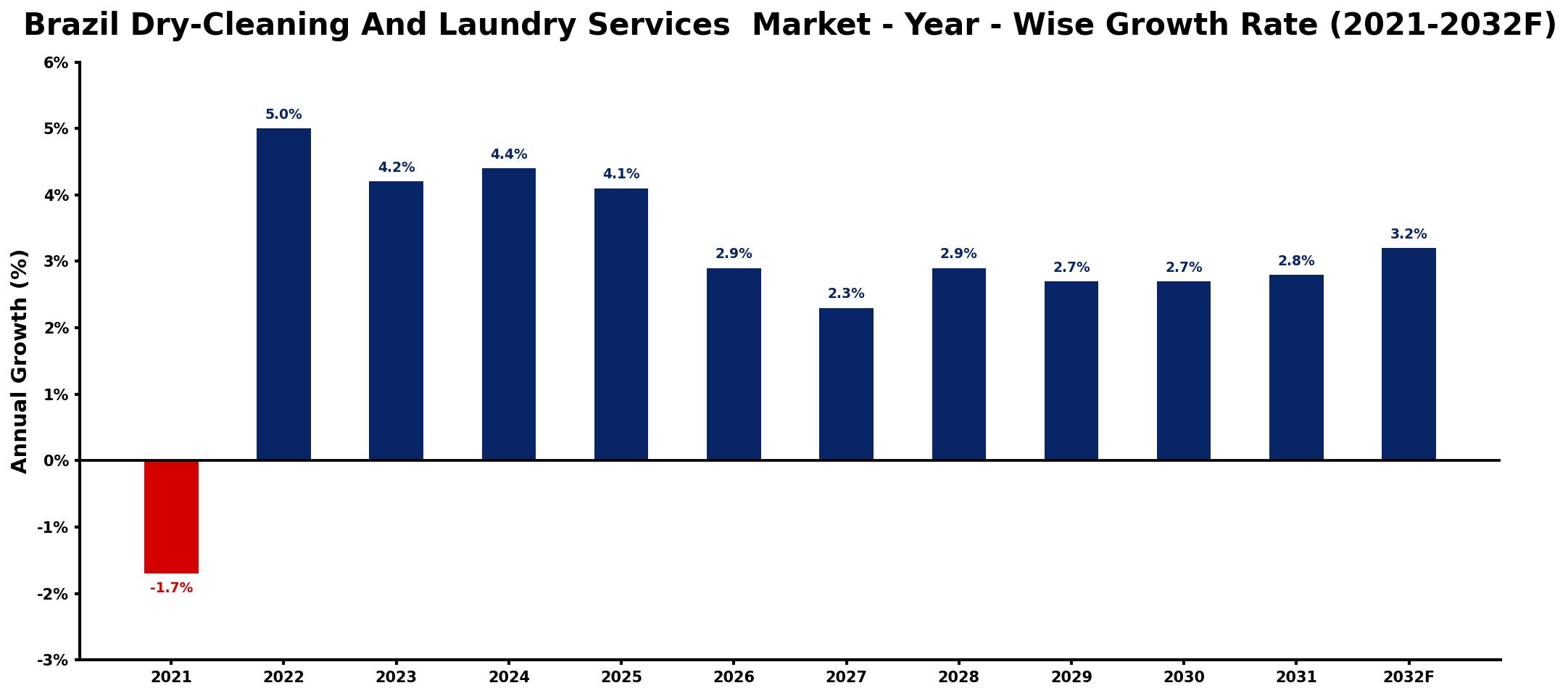
The table below presents the year‑wise growth rates along with the key drivers influencing the market
| Year | Growth Rate | Major Drivers |
| 2021 | -1.7% | Consumer spending decreased significantly |
| 2022 | 5.0% | Increased urban population density |
| 2023 | 4.2% | Rise in disposable income levels |
| 2024 | 4.4% | Growth in e-commerce sector |
| 2025 | 4.1% | Expansion of residential complexes |
| 2026 | 2.9% | Higher focus on sustainability practices |
| 2027 | 2.3% | Emergence of smart technology adoption |
| 2028 | 2.9% | Increase in tourism and travel |
| 2029 | 2.7% | Rising awareness of hygiene standards |
| 2030 | 2.7% | expanding healthcare application demand |
| 2031 | 2.8% | strengthening underlying market demand |
| 2032 | 3.2% | growing regional consumption patterns |
Note: Market size estimations and growth projections presented in this report are based on 6Wresearch's proprietary forecasting methodology, utilizing the latest available industry data, government publications, and primary research inputs.
Brazil Dry-Cleaning And Laundry Services Market Synopsis
The strongest force currently shaping the Brazil Dry-Cleaning And Laundry Services Market is the burgeoning urbanization trend, leading to an increase in disposable incomes and a significant shift in consumer behavior. Busy lifestyles prompt individuals to seek professional services that guarantee cleanliness and care for their garments and textiles.
Moreover, as awareness around hygiene grows, especially post-pandemic, there is a heightened demand for specialized cleaning services. This shift not only reflects changing consumer preferences but also places pressure on service providers to maintain high-quality standards and incorporate sustainable practices into their operations.
Brazil Dry-Cleaning And Laundry Services Market Key Takeaways
- Rapid urbanization is propelling demand for dry-cleaning and laundry services.
- Consumer preferences are shifting toward convenience and quality in professional cleaning.
- Sustainability and eco-friendly practices are becoming critical differentiators.
- Compliance with government regulations is essential for operational success.
- The market is expected to expand steadily, with significant growth opportunities in the coming years.
Evaluation of Restraints in Brazil Dry-Cleaning And Laundry Services Market
Despite promising growth, the Brazil Dry-Cleaning And Laundry Services Market faces several constraints. The increasing competition from in-house laundry solutions presents a significant challenge. Many consumers are opting for home laundering due to convenience and cost considerations. Additionally, the necessity of adhering to stringent environmental regulations can increase operational complexities and costs. Balancing these challenges while maintaining service quality is crucial for companies to thrive in this competitive landscape.
Brazil Dry-Cleaning And Laundry Services Market Trends
A notable trend in the Brazil Dry-Cleaning And Laundry Services Market is the integration of technology into operations. Innovations such as mobile apps for service scheduling and tracking, along with advancements in cleaning equipment, are enhancing customer experiences. Moreover, an increased focus on sustainable practices is prompting many providers to invest in eco-friendly cleaning technologies, which are increasingly demanded by conscientious consumers.
Additionally, the rise of subscription models is changing how services are marketed and consumed. These models offer consumers convenience and predictability, which are attractive attributes for time-strapped individuals looking to streamline their domestic responsibilities.
Brazil Dry-Cleaning And Laundry Services Market Opportunities
The Brazilian market presents genuine growth opportunities, particularly for businesses willing to innovate and adapt to changing consumer preferences. The rise in eco-consciousness among consumers offers a significant avenue for companies that invest in sustainable practices and technologies. Furthermore, expanding service offerings to include specialized cleaning for delicate and high-value items can attract a discerning customer base, providing a competitive edge in the market.
Government Initiatives in the Brazil Dry-Cleaning And Laundry Services Market
Government regulations significantly influence the Brazil Dry-Cleaning And Laundry Services Market, particularly regarding environmental practices and labor standards. Compliance with these regulations is not just a legal obligation but also a pathway to building consumer trust and enhancing brand reputation. Additionally, various governmental initiatives aimed at promoting sustainable business practices can provide further support for companies making eco-friendly shifts.
Future Insights of the Brazil Dry-Cleaning And Laundry Services Market
Looking ahead to the period from 2026 to 2032, the Brazil Dry-Cleaning And Laundry Services Market is poised for steady growth. As urbanization continues and consumer lifestyles evolve, the demand for professional cleaning services will likely increase. Providers that embrace technology, prioritize customer satisfaction, and commit to sustainable practices will be well-positioned to capitalize on this growth and navigate the complexities of an ever-changing market landscape.
Brazil Dry-Cleaning And Laundry Services Market Latest Developments (2025 - 2026)
Recent developments in the Brazil Dry-Cleaning And Laundry Services Market indicate a shift towards increased adoption of technology, particularly mobile applications that facilitate easier customer interaction. This trend is coupled with a rise in service providers emphasizing eco-friendly practices to meet consumer demand. Additionally, new entrants are exploring subscription-based service models, reflecting a broader trend towards convenience and customization in consumer services.
Brazil Dry-Cleaning And Laundry Services Market - Key Attractiveness of the Report
- 10 Years of Market Numbers
- Historical Data Starting from 2022 to 2025
- Base Year: 2025
- Forecast Data until 2032
- Key Performance Indicators Impacting the Market
- Major Upcoming Developments and Projects
Key Highlights of the Report:
- Brazil Dry-Cleaning And Laundry Services Market Outlook
- Market Size of Brazil Dry-Cleaning And Laundry Services Market, 2025
- Forecast of Brazil Dry-Cleaning And Laundry Services Market, 2032
- Historical Data and Forecast of Brazil Dry-Cleaning And Laundry Services Revenues & Volume for the Period 2022-2032F
- Brazil Dry-Cleaning And Laundry Services Market Trend Evolution
- Brazil Dry-Cleaning And Laundry Services Market Drivers and Challenges
- Brazil Dry-Cleaning And Laundry Services Price Trends
- Brazil Dry-Cleaning And Laundry Services Porter's Five Forces
- Brazil Dry-Cleaning And Laundry Services Industry Life Cycle
- Historical Data and Forecast of Brazil Dry-Cleaning And Laundry Services Market Revenues & Volume By Type for the Period 2022-2032F
- Historical Data and Forecast of Brazil Dry-Cleaning And Laundry Services Market Revenues & Volume By Coin-Operated Laundries and Drycleaners for the Period 2022-2032F
- Historical Data and Forecast of Brazil Dry-Cleaning And Laundry Services Market Revenues & Volume By Dry-Cleaning and Laundry Services for the Period 2022-2032F
- Historical Data and Forecast of Brazil Dry-Cleaning And Laundry Services Market Revenues & Volume By Linen and Uniform Supply for the Period 2022-2032F
- Historical Data and Forecast of Brazil Dry-Cleaning And Laundry Services Market Revenues & Volume By End-Use for the Period 2022-2032F
- Historical Data and Forecast of Brazil Dry-Cleaning And Laundry Services Market Revenues & Volume By Commericial Dry-Cleaning and Laundry Services for the Period 2022-2032F
- Historical Data and Forecast of Brazil Dry-Cleaning And Laundry Services Market Revenues & Volume By Residential Dry-Cleaning and Laundry Services for the Period 2022-2032F
- Historical Data and Forecast of Brazil Dry-Cleaning And Laundry Services Market Revenues & Volume By Coin-Operated Laundries and Drycleaners for the Period 2022-2032F
- Historical Data and Forecast of Brazil Dry-Cleaning And Laundry Services Market Revenues & Volume By Distribution Channel for the Period 2022-2032F
- Historical Data and Forecast of Brazil Dry-Cleaning And Laundry Services Market Revenues & Volume By Offline for the Period 2022-2032F
- Historical Data and Forecast of Brazil Dry-Cleaning And Laundry Services Market Revenues & Volume By Online for the Period 2022-2032F
- Brazil Dry-Cleaning And Laundry Services Import Export Trade Statistics
- Market Opportunity Assessment By Type
- Market Opportunity Assessment By End-Use
- Market Opportunity Assessment By Distribution Channel
- Brazil Dry-Cleaning And Laundry Services Top Companies Market Share
- Brazil Dry-Cleaning And Laundry Services Competitive Benchmarking By Technical and Operational Parameters
- Brazil Dry-Cleaning And Laundry Services Company Profiles
- Brazil Dry-Cleaning And Laundry Services Key Strategic Recommendations






































