Brazil EdTech and Smart Classrooms Market Size & Growth Rate (2026-2032)
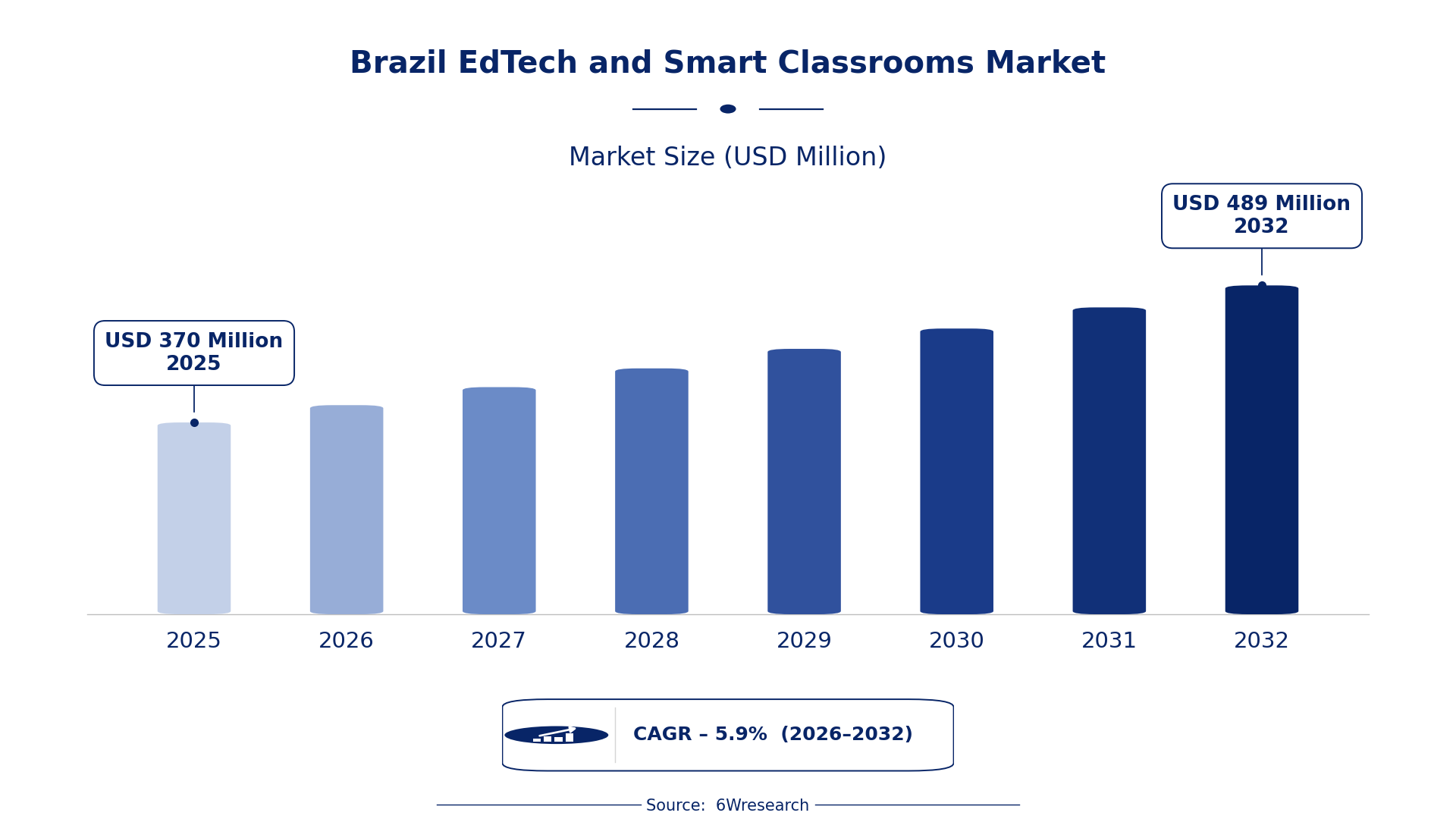
The Brazil EdTech and Smart Classrooms Market was estimated at USD 370 Million in 2025 and is projected to reach USD 489 Million by 2032, growing at a CAGR of 5.9% from 2026 to 2032.
Brazil EdTech and Smart Classrooms Market Synopsis
The digital transformation in education is the foremost influence on the Brazil EdTech and Smart Classrooms Market. Institutions are increasingly prioritizing technology-driven learning, integrating various EdTech solutions to enhance educational delivery.
With an emphasis on interactive learning experiences, the demand for smart classroom technologies is surging. This shift not only improves engagement but also prepares students for a technology-centric future, positioning Brazil as a noteworthy player in the global EdTech arena.
Brazil EdTech and Smart Classrooms Market Year-wise Growth Rate and Key Drivers
This graph illustrates the annual growth rates of the Brazil EdTech and Smart Classrooms Market from 2021 to 2032, highlighting a steady upward trajectory and projected expansion over the forecast period.
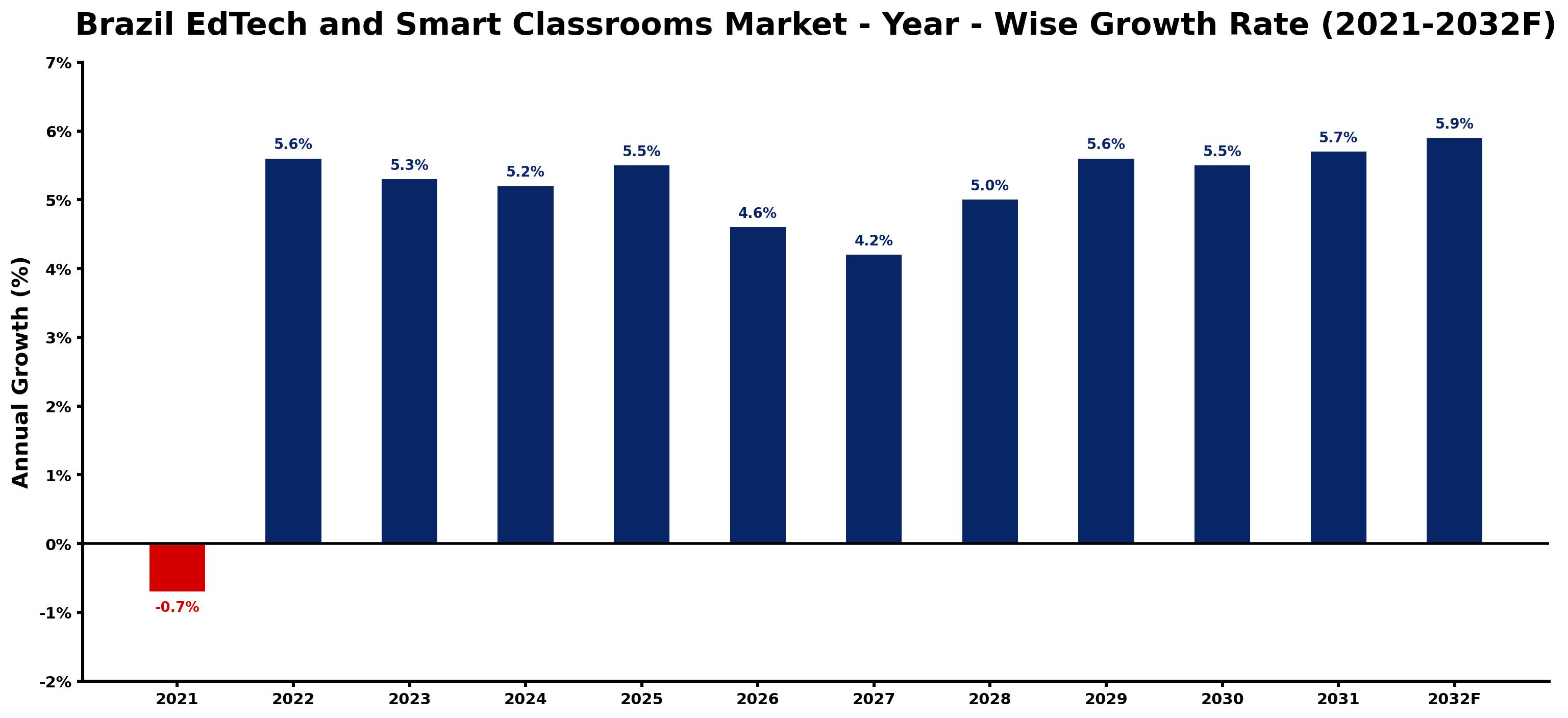
The table below presents the year‑wise growth rates along with the key drivers influencing the market
| Year | Growth Rate | Major Drivers |
| 2021 | -0.7% | Funding cuts by Brazilian Ministry of Education |
| 2022 | 5.6% | Launch of 'Educação Conectada' program promoting digital learning |
| 2023 | 5.3% | Increased smartphone adoption driving online learning accessibility |
| 2024 | 5.2% | Partnerships with local tech firms enhancing smart classroom tools |
| 2025 | 5.5% | Government mandates on technology use in education |
| 2026 | 4.6% | Rise in private school adoption of blended learning models |
| 2027 | 4.2% | Integration of AI tools in Brazilian classrooms increasing engagement |
| 2028 | 5.0% | Growth in digital content providers for Brazilian curricula |
| 2029 | 5.6% | Public recognition of remote learning success influencing policy |
| 2030 | 5.5% | Emergence of local incubators supporting EdTech startups |
| 2031 | 5.7% | Increased focus on STEM education boosting smart classroom investments |
| 2032 | 5.9% | Collaboration between universities and EdTech firms fostering innovation |
Note: Market size estimations and growth projections presented in this report are based on 6Wresearch's proprietary forecasting methodology, utilizing the latest available industry data, government publications, and primary research inputs.
Brazil EdTech and Smart Classrooms Market Key Takeaways
Below are some of the specific key takeaways from the market, including:
- The market is experiencing a shift toward personalized learning, driven by technology.
- Interactive classroom technologies are becoming essential for modern education in Brazil.
- Government policies are increasingly supportive of EdTech integration in schools.
- Infrastructure challenges remain a barrier to widespread adoption.
- There is a growing demand for online learning solutions, especially post-pandemic.
Evaluation of Restraints in Brazil EdTech and Smart Classrooms Market
Despite its growth, the Brazil EdTech and Smart Classrooms Market faces critical limitations. Infrastructure inadequacies hinder the effective implementation of advanced educational technologies. Many schools, especially in rural areas, lack reliable internet access, which restricts the use of online learning platforms. on top of that, ensuring inclusivity for diverse learning needs remains a challenge. Addressing these barriers will require substantial investment and collaboration between educational institutions and technology providers.
Brazil EdTech and Smart Classrooms Market Trends
A notable trend in this market is the increasing adoption of hybrid learning models, blending traditional classroom instruction with online learning. This approach not only caters to varied learning preferences but also offers flexibility, which has become essential in today’s educational environment. on top of that, the rise of gamification in learning tools is making education more engaging and interactive for students.
Additionally, the integration of artificial intelligence in educational platforms is enhancing personalization, allowing for tailored learning experiences that address individual student needs more effectively. These trends are pivotal in shaping the future of education in Brazil.
Brazil EdTech and Smart Classrooms Market Opportunities
Investment opportunities in the Brazil EdTech and Smart Classrooms Market are on the rise. There is a particular focus on developing localized content that meets the unique needs of Brazilian students. Companies that can provide scalable solutions to bridge the digital divide will find a receptive market. on top of that, partnerships with government bodies to enhance educational infrastructure represent a significant avenue for growth, particularly in underserved regions.
Government Initiatives in the Brazil EdTech and Smart Classrooms Market
Government policy is crucial in steering the Brazil EdTech and Smart Classrooms Market toward a tech-integrated educational future. Initiatives aimed at fostering digital literacy, enhancing online education, and improving technology access in schools illustrate a commitment to modernizing Brazil's education system. Aligning EdTech solutions with these policies is essential for market participants.
- A national initiative launched in 2025 to promote digital literacy among educators and students.
- Current projects involve upgrading technological infrastructure in public schools across major urban centers.
- Upcoming policies planned for 2027 will mandate the integration of EdTech solutions in the curriculum.
- Ongoing collaborations between the government and EdTech firms to develop tailored educational content.
- A regulatory framework established in 2026 to ensure compliance with digital education standards.
Future Insights of the Brazil EdTech and Smart Classrooms Market
Looking ahead to 2026-2032, the Brazil EdTech and Smart Classrooms Market is expected to evolve significantly. As digital tools become increasingly integral to education, institutions will likely invest more in technology-driven learning environments. The focus will shift toward creating inclusive educational experiences that cater to diverse student needs. With continued government support and private investment, the market is set for sustained growth and innovation.
Brazil EdTech and Smart Classrooms Market Latest Developments
In the past year, the Brazil EdTech and Smart Classrooms Market has witnessed a flurry of activity reflecting its dynamic nature. Companies are increasingly rolling out innovative products designed to enhance the learning experience, while educational institutions are adapting to embrace these changes. The collaborative efforts between stakeholders in the sector are shaping a promising future.
- A major technology vendor launched an interactive learning platform in early 2025, enhancing student engagement through gamified experiences.
- An initiative that began in mid-2025 is currently underway, focusing on training teachers in digital tools and online teaching methodologies.
- A leading regional operator is expanding its services to rural schools, aiming to improve access to educational technologies by late 2026.
- Plans for a nationwide campaign to raise awareness about digital education benefits are set to roll out in 2027.
- A partnership between educational institutions and tech companies was established in Q1 2025 to create localized content for Brazilian students.
Brazil EdTech and Smart Classrooms Market - Key Attractiveness of the Report
- 10 Years of Market Numbers
- Historical Data Starting from 2022 to 2025
- Base Year: 2025
- Forecast Data until 2032
- Key Performance Indicators Impacting the Market
- Major Upcoming Developments and Projects
Key Highlights of the Report:
- Brazil EdTech and Smart Classrooms Market Outlook
- Market Size of Brazil EdTech and Smart Classrooms Market, 2025
- Forecast of Brazil EdTech and Smart Classrooms Market, 2032
- Historical Data and Forecast of Brazil EdTech and Smart Classrooms Revenues & Volume for the Period 2022-2032F
- Brazil EdTech and Smart Classrooms Market Trend Evolution
- Brazil EdTech and Smart Classrooms Market Drivers and Challenges
- Brazil EdTech and Smart Classrooms Price Trends
- Brazil EdTech and Smart Classrooms Porter's Five Forces
- Brazil EdTech and Smart Classrooms Industry Life Cycle
- Historical Data and Forecast of Brazil EdTech and Smart Classrooms Market Revenues & Volume By Hardware for the Period 2022-2032F
- Historical Data and Forecast of Brazil EdTech and Smart Classrooms Market Revenues & Volume By Interactive Displays for the Period 2022-2032F
- Historical Data and Forecast of Brazil EdTech and Smart Classrooms Market Revenues & Volume By Interactive Projectors for the Period 2022-2032F
- Historical Data and Forecast of Brazil EdTech and Smart Classrooms Market Revenues & Volume By Education System Solution for the Period 2022-2032F
- Historical Data and Forecast of Brazil EdTech and Smart Classrooms Market Revenues & Volume By Learning Management System for the Period 2022-2032F
- Historical Data and Forecast of Brazil EdTech and Smart Classrooms Market Revenues & Volume By Student Information and Administration System for the Period 2022-2032F
- Historical Data and Forecast of Brazil EdTech and Smart Classrooms Market Revenues & Volume By Student Collaboration System for the Period 2022-2032F
- Historical Data and Forecast of Brazil EdTech and Smart Classrooms Market Revenues & Volume By Student Response System for the Period 2022-2032F
- Historical Data and Forecast of Brazil EdTech and Smart Classrooms Market Revenues & Volume By Learning and Gamification for the Period 2022-2032F
- Historical Data and Forecast of Brazil EdTech and Smart Classrooms Market Revenues & Volume By Test Preparation for the Period 2022-2032F
- Historical Data and Forecast of Brazil EdTech and Smart Classrooms Market Revenues & Volume By Classroom Management System for the Period 2022-2032F
- Historical Data and Forecast of Brazil EdTech and Smart Classrooms Market Revenues & Volume By Document Management System for the Period 2022-2032F
- Historical Data and Forecast of Brazil EdTech and Smart Classrooms Market Revenues & Volume By Deployment Type for the Period 2022-2032F
- Historical Data and Forecast of Brazil EdTech and Smart Classrooms Market Revenues & Volume By Cloud for the Period 2022-2032F
- Historical Data and Forecast of Brazil EdTech and Smart Classrooms Market Revenues & Volume By On-Premises for the Period 2022-2032F
- Historical Data and Forecast of Brazil EdTech and Smart Classrooms Market Revenues & Volume By End User for the Period 2022-2032F
- Historical Data and Forecast of Brazil EdTech and Smart Classrooms Market Revenues & Volume By K-12 for the Period 2022-2032F
- Historical Data and Forecast of Brazil EdTech and Smart Classrooms Market Revenues & Volume By Higher Education for the Period 2022-2032F
- Brazil EdTech and Smart Classrooms Import Export Trade Statistics
- Market Opportunity Assessment By Hardware
- Market Opportunity Assessment By Education System Solution
- Market Opportunity Assessment By Deployment Type
- Market Opportunity Assessment By End User
- Brazil EdTech and Smart Classrooms Top Companies Market Share
- Brazil EdTech and Smart Classrooms Competitive Benchmarking By Technical and Operational Parameters
- Brazil EdTech and Smart Classrooms Company Profiles
- Brazil EdTech and Smart Classrooms Key Strategic Recommendations






































