Brazil Electric Hair Clipper & Trimmer Market Size, Share & Growth Rate
The Brazil Electric Hair Clipper & Trimmer Market was estimated at USD 375 Million in 2025 and is projected to reach USD 519 Million by 2032, growing at a CAGR of 4.8% from 2026 to 2032. This growth trajectory is largely fueled by shifting consumer grooming habits and the increasing inclination towards at-home hair care solutions. As Brazilian consumers seek more convenience and professional-grade tools for personal grooming, the demand for advanced electric clippers and trimmers continues to gain momentum.
Brazil Electric Hair Clipper & Trimmer Market Year-wise Growth Rate and Key Drivers
This graph highlights how the Brazil Electric Hair Clipper & Trimmer Market has steadily grown over the years, supported by major growth factors.
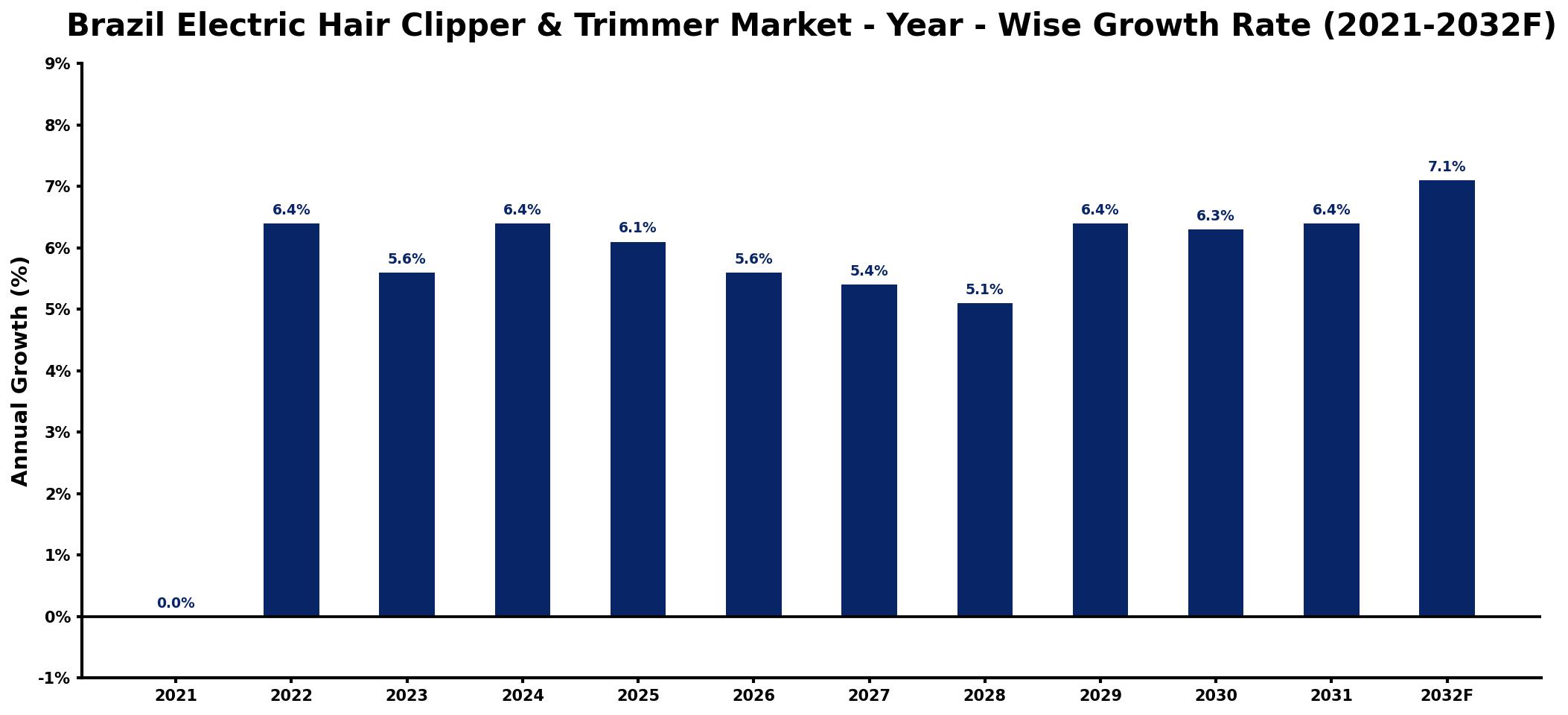
The table below presents the year‑wise growth rates along with the key drivers influencing the market
| Year | Growth Rate | Major Drivers |
| 2021 | 0.0% | Rising grooming awareness among consumers |
| 2022 | 6.4% | Increase in disposable income levels |
| 2023 | 5.6% | Growth of e-commerce platforms |
| 2024 | 6.4% | Expansion of beauty industry services |
| 2025 | 6.1% | Popularity of home grooming solutions |
| 2026 | 5.6% | Technological advancements in devices |
| 2027 | 5.4% | Demand for personalized grooming tools |
| 2028 | 5.1% | Influence of social media trends |
| 2029 | 6.4% | Rising consumer preference for convenience |
| 2030 | 6.3% | Increased focus on sustainability practices |
| 2031 | 6.4% | Growth in men's grooming segment |
| 2032 | 7.1% | Emergence of innovative product designs |
Note: Market size estimations and growth projections presented in this report are based on 6Wresearch's proprietary forecasting methodology, utilizing the latest available industry data, government publications, and primary research inputs.
Brazil Electric Hair Clipper & Trimmer Market Synopsis
The strongest force shaping the Brazil Electric Hair Clipper & Trimmer Market is the rising DIY grooming culture. Empowered by social media and online tutorials, consumers are increasingly motivated to invest in high-quality grooming tools that enable salon-like results at home. This trend is particularly pronounced among millennials and Generation Z, who prioritize convenience and personalization in their grooming routines.
Additionally, the introduction of innovative features such as cordless functionality, precision trimming options, and ergonomic designs is reshaping product offerings. As consumers become more discerning about quality and functionality, manufacturers are responding by continuously upgrading their products to include cutting-edge technologies, ensuring they meet the evolving preferences of the Brazilian market.
- The market is experiencing robust growth due to the rising trend of at-home grooming.
- Social media influence is significantly driving consumer investment in grooming tools.
- Technological innovations are paramount in enhancing product appeal and functionality.
- Regulatory compliance regarding safety and quality is essential for manufacturers.
- Government initiatives support consumer awareness of safe product usage and maintenance.
While the market is on an upward trend, it faces certain restraints that could hinder growth. Rapid technological advancements and changing consumer preferences create a challenge for manufacturers, necessitating continuous innovation to stay relevant. Furthermore, the market's product life cycle is influenced by these dynamics, as older models quickly become outdated. This places pressure on brands to invest in research and development to produce high-quality, innovative products that resonate with consumers' evolving needs.
Several key trends are shaping the Brazil Electric Hair Clipper & Trimmer Market. Firstly, there is a noticeable shift towards cordless models, reflecting consumer preference for convenience and mobility. Additionally, features like self-sharpening blades, quick charging capabilities, and customizable trimming lengths are becoming increasingly sought after. Eco-conscious consumers are also driving demand for energy-efficient and sustainable grooming solutions, pushing manufacturers to adopt greener practices in product design and packaging.
The Brazil Electric Hair Clipper & Trimmer Market presents numerous opportunities for growth and investment. The expanding DIY grooming culture is a significant avenue for brands to explore, particularly through targeted marketing campaigns aimed at younger consumers. Furthermore, the growing trend of personalized grooming experiences suggests potential for developing customizable and high-tech grooming devices. As manufacturers innovate and align their offerings with consumer demands, the market could see substantial expansion in the coming years.
The Brazilian government plays a pivotal role in shaping the Electric Hair Clipper & Trimmer Market through regulations aimed at consumer safety and product quality. These policies enforce stringent safety standards during the manufacturing process and mandate regular inspections to ensure compliance. Additionally, the government actively promotes consumer awareness initiatives, educating the public about safe product usage and maintenance to enhance user experience and satisfaction.
Looking ahead to 2026-2032, the Brazil Electric Hair Clipper & Trimmer Market is poised for continued expansion. Consumer demand for convenient, professional-quality grooming tools is expected to remain strong, bolstered by ongoing trends in DIY grooming. Additionally, advancements in technology, particularly in wireless and smart grooming solutions, will likely play a significant role in market evolution. As manufacturers adapt to these trends and invest in innovation, the market will continue to thrive in the face of emerging challenges.
In recent months, the Brazilian Electric Hair Clipper & Trimmer Market has witnessed a surge in product launches featuring advanced technology aimed at enhancing user experience. Manufacturers are increasingly focusing on ergonomic designs that improve comfort during use. Additionally, brands are investing in digital marketing strategies that leverage social media influencers to reach a broader audience, aligning product messaging with the preferences of younger consumers. Such strategic initiatives are expected to further drive market growth and brand loyalty.
- 10 Years of Market Numbers
- Historical Data Starting from 2022 to 2025
- Base Year: 2025
- Forecast Data until 2032
- Key Performance Indicators Impacting the Market
- Major Upcoming Developments and Projects
Key Highlights of the Report:
- Brazil Electric Hair Clipper & Trimmer Market Outlook
- Market Size of Brazil Electric Hair Clipper & Trimmer Market, 2025
- Forecast of Brazil Electric Hair Clipper & Trimmer Market, 2032
- Historical Data and Forecast of Brazil Electric Hair Clipper & Trimmer Revenues & Volume for the Period 2022-2032F
- Brazil Electric Hair Clipper & Trimmer Market Trend Evolution
- Brazil Electric Hair Clipper & Trimmer Market Drivers and Challenges
- Brazil Electric Hair Clipper & Trimmer Price Trends
- Brazil Electric Hair Clipper & Trimmer Porter's Five Forces
- Brazil Electric Hair Clipper & Trimmer Industry Life Cycle
- Historical Data and Forecast of Brazil Electric Hair Clipper & Trimmer Market Revenues & Volume By Product for the Period 2022-2032F
- Historical Data and Forecast of Brazil Electric Hair Clipper & Trimmer Market Revenues & Volume By Corded for the Period 2022-2032F
- Historical Data and Forecast of Brazil Electric Hair Clipper & Trimmer Market Revenues & Volume By Cordless for the Period 2022-2032F
- Historical Data and Forecast of Brazil Electric Hair Clipper & Trimmer Market Revenues & Volume By Distribution Channel for the Period 2022-2032F
- Historical Data and Forecast of Brazil Electric Hair Clipper & Trimmer Market Revenues & Volume By Offline for the Period 2022-2032F
- Historical Data and Forecast of Brazil Electric Hair Clipper & Trimmer Market Revenues & Volume By Online for the Period 2022-2032F
- Brazil Electric Hair Clipper & Trimmer Import Export Trade Statistics
- Market Opportunity Assessment By Product
- Market Opportunity Assessment By Distribution Channel
- Brazil Electric Hair Clipper & Trimmer Top Companies Market Share
- Brazil Electric Hair Clipper & Trimmer Competitive Benchmarking By Technical and Operational Parameters
- Brazil Electric Hair Clipper & Trimmer Company Profiles
- Brazil Electric Hair Clipper & Trimmer Key Strategic Recommendations






































