Brazil Electric Locomotives Market Size, Share & Growth Rate
The Brazil Electric Locomotives Market was estimated at USD 184 Million in 2025 and is projected to reach USD 218 Million by 2032, growing at a CAGR of 2.5% from 2026 to 2032. This positive trajectory is primarily driven by an increasing demand for sustainable transportation solutions and a shift toward electrification within the transportation sector. As environmental considerations gain prominence, the push for electric locomotives aligns with Brazil's broader goals for reducing carbon emissions and enhancing energy efficiency.
Brazil Electric Locomotives Market Year-wise Growth Rate and Key Drivers
This graph highlights how the Brazil Electric Locomotives Market has steadily grown over the years, supported by major growth factors.
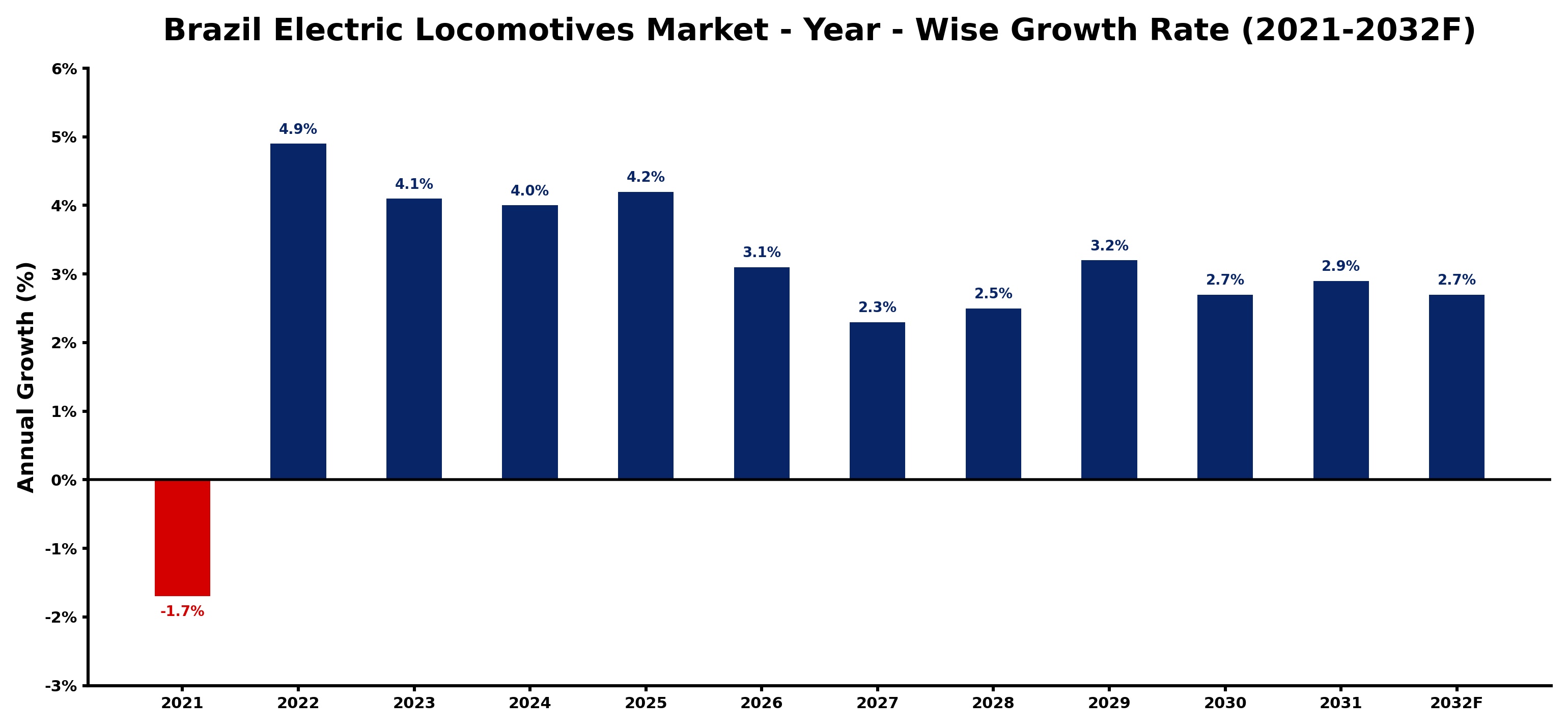
The table below presents the year‑wise growth rates along with the key drivers influencing the market
| Year | Growth Rate | Major Drivers |
| 2021 | -1.7% | Increasing smart city development projects |
| 2022 | 4.9% | Increasing industrial automation investments |
| 2023 | 4.1% | Increasing industrial automation investments |
| 2024 | 4.0% | Rising electricity demand across industries |
| 2025 | 4.2% | Growing renewable energy integration projects |
| 2026 | 3.1% | Increasing industrial automation investments |
| 2027 | 2.3% | Government infrastructure modernization initiatives |
| 2028 | 2.5% | Rising electricity demand across industries |
| 2029 | 3.2% | Expansion of manufacturing activities |
| 2030 | 2.7% | Increasing smart city development projects |
| 2031 | 2.9% | Government infrastructure modernization initiatives |
| 2032 | 2.7% | Growing renewable energy integration projects |
Note - Market size estimations and growth projections presented in this report are based on 6Wresearch’s advanced forecasting approach, validated with industry datasets as of June 2026.
Brazil Electric Locomotives Market Synopsis
The Brazil Electric Locomotives market has experienced momentum recently, propelled by government initiatives and an evolving public attitude favoring environmentally friendly transport options. However, while the demand is rising, the future landscape of the market hinges on strategic investments in infrastructure and collaborative efforts among stakeholders.
As the market moves forward, stakeholders will need to tackle various challenges, including the initial capital required for electrification and the establishment of necessary frameworks. This transitional phase represents both a hurdle and an opportunity for sustainable growth in Brazil's transportation ecosystem.
Brazil Electric Locomotives Market Key Takeaways
- The market is positioned for consistent growth, with a projected increase in size from USD 184 Million in 2025 to USD 218 Million by 2032.
- Environmental concerns and regulatory frameworks are key drivers pushing the adoption of electric locomotives.
- Strategic collaboration between industry stakeholders and policymakers is essential to address infrastructure challenges.
- Government policies aimed at promoting sustainable transportation will significantly influence market dynamics.
- Innovations in electric locomotive technology are expected to enhance operational efficiency and reliability.
Evaluation of Restraints in Brazil Electric Locomotives Market
Despite the promising outlook for the Brazil Electric Locomotives market, several constraints are limiting its full potential. The initial investment cost of electric locomotives remains a significant barrier for many operators, often discouraging the transition from traditional diesel-powered systems. Additionally, the existing railway infrastructure requires substantial upgrades to support electrification, creating further delays. Compounding these issues are regulatory hurdles that can impede swift decision-making, requiring careful navigation and a unified approach from industry players and government bodies alike. Addressing these issues is critical for fostering a more robust market environment.
Brazil Electric Locomotives Market Trends
Several current and emerging trends are shaping the Brazil Electric Locomotives market. A notable shift is the increasing emphasis on energy-efficient technologies, driven by advancements in battery storage and electric traction systems. Furthermore, the integration of digital solutions, such as IoT-enabled systems for real-time monitoring, is transforming operational efficiency. There is also a rising trend towards public-private partnerships that facilitate infrastructure development, essential for supporting electrification efforts within Brazil's railway network.
Brazil Electric Locomotives Market Opportunities
The Brazil Electric Locomotives market presents genuine growth and investment opportunities, particularly in the realms of infrastructure modernization and technological innovation. As the government intensifies efforts to promote sustainable transport, public funding and incentives can pave the way for expanded electrification projects. This opens avenues for private investments in developing electric rail networks and retrofitting existing locomotives to operate on electric systems. Additionally, the push for green technologies offers lucrative prospects for firms specializing in energy-efficient solutions.
Government Initiatives in the Brazil Electric Locomotives Market
The Brazilian government has been active in promoting policies aimed at fostering sustainable transportation solutions. These initiatives include financial incentives for electric locomotive adoption, as well as funding for infrastructure upgrades necessary for electrification. The government's focus on reducing carbon emissions aligns with its broader climate goals, influencing market dynamics positively. Ongoing dialogues among policymakers, industry representatives, and stakeholders are crucial to ensure that the necessary frameworks are established for a successful transition to electric rail transport.
Future Insights of the Brazil Electric Locomotives Market
Looking ahead to the period from 2026 to 2032, the Brazil Electric Locomotives market is anticipated to evolve significantly. With increasing investments in rail infrastructure and technological advancements, the adoption of electric locomotives is expected to gain further momentum. The convergence of public policy support and market demand will likely result in a more established presence of electric locomotives within the country's transportation landscape, driving towards a cleaner, more efficient rail system.
Brazil Electric Locomotives Market Latest Developments (May 2025 - June 2026)
Recent developments in the Brazil Electric Locomotives market have shown a marked focus on enhancing operational efficiencies through new technology adoptions. Stakeholders are exploring innovative financing models to overcome initial investment challenges, while several collaborative projects between public and private sectors are emerging to bolster infrastructure capabilities. These trends suggest a dynamic evolution within the market as it adapts to changing environmental standards and technological advancements.
Brazil Electric Locomotives Market - Key Attractiveness of the Report
- 10 Years of Market Numbers
- Historical Data Starting from 2022 to 2025
- Base Year: 2025
- Forecast Data until 2032
- Key Performance Indicators Impacting the Market
- Major Upcoming Developments and Projects
Key Highlights of the Report:
- Brazil Electric Locomotives Market Outlook
- Market Size of Brazil Electric Locomotives Market, 2025
- Forecast of Brazil Electric Locomotives Market, 2032
- Historical Data and Forecast of Brazil Electric Locomotives Revenues & Volume for the Period 2022-2032F
- Brazil Electric Locomotives Market Trend Evolution
- Brazil Electric Locomotives Market Drivers and Challenges
- Brazil Electric Locomotives Price Trends
- Brazil Electric Locomotives Porter's Five Forces
- Brazil Electric Locomotives Industry Life Cycle
- Historical Data and Forecast of Brazil Electric Locomotives Market Revenues & Volume By Energy Transfer for the Period 2022-2032F
- Historical Data and Forecast of Brazil Electric Locomotives Market Revenues & Volume By Overhead Lines for the Period 2022-2032F
- Historical Data and Forecast of Brazil Electric Locomotives Market Revenues & Volume By Third Rail for the Period 2022-2032F
- Historical Data and Forecast of Brazil Electric Locomotives Market Revenues & Volume By On-board Energy Storage for the Period 2022-2032F
- Historical Data and Forecast of Brazil Electric Locomotives Market Revenues & Volume By Technology for the Period 2022-2032F
- Historical Data and Forecast of Brazil Electric Locomotives Market Revenues & Volume By IGBT Module for the Period 2022-2032F
- Historical Data and Forecast of Brazil Electric Locomotives Market Revenues & Volume By GTO Thyristor for the Period 2022-2032F
- Historical Data and Forecast of Brazil Electric Locomotives Market Revenues & Volume By SiC Module for the Period 2022-2032F
- Historical Data and Forecast of Brazil Electric Locomotives Market Revenues & Volume By Traction Units for the Period 2022-2032F
- Historical Data and Forecast of Brazil Electric Locomotives Market Revenues & Volume By AC Traction Units for the Period 2022-2032F
- Historical Data and Forecast of Brazil Electric Locomotives Market Revenues & Volume By DC Traction Units for the Period 2022-2032F
- Historical Data and Forecast of Brazil Electric Locomotives Market Revenues & Volume By Multi System Units for the Period 2022-2032F
- Historical Data and Forecast of Brazil Electric Locomotives Market Revenues & Volume By Application for the Period 2022-2032F
- Historical Data and Forecast of Brazil Electric Locomotives Market Revenues & Volume By Passenger Transport for the Period 2022-2032F
- Historical Data and Forecast of Brazil Electric Locomotives Market Revenues & Volume By Freight Transport for the Period 2022-2032F
- Brazil Electric Locomotives Import Export Trade Statistics
- Market Opportunity Assessment By Energy Transfer
- Market Opportunity Assessment By Technology
- Market Opportunity Assessment By Traction Units
- Market Opportunity Assessment By Application
- Brazil Electric Locomotives Top Companies Market Share
- Brazil Electric Locomotives Competitive Benchmarking By Technical and Operational Parameters
- Brazil Electric Locomotives Company Profiles
- Brazil Electric Locomotives Key Strategic Recommendations






































