Brazil Ferro Aluminum Market Size, Share & Growth Rate
The Brazil Ferro Aluminum Market was estimated at USD 201 Million in 2025 and is projected to reach USD 239 Million by 2032, growing at a CAGR of 2.5% from 2026 to 2032. This growth trajectory is primarily fueled by the increasing demand for high-strength materials within the automotive and aerospace sectors, where ferro aluminum plays a crucial role in improving aluminum's structural integrity. Additionally, the ongoing developments in metal recycling are promoting the use of ferro aluminum, as manufacturers seek to enhance sustainability in production processes.
Brazil Ferro Aluminum Market Year-wise Growth Rate and Key Drivers
This graph highlights how the Brazil Ferro Aluminum Market has steadily grown over the years, supported by major growth factors.
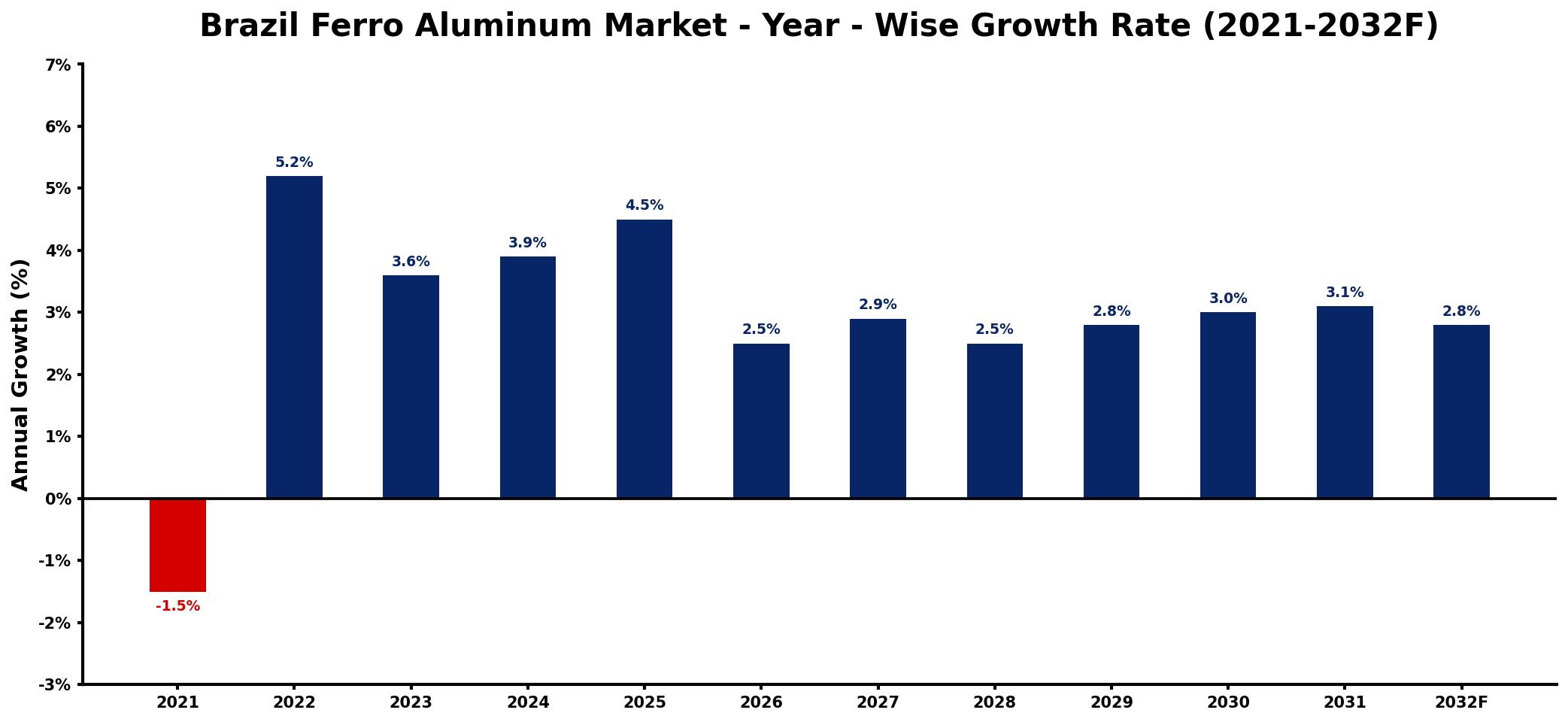
The table below presents the year‑wise growth rates along with the key drivers influencing the market
| Year | Growth Rate | Major Drivers |
| 2021 | -1.5% | decreased industrial sector activity |
| 2022 | 5.2% | increased construction project investments |
| 2023 | 3.6% | growing automotive manufacturing demand |
| 2024 | 3.9% | expansion of renewable energy projects |
| 2025 | 4.5% | rising infrastructure development initiatives |
| 2026 | 2.5% | strengthened mining sector investments |
| 2027 | 2.9% | enhanced aerospace industry requirements |
| 2028 | 2.5% | growing demand from electronics sector |
| 2029 | 2.8% | increased domestic production output |
| 2030 | 3.0% | increased focus on sustainability initiatives |
| 2031 | 3.1% | increased pharmaceutical industry usage |
| 2032 | 2.8% | rising global market competitiveness |
Note: Market size estimations and growth projections presented in this report are based on 6Wresearch's proprietary forecasting methodology, utilizing the latest available industry data, government publications, and primary research inputs.
Brazil Ferro Aluminum Market Synopsis
The ferro aluminum market in Brazil is witnessing a significant shift driven by the countrys robust aluminum industry, which spans several key sectors. Automotive manufacturers are increasingly incorporating ferro aluminum in their designs to meet stringent performance standards, while the aerospace industry is also leveraging its properties for innovative applications.
Recent advancements in production technologies and rising investments in infrastructure are further bolstering market growth. As Brazil positions itself as a leader in the alloy industry, the interplay of domestic production and foreign investments is set to redefine the competitive landscape of the ferro aluminum market.
Brazil Ferro Aluminum Market Key Takeaways
- The market is driven by increased consumption in automotive and aerospace industries.
- Innovative recycling technologies are enhancing the sustainability of ferro aluminum production.
- Government policies are focused on technological advancements and reducing regulatory hurdles.
- Price volatility of aluminum remains a significant concern impacting profitability.
- Market players are exploring alternative alloys to maintain competitive advantage.
Evaluation of Restraints in Brazil Ferro Aluminum Market
Despite the promising outlook, the Brazil ferro aluminum market grapples with several restraints that could limit its potential. Chief among these is the price volatility of aluminum, which often creates uncertainty for manufacturers relying on stable pricing. Coupled with fluctuating energy costs, this volatility can lead to challenges in managing production budgets effectively. Furthermore, competition from alternative alloys poses a threat, as innovations in material science yield substitutes that may outperform ferro aluminum in specific applications. Compliance with stringent environmental regulations also drives up operational costs, necessitating that companies adopt proactive strategies to remain competitive.
Brazil Ferro Aluminum Market Trends
A noticeable trend in the Brazil ferro aluminum market is the growing focus on sustainability. Many manufacturers are investing in eco-friendly practices and developing processes that reduce waste and energy consumption. Additionally, the trend towards lightweight materials continues to gain traction in industries such as automotive, where fuel efficiency remains paramount. This shift towards lighter, stronger materials is propelling the demand for ferro aluminum, as its unique properties align with the industry's evolving requirements.
Technological advancements are also playing a pivotal role. Innovations in metallurgical processes are enhancing the quality of ferro aluminum and expanding its applications in various sectors. As companies strive for competitive advantages, the integration of artificial intelligence and automation in production lines is becoming increasingly common, signaling a transformative phase for the market.
Brazil Ferro Aluminum Market Opportunities
The Brazil ferro aluminum market presents significant growth opportunities for investors and stakeholders. With the nations ongoing push towards infrastructure development, there is ample scope for increased demand in construction applications. The rise of electric vehicles and the global shift towards renewable energy sources also open new avenues for ferro aluminum, as its strength and lightweight properties are ideal for components in these emerging technologies. Furthermore, ongoing research and development initiatives aimed at improving product performance create a fertile ground for innovation and market expansion.
Government Initiatives in the Brazil Ferro Aluminum Market
The Brazilian government is actively supporting the ferro aluminum market through strategic initiatives aimed at boosting domestic production and fostering technological innovation. Policies encouraging research and development are vital for enhancing industry competitiveness. Additionally, efforts to streamline regulatory processes aim to reduce bureaucratic barriers, making it easier for businesses to operate and expand. The government's focus on sustainable practices is also evident in its support for environmentally friendly initiatives, which are increasingly being adopted by industry players to meet both regulatory demands and market expectations.
Future Insights of the Brazil Ferro Aluminum Market
Looking ahead to 2026-2032, the Brazil ferro aluminum market is poised for steady growth, underpinned by expanding applications across key industries. The continuous evolution of manufacturing technologies, combined with Brazils rich natural resources, positions the country to capitalize on global market trends. As the demand for lightweight and durable materials surges, ferro aluminum is likely to secure a pivotal role in the materials landscape. Moreover, ongoing investments in green technologies and infrastructure development are expected to bolster market resilience and foster sustainable growth.
Brazil Ferro Aluminum Market Latest Developments (2025 - 2026)
In recent months, the Brazilian ferro aluminum industry has seen a concerted push towards enhancing production efficiency and sustainability. Companies are increasingly adopting advanced metallurgical practices that optimize the quality of ferro aluminum while minimizing environmental impact. Moreover, strategic partnerships aimed at advancing recycling technologies are being formed, enabling a more circular economy within the sector. These developments underscore a proactive approach to meeting both domestic and international demand for high-quality ferro aluminum.
Brazil Ferro Aluminum Market - Key Attractiveness of the Report
- 10 Years of Market Numbers
- Historical Data Starting from 2022 to 2025
- Base Year: 2025
- Forecast Data until 2032
- Key Performance Indicators Impacting the Market
- Major Upcoming Developments and Projects
Key Highlights of the Report:
- Brazil Ferro Aluminum Market Outlook
- Market Size of Brazil Ferro Aluminum Market, 2025
- Forecast of Brazil Ferro Aluminum Market, 2032
- Historical Data and Forecast of Brazil Ferro Aluminum Revenues & Volume for the Period 2022-2032F
- Brazil Ferro Aluminum Market Trend Evolution
- Brazil Ferro Aluminum Market Drivers and Challenges
- Brazil Ferro Aluminum Price Trends
- Brazil Ferro Aluminum Porter's Five Forces
- Brazil Ferro Aluminum Industry Life Cycle
- Historical Data and Forecast of Brazil Ferro Aluminum Market Revenues & Volume By Type for the Period 2022-2032F
- Historical Data and Forecast of Brazil Ferro Aluminum Market Revenues & Volume By Pure Ferro Aluminium Alloy for the Period 2022-2032F
- Historical Data and Forecast of Brazil Ferro Aluminum Market Revenues & Volume By Ferro Aluminium Alloy Mixture for the Period 2022-2032F
- Historical Data and Forecast of Brazil Ferro Aluminum Market Revenues & Volume By Application for the Period 2022-2032F
- Historical Data and Forecast of Brazil Ferro Aluminum Market Revenues & Volume By Automobile Industry for the Period 2022-2032F
- Historical Data and Forecast of Brazil Ferro Aluminum Market Revenues & Volume By Machinery Manufacturing for the Period 2022-2032F
- Historical Data and Forecast of Brazil Ferro Aluminum Market Revenues & Volume By Fireworks Industry for the Period 2022-2032F
- Historical Data and Forecast of Brazil Ferro Aluminum Market Revenues & Volume By Other for the Period 2022-2032F
- Brazil Ferro Aluminum Import Export Trade Statistics
- Market Opportunity Assessment By Type
- Market Opportunity Assessment By Application
- Brazil Ferro Aluminum Top Companies Market Share
- Brazil Ferro Aluminum Competitive Benchmarking By Technical and Operational Parameters
- Brazil Ferro Aluminum Company Profiles
- Brazil Ferro Aluminum Key Strategic Recommendations






































