Brazil Flame Lily Extract Market Size, Share & Growth Rate
The Brazil Flame Lily Extract Market was estimated at USD 389 Million in 2025 and is projected to reach USD 464 Million by 2032, growing at a CAGR of 2.6% from 2026 to 2032. This growth trajectory is driven largely by a rising consumer inclination toward natural and herbal products, which are believed to offer holistic health benefits. Additionally, advancements in extraction technologies and a deeper understanding of the flame lily's medicinal properties are set to further boost market demand.
Brazil Flame Lily Extract Market Year-wise Growth Rate and Key Drivers
This graph highlights how the Brazil Flame Lily Extract Market has steadily grown over the years, supported by major growth factors.
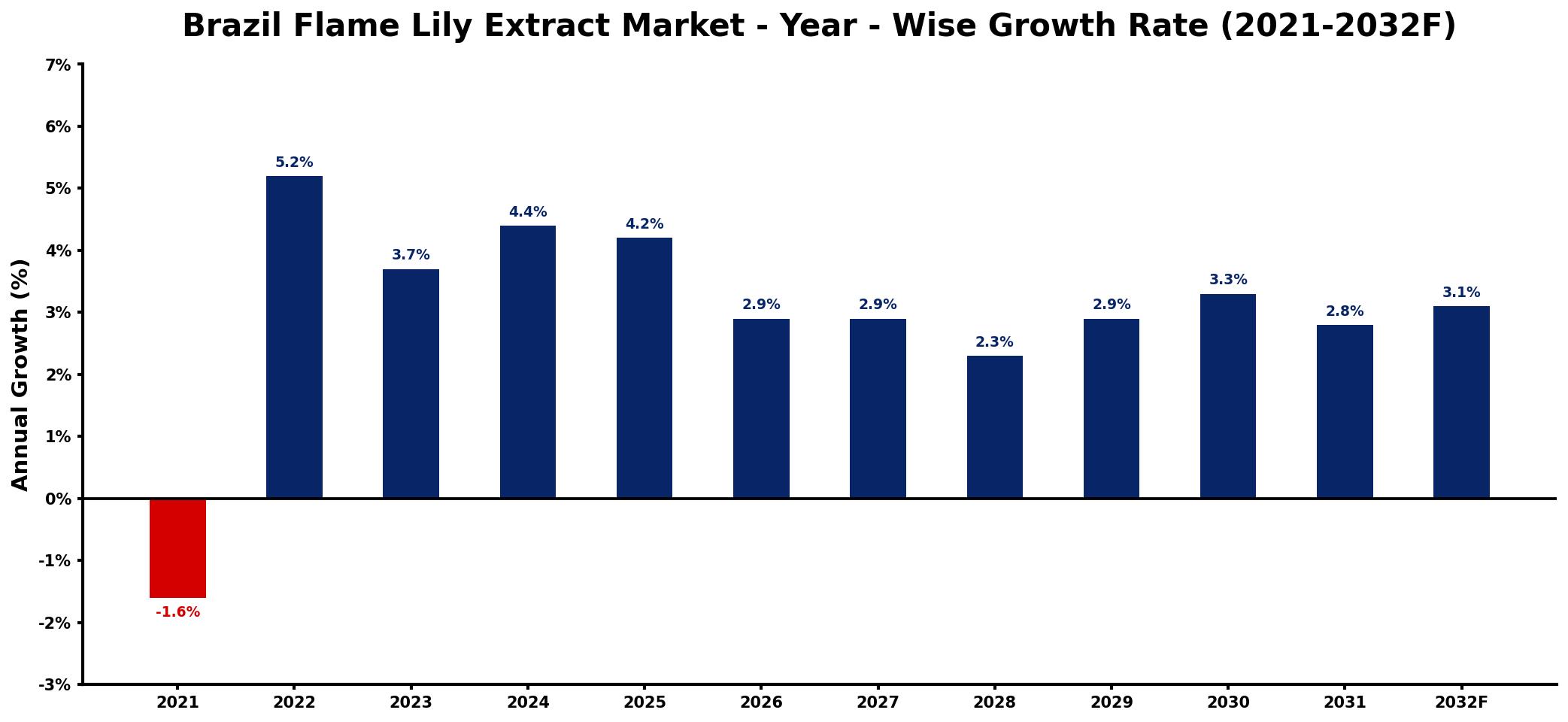
The table below presents the year‑wise growth rates along with the key drivers influencing the market
| Year | Growth Rate | Major Drivers |
| 2021 | -1.6% | decreased consumer interest in applications |
| 2022 | 5.2% | expansion of natural ingredient usage |
| 2023 | 3.7% | growing demand for wellness products |
| 2024 | 4.4% | increased investments in sustainable sourcing |
| 2025 | 4.2% | rising popularity of herbal remedies |
| 2026 | 2.9% | enhanced marketing for health benefits |
| 2027 | 2.9% | growth in organic product categories |
| 2028 | 2.3% | development of new product formulations |
| 2029 | 2.9% | increased collaboration with beauty brands |
| 2030 | 3.3% | growing regional consumption patterns |
| 2031 | 2.8% | growing trend towards eco-friendly products |
| 2032 | 3.1% | increased consumer awareness of health |
Note: Market size estimations and growth projections presented in this report are based on 6Wresearch's proprietary forecasting methodology, utilizing the latest available industry data, government publications, and primary research inputs.
Brazil Flame Lily Extract Market Synopsis
The most significant force currently shaping the Brazil Flame Lily Extract Market is the increasing consumer preference for natural remedies and herbal supplements. With a growing awareness of the adverse effects of synthetic products, consumers are turning to botanical extracts like flame lily to enhance their well-being.
Furthermore, the integration of flame lily extract into cosmetics and skincare products has opened new avenues for market expansion. The appeal of natural ingredients in beauty products is gaining traction, which aligns with the overarching trend of wellness and self-care among Brazilian consumers.
Brazil Flame Lily Extract Market Key Takeaways
- The market is benefitting from rising health-conscious consumer behavior.
- Technological advancements in extraction methods are enhancing product quality.
- Collaboration across the industry is critical for sustainable sourcing practices.
- Regulatory compliance is essential for maintaining consumer trust.
- Demand for natural ingredients in cosmetics is a significant growth driver.
Evaluation of Restraints in Brazil Flame Lily Extract Market
Despite its promising growth, the Brazil Flame Lily Extract Market faces several restraints that could inhibit its potential. Supply chain management is a notable concern, as fluctuations in flower availability can disrupt production schedules. Furthermore, ensuring quality control remains a challenge, particularly as the market grows and more players enter the field. As consumer demand varies, companies must be vigilant in maintaining product integrity and compliance with stringent regulatory standards, which requires substantial investment in both time and resources.
Brazil Flame Lily Extract Market Trends
The trend toward sustainability is significantly impacting the Brazil Flame Lily Extract Market. Companies are increasingly focusing on responsible sourcing and eco-friendly harvesting practices to ensure long-term viability of flame lily populations. Additionally, the rise of e-commerce and online marketplaces is reshaping how products are marketed and distributed, making them more accessible to a broader audience.
Moreover, innovation in formulation techniques is enhancing the efficacy of flame lily extract in both health and beauty applications. This trend is being complemented by the broader wellness movement, which promotes natural and organic ingredients in personal care and dietary products.
Brazil Flame Lily Extract Market Opportunities
There are promising opportunities within the Brazil Flame Lily Extract Market for investment and growth. The increasing focus on herbal supplements for immune support and overall health presents a viable niche for market players. Additionally, partnerships with local farmers for sustainable cultivation can strengthen supply chains while ensuring product authenticity. Finally, expanding into export markets could leverage Brazils rich biodiversity and enhance the global footprint of flame lily extract.
Government Initiatives in the Brazil Flame Lily Extract Market
Government policies in Brazil are increasingly prioritizing sustainable practices and conservation of native flora, including flame lily. Programs aimed at promoting awareness about the ecological significance of these plants are critical in fostering responsible harvesting. Additionally, public incentives to cultivate flame lilies sustainably can enhance both availability and quality, creating a more robust market environment.
Future Insights of the Brazil Flame Lily Extract Market
Looking ahead to 2026-2032, the Brazil Flame Lily Extract Market is poised for steady growth as consumer preferences continue to shift toward natural alternatives. Ongoing research into the therapeutic benefits of flame lily may further validate its market position and expand its applications. Moreover, as regulatory frameworks evolve, businesses that adapt quickly to compliance requirements will likely gain a competitive advantage in this expanding market.
Brazil Flame Lily Extract Market Latest Developments (2025 - 2026)
Recent developments indicate a significant uptick in investment towards enhancing extraction techniques, aimed at maximizing yield while minimizing environmental impact. Industry collaborations are forming to bolster awareness campaigns that educate consumers about the benefits and sustainable sourcing of flame lily extract. Additionally, the rise in artisanal and niche products incorporating flame lily is diversifying the market landscape.
Brazil Flame Lily Extract Market - Key Attractiveness of the Report
- 10 Years of Market Numbers
- Historical Data Starting from 2022 to 2025
- Base Year: 2025
- Forecast Data until 2032
- Key Performance Indicators Impacting the Market
- Major Upcoming Developments and Projects
Key Highlights of the Report:
- Brazil Flame Lily Extract Market Outlook
- Market Size of Brazil Flame Lily Extract Market, 2025
- Forecast of Brazil Flame Lily Extract Market, 2032
- Historical Data and Forecast of Brazil Flame Lily Extract Revenues & Volume for the Period 2022-2032F
- Brazil Flame Lily Extract Market Trend Evolution
- Brazil Flame Lily Extract Market Drivers and Challenges
- Brazil Flame Lily Extract Price Trends
- Brazil Flame Lily Extract Porter's Five Forces
- Brazil Flame Lily Extract Industry Life Cycle
- Historical Data and Forecast of Brazil Flame Lily Extract Market Revenues & Volume By Source for the Period 2022-2032F
- Historical Data and Forecast of Brazil Flame Lily Extract Market Revenues & Volume By Seeds for the Period 2022-2032F
- Historical Data and Forecast of Brazil Flame Lily Extract Market Revenues & Volume By Leaf for the Period 2022-2032F
- Historical Data and Forecast of Brazil Flame Lily Extract Market Revenues & Volume By Root for the Period 2022-2032F
- Historical Data and Forecast of Brazil Flame Lily Extract Market Revenues & Volume By Others for the Period 2022-2032F
- Historical Data and Forecast of Brazil Flame Lily Extract Market Revenues & Volume By End Users for the Period 2022-2032F
- Historical Data and Forecast of Brazil Flame Lily Extract Market Revenues & Volume By Pharmaceuticals for the Period 2022-2032F
- Historical Data and Forecast of Brazil Flame Lily Extract Market Revenues & Volume By Agriculture for the Period 2022-2032F
- Historical Data and Forecast of Brazil Flame Lily Extract Market Revenues & Volume By Others for the Period 2022-2032F
- Brazil Flame Lily Extract Import Export Trade Statistics
- Market Opportunity Assessment By Source
- Market Opportunity Assessment By End Users
- Brazil Flame Lily Extract Top Companies Market Share
- Brazil Flame Lily Extract Competitive Benchmarking By Technical and Operational Parameters
- Brazil Flame Lily Extract Company Profiles
- Brazil Flame Lily Extract Key Strategic Recommendations






































