Brazil Flat Glass Coatings Market Size, Share & Growth Rate
The Brazil Flat Glass Coatings Market was estimated at USD 248 Million in 2025 and is projected to reach USD 294 Million by 2032, growing at a CAGR of 2.5% from 2026 to 2032. This growth trajectory can be attributed to the increasing focus on energy-efficient solutions in both construction and automotive sectors. As sustainability becomes a central tenet of modern design, the demand for flat glass coatings that enhance thermal insulation and reduce glare is steadily on the rise.
Brazil Flat Glass Coatings Market Year-wise Growth Rate and Key Drivers
This graph highlights how the Brazil Flat Glass Coatings Market has steadily grown over the years, supported by major growth factors.
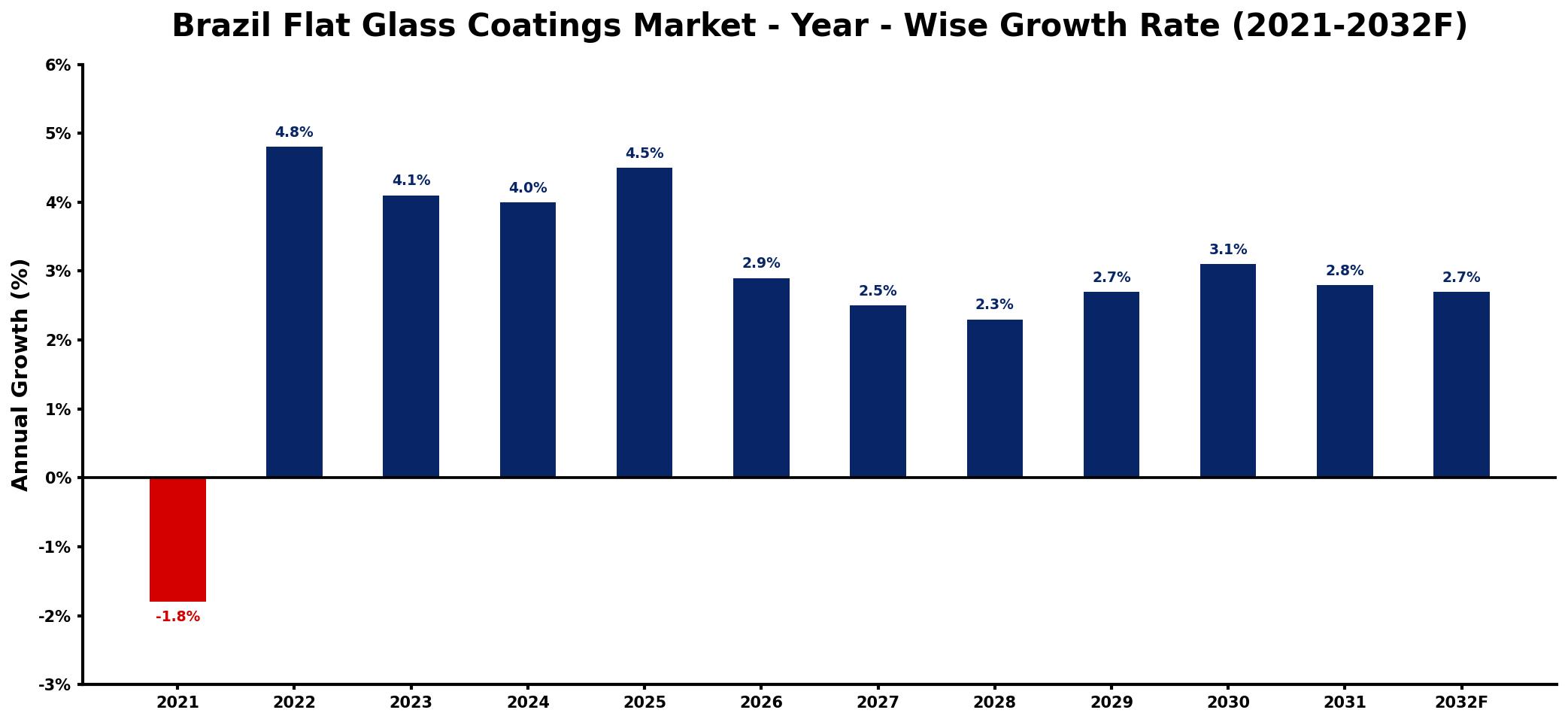
The table below presents the year‑wise growth rates along with the key drivers influencing the market
| Year | Growth Rate | Major Drivers |
| 2021 | -1.8% | Decreased construction project investments |
| 2022 | 4.8% | Rising demand from automotive sector |
| 2023 | 4.1% | Expansion in renewable energy projects |
| 2024 | 4.0% | Increased residential building activities |
| 2025 | 4.5% | Growth in infrastructure spending programs |
| 2026 | 2.9% | Surge in energy efficiency initiatives |
| 2027 | 2.5% | Higher adoption of green technologies |
| 2028 | 2.3% | Increased focus on sustainability trends |
| 2029 | 2.7% | Growing urbanization and population density |
| 2030 | 3.1% | Rising consumer preference for aesthetics |
| 2031 | 2.8% | Expansion of commercial real estate |
| 2032 | 2.7% | Increased investment in renovation projects |
Note: Market size estimations and growth projections presented in this report are based on 6Wresearch's proprietary forecasting methodology, utilizing the latest available industry data, government publications, and primary research inputs.
Brazil Flat Glass Coatings Market Synopsis
The Brazilian market for flat glass coatings is characterized by a strong shift towards environmentally friendly products. This trend is not only a response to consumer preferences but is also spurred by stricter regulations aimed at reducing carbon footprints. Architectural firms and builders are increasingly integrating these coatings into their projects to achieve better energy ratings.
Additionally, the automotive sector in Brazil is witnessing a surge in demand for advanced glass coatings, driven by the need for improved safety features and aesthetic appeal. This has propelled manufacturers to innovate and adapt their offerings, leading to a competitive landscape that fosters growth.
Brazil Flat Glass Coatings Market Key Takeaways
- The market is driven by rising demand for energy-efficient building materials.
- Eco-friendly coatings are becoming increasingly vital due to regulatory pressures.
- The automotive sector is a key application area, significantly impacting market dynamics.
- Technological advancements are fostering innovation in coating formulations.
- Government policies are encouraging the adoption of sustainable practices in construction.
Evaluation of Restraints in Brazil Flat Glass Coatings Market
Despite the promising growth potential, several restraints may hinder the Brazil Flat Glass Coatings Market. One prominent challenge is the increasing pressure to develop coatings that are both high-performing and environmentally sustainable. This requires significant investment in R&D, which may be difficult for smaller players. Furthermore, the relatively high cost of advanced coatings compared to traditional alternatives could limit market penetration, particularly in price-sensitive segments of the construction industry.
Brazil Flat Glass Coatings Market Trends
A notable trend in the Brazil Flat Glass Coatings Market is the integration of smart technologies into coatings, such as self-cleaning and anti-fogging properties. These innovations are in response to consumer demands for convenience and functionality. Additionally, there is a growing inclination towards coatings that offer UV protection and enhanced durability, reflecting a broader awareness of health and safety among consumers.
Brazil Flat Glass Coatings Market Opportunities
The expanding real estate and construction sectors in Brazil present significant opportunities for the flat glass coatings market. As urbanization continues, more residential and commercial properties are being constructed, thereby driving the demand for advanced glass solutions. Furthermore, the adoption of energy-efficient technologies in buildings, bolstered by government incentives, highlights the markets potential for innovation and growth.
Government Initiatives in the Brazil Flat Glass Coatings Market
The Brazilian government is actively promoting policies that encourage the use of flat glass coatings for enhanced energy efficiency. Initiatives include providing financial incentives for projects that utilize energy-saving technologies and enforcing regulations aimed at promoting eco-friendly coatings. These efforts not only aim to reduce energy consumption but also align with Brazils commitment to sustainability and climate change mitigation.
Future Insights of the Brazil Flat Glass Coatings Market
Looking ahead to 2026-2032, the Brazil Flat Glass Coatings Market is poised for steady growth. With increasing investments in green building technologies and a heightened emphasis on sustainability, manufacturers are expected to focus on developing innovative products that meet evolving consumer needs. Enhanced collaboration between industry stakeholders, including government entities and manufacturers, will likely play a crucial role in shaping the market landscape.
Brazil Flat Glass Coatings Market Latest Developments (2025 - 2026)
Recent developments in the Brazil Flat Glass Coatings Market indicate a surge in R&D efforts focused on creating sustainable and high-performance coatings. Companies are prioritizing investments in eco-friendly technology as consumer demand for green products escalates. Additionally, industry collaborations are emerging to streamline the supply chain and improve product distribution, further enhancing market accessibility.
Brazil Flat Glass Coatings Market - Key Attractiveness of the Report
- 10 Years of Market Numbers
- Historical Data Starting from 2022 to 2025
- Base Year: 2025
- Forecast Data until 2032
- Key Performance Indicators Impacting the Market
- Major Upcoming Developments and Projects
Key Highlights of the Report:
- Brazil Flat Glass Coatings Market Outlook
- Market Size of Brazil Flat Glass Coatings Market, 2025
- Forecast of Brazil Flat Glass Coatings Market, 2032
- Historical Data and Forecast of Brazil Flat Glass Coatings Revenues & Volume for the Period 2022-2032F
- Brazil Flat Glass Coatings Market Trend Evolution
- Brazil Flat Glass Coatings Market Drivers and Challenges
- Brazil Flat Glass Coatings Price Trends
- Brazil Flat Glass Coatings Porter's Five Forces
- Brazil Flat Glass Coatings Industry Life Cycle
- Historical Data and Forecast of Brazil Flat Glass Coatings Market Revenues & Volume By Application for the Period 2022-2032F
- Historical Data and Forecast of Brazil Flat Glass Coatings Market Revenues & Volume By Flat Glass Mirror Coatings for the Period 2022-2032F
- Historical Data and Forecast of Brazil Flat Glass Coatings Market Revenues & Volume By Flat Glass Coatings for Solar Power Generation for the Period 2022-2032F
- Historical Data and Forecast of Brazil Flat Glass Coatings Market Revenues & Volume By Flat Glass Coatings for Architectural Applications for the Period 2022-2032F
- Historical Data and Forecast of Brazil Flat Glass Coatings Market Revenues & Volume By Flat Glass Coatings for Automotive Applications for the Period 2022-2032F
- Historical Data and Forecast of Brazil Flat Glass Coatings Market Revenues & Volume By Flat Glass Coatings for Other Applications for the Period 2022-2032F
- Historical Data and Forecast of Brazil Flat Glass Coatings Market Revenues & Volume By Resin for the Period 2022-2032F
- Historical Data and Forecast of Brazil Flat Glass Coatings Market Revenues & Volume By Polyurethane Flat Glass Coatings for the Period 2022-2032F
- Historical Data and Forecast of Brazil Flat Glass Coatings Market Revenues & Volume By Epoxy Flat Glass Coatings for the Period 2022-2032F
- Historical Data and Forecast of Brazil Flat Glass Coatings Market Revenues & Volume By Acrylic Flat Glass Coatings for the Period 2022-2032F
- Historical Data and Forecast of Brazil Flat Glass Coatings Market Revenues & Volume By Other Resin Flat Glass Coatings for the Period 2022-2032F
- Historical Data and Forecast of Brazil Flat Glass Coatings Market Revenues & Volume By Technology for the Period 2022-2032F
- Historical Data and Forecast of Brazil Flat Glass Coatings Market Revenues & Volume By Solvent-based Flat Glass Coatings for the Period 2022-2032F
- Historical Data and Forecast of Brazil Flat Glass Coatings Market Revenues & Volume By Water-based Flat Glass Coatings for the Period 2022-2032F
- Historical Data and Forecast of Brazil Flat Glass Coatings Market Revenues & Volume By Nano Flat Glass Coatings for the Period 2022-2032F
- Brazil Flat Glass Coatings Import Export Trade Statistics
- Market Opportunity Assessment By Application
- Market Opportunity Assessment By Resin
- Market Opportunity Assessment By Technology
- Brazil Flat Glass Coatings Top Companies Market Share
- Brazil Flat Glass Coatings Competitive Benchmarking By Technical and Operational Parameters
- Brazil Flat Glass Coatings Company Profiles
- Brazil Flat Glass Coatings Key Strategic Recommendations






































