Brazil Food Packaging Market Summary
The brazil food packaging market was estimated at USD 229 Million in 2025 and is projected to reach USD 273 Million by 2032, growing at a CAGR of 3.2% from 2026 to 2032.
Brazil Food Packaging Market Year-wise Growth Rate and Key Drivers
This graph highlights how the Brazil Food Packaging Market has steadily grown over the years, supported by major growth factors.
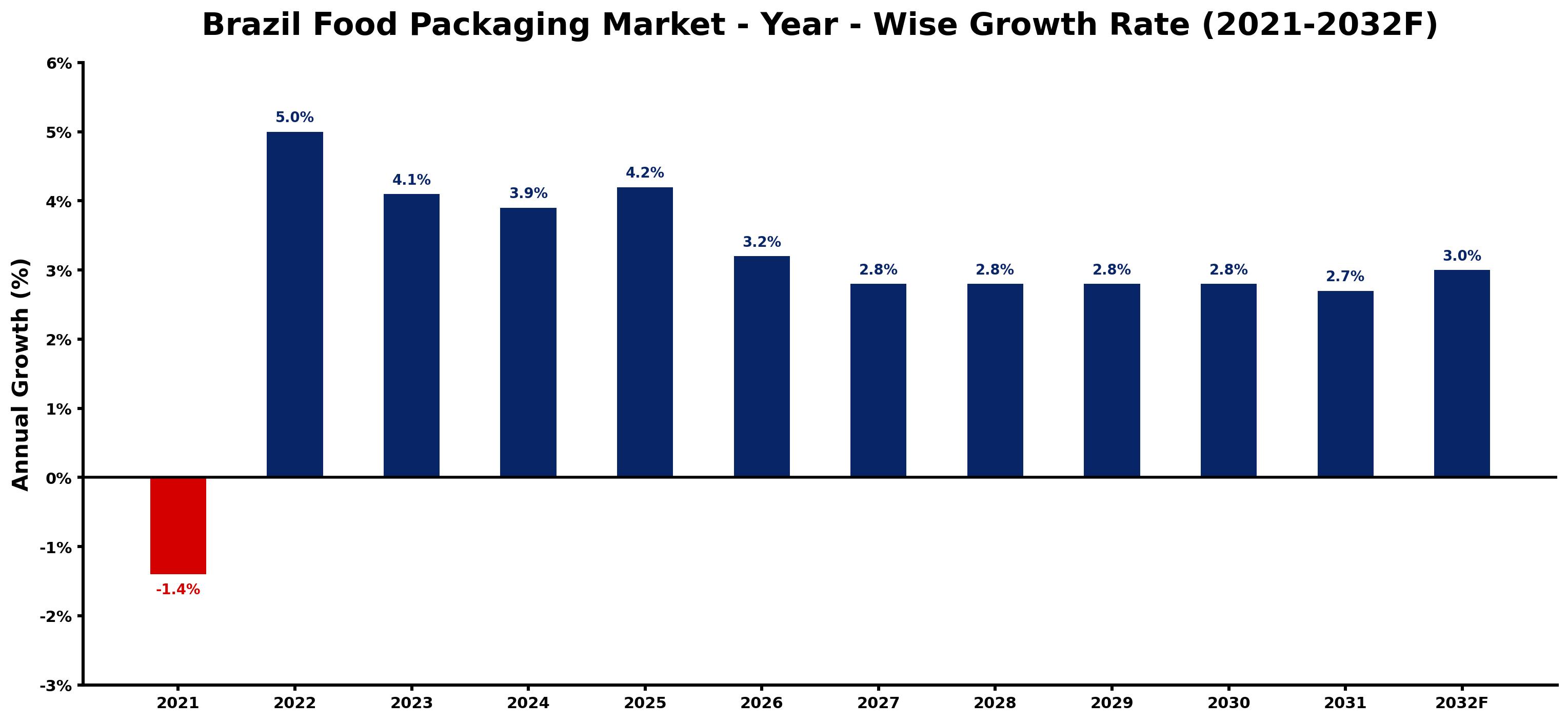
The table below presents the year wise growth rates along with the key drivers influencing the market
| Year | Growth Rate | Major Drivers |
| 2021 | -1.4% | Supply chain disruptions hindered the timely availability of packaging materials, impacting overall market performance. |
| 2022 | 5.0% | E-commerce expansion necessitated versatile packaging options for diverse food products. |
| 2023 | 4.1% | Sustainable packaging materials caught attention, aligning with consumer environmental consciousness trends. |
| 2024 | 3.9% | Local food production growth encouraged innovation in customized packaging designs. |
| 2025 | 4.2% | Technological advancements in packaging machinery enhanced production efficiency and quality control. |
| 2026 | 3.2% | Increased urbanization created higher demand for convenient, ready-to-eat food options. |
| 2027 | 2.8% | Food safety regulations pushed manufacturers towards compliant, high-quality packaging solutions. |
| 2028 | 2.8% | Rising disposable income allowed consumers to invest in premium food packaging products. |
| 2029 | 2.8% | Market competition intensified, leading brands to innovate and differentiate packaging strategies. |
| 2030 | 2.8% | Adoption of automation streamlined packaging processes, reducing operational costs significantly. |
| 2031 | 2.7% | Consumer preference for sustainable options continued to shape packaging material choices. |
| 2032 | 3.0% | Collaboration between food brands and packaging companies emphasized design and sustainability synergy. |
Note - Market size estimations and growth projections presented in this report are based on 6Wresearch's advanced forecasting approach, validated with industry datasets as of June 2026.
Brazil Food Packaging Market Synopsis
The Brazil Food Packaging Market is projected to reach 3.2% and witness significant growth during the forecast period (2026-2032). Driven by shifting consumer behavior, enhanced demands for sustainability, and strict regulatory measures, the food packaging sector in Brazil is at a pivotal transformation point. Innovations in packaging materials and processes are critical to addressing both safety and environmental concerns, thereby influencing market dynamics.
Brazil Food Packaging Market Growth Drivers
The demand for advanced food packaging solutions in Brazil is being propelled by several factors:
- The trend towards healthier eating habits is prompting manufacturers to invest in packaging that can extend product shelf life while maintaining freshness.
- An increased awareness among consumers regarding food safety has led to higher standards for packaging materials, driving the need for compliance with stringent food safety regulations.
- Sustainability trends are reshaping consumer preferences, with a growing inclination towards recyclable and biodegradable packaging options, thereby pushing businesses to adapt accordingly.
- Technological advancements in packaging processes, such as modified atmosphere packaging (MAP), are enhancing the preservation of food products, aligning with market demands for longer shelf life.
- The rise of e-commerce in food retail is necessitating robust packaging solutions that can protect products during transportation, further influencing developments in the sector.
Brazil Food Packaging Market Challenges and Restraints
Despite the promising growth, the Brazil Food Packaging Market faces several challenges that may hinder its expansion:
- Compliance with complex food safety regulations presents a significant barrier for many manufacturers, as they must ensure that packaging materials uphold the quality and safety of food products.
- The evolving landscape of consumer preferences demands continuous innovation, making it crucial for companies to stay agile and responsive to shifting trends in food consumption.
- Sustainability concerns are leading to increased pressure on businesses to reduce environmental footprints, complicating the balance between functionality and eco-friendliness in packaging design.
- The fluctuating prices of raw materials used in packaging production can affect overall manufacturing costs, presenting financial challenges for companies in the industry.
- Additionally, the need for convenience in packaging, such as easy-to-open and resealable designs, further complicates the manufacturing process and increases production complexity.
Brazil Food Packaging Market Government Investment and Initiatives
The Brazilian government plays a pivotal role in influencing the food packaging sector through various policies and initiatives aimed at enhancing food safety and promoting sustainable practices:
- Regulatory frameworks are rigorously enforced to ensure that food packaging materials meet safety and hygiene standards, safeguarding consumer health.
- Initiatives aimed at increasing the use of recyclable and biodegradable materials are gaining momentum, supported by government incentives towards eco-friendly packaging solutions.
- Public funding has been directed towards research and development in innovative packaging technologies, facilitating the evolution of sustainable practices within the industry.
- The government is also prioritizing educational programs to inform both consumers and manufacturers about the importance of sustainable packaging, fostering a culture of responsibility.
- Strategic partnerships between the public and private sectors are being formed to enhance technological advancements in food packaging, ensuring alignment with safety regulations and consumer preferences.
Brazil Food Packaging Market Latest Developments (May 2025 - June 2026)
In the period from May 2025 to June 2026, the Brazil Food Packaging Market is observing notable developments that indicate a shift towards sustainability and innovation:
- Heightened focus on sustainable packaging solutions is leading to increased investments in bioplastics and other eco-friendly materials, aligning with global sustainability trends.
- Companies are undertaking significant efforts to redesign packaging solutions that reduce waste and enhance recyclability, aiming to meet stringent environmental regulations.
- Collaborations among stakeholders, including packaging manufacturers and food producers, are intensifying to innovate on sustainable practices and develop new packaging technologies.
- Consumer demand for transparency in product sourcing and packaging is growing, driving businesses to adopt clearer labeling practices that emphasize sustainability.
- Digital technologies are gaining traction in packaging design processes, allowing for enhanced customization and optimization to meet specific consumer and regulatory requirements.
Brazil Food Packaging Market - Key Attractiveness of the Report
- 10 Years of Market Numbers
- Historical Data Starting from 2022 to 2025
- Base Year: 2025
- Forecast Data until 2032
- Key Performance Indicators Impacting the Market
- Major Upcoming Developments and Projects
Key Highlights of the Report:
- Brazil Food Packaging Market Outlook
- Market Size of Brazil Food Packaging Market, 2025
- Forecast of Brazil Food Packaging Market, 2032
- Historical Data and Forecast of Brazil Food Packaging Revenues & Volume for the Period 2022-2032F
- Brazil Food Packaging Market Trend Evolution
- Brazil Food Packaging Market Drivers and Challenges
- Brazil Food Packaging Price Trends
- Brazil Food Packaging Porter's Five Forces
- Brazil Food Packaging Industry Life Cycle
- Historical Data and Forecast of Brazil Food Packaging Market Revenues & Volume By Material Types for the Period 2022-2032F
- Historical Data and Forecast of Brazil Food Packaging Market Revenues & Volume By Paper & board for the Period 2022-2032F
- Historical Data and Forecast of Brazil Food Packaging Market Revenues & Volume By Plastic for the Period 2022-2032F
- Historical Data and Forecast of Brazil Food Packaging Market Revenues & Volume By Metal for the Period 2022-2032F
- Historical Data and Forecast of Brazil Food Packaging Market Revenues & Volume By Glass for the Period 2022-2032F
- Historical Data and Forecast of Brazil Food Packaging Market Revenues & Volume By Others for the Period 2022-2032F
- Historical Data and Forecast of Brazil Food Packaging Market Revenues & Volume By Product Types for the Period 2022-2032F
- Historical Data and Forecast of Brazil Food Packaging Market Revenues & Volume By Rigid for the Period 2022-2032F
- Historical Data and Forecast of Brazil Food Packaging Market Revenues & Volume By Semi-Rigid for the Period 2022-2032F
- Historical Data and Forecast of Brazil Food Packaging Market Revenues & Volume By Flexible for the Period 2022-2032F
- Historical Data and Forecast of Brazil Food Packaging Market Revenues & Volume By Applications for the Period 2022-2032F
- Historical Data and Forecast of Brazil Food Packaging Market Revenues & Volume By Bakery & Confectionary for the Period 2022-2032F
- Historical Data and Forecast of Brazil Food Packaging Market Revenues & Volume By Dairy Products for the Period 2022-2032F
- Historical Data and Forecast of Brazil Food Packaging Market Revenues & Volume By Fruits & Vegetables for the Period 2022-2032F
- Historical Data and Forecast of Brazil Food Packaging Market Revenues & Volume By Meat, Poultry, & Seafood for the Period 2022-2032F
- Historical Data and Forecast of Brazil Food Packaging Market Revenues & Volume By Sauces & Dressings for the Period 2022-2032F
- Historical Data and Forecast of Brazil Food Packaging Market Revenues & Volume By Others for the Period 2022-2032F
- Brazil Food Packaging Import Export Trade Statistics
- Market Opportunity Assessment By Material Types
- Market Opportunity Assessment By Product Types
- Market Opportunity Assessment By Applications
- Brazil Food Packaging Top Companies Market Share
- Brazil Food Packaging Competitive Benchmarking By Technical and Operational Parameters
- Brazil Food Packaging Company Profiles
- Brazil Food Packaging Key Strategic Recommendations






































