Brazil Forklift Truck Market Growth Rate Analysis (2025 - 2031)
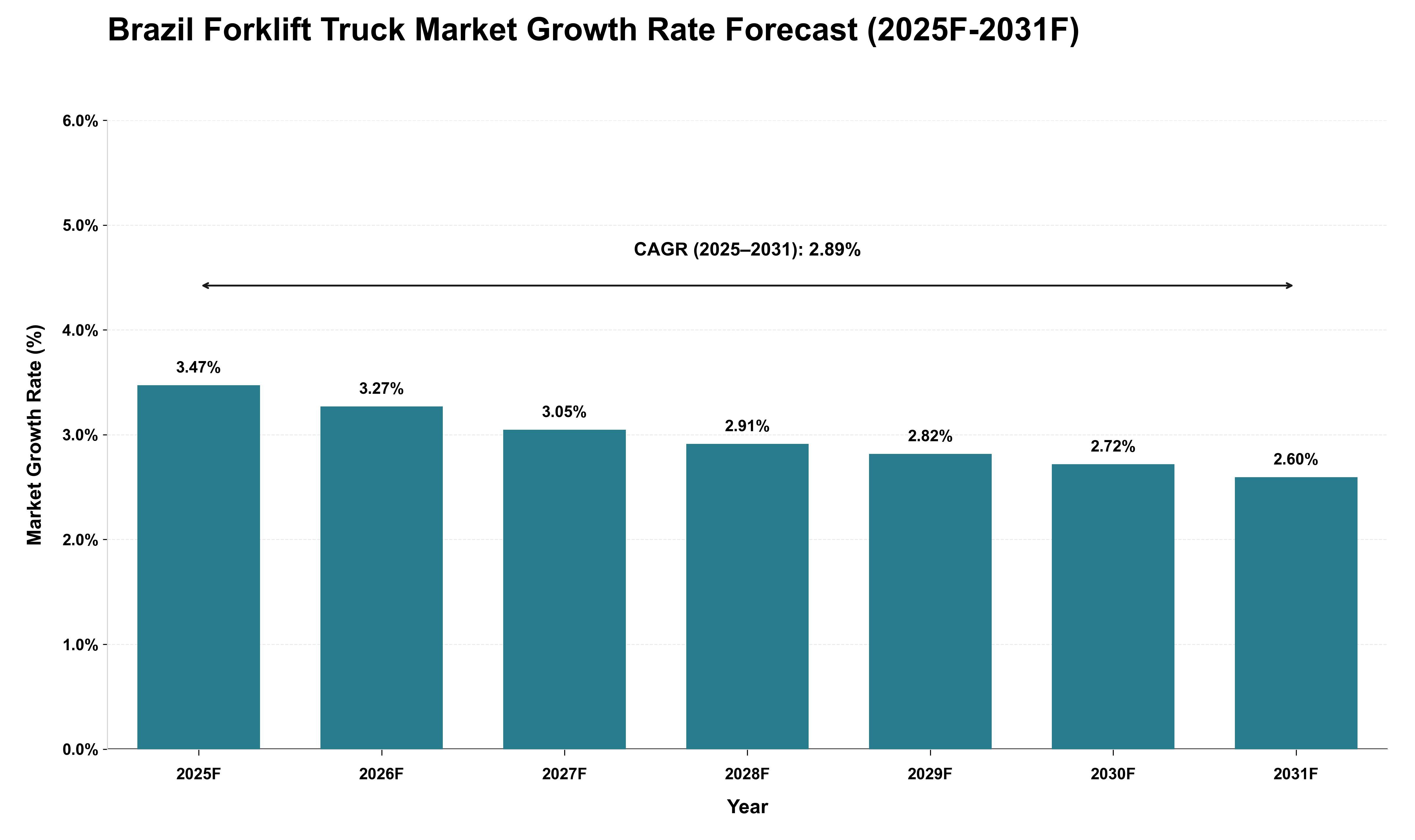
The Brazilian forklift truck market will experience a compound annual growth rate (CAGR) of 2.89% from 2025 to 2031, driven primarily by evolving supply chain dynamics and fluctuating input costs. As global trade patterns shift, Brazil's reliance on imported components for forklift manufacturing will likely influence pricing structures and availability, particularly in the face of potential tariff adjustments and logistics challenges. The initial growth rate of 3.47% in 2025 suggests a robust demand recovery phase, which will gradually taper as input costs stabilize and production efficiencies are realized. By 2031, the growth rate is projected to decline to 2.60%, reflecting a normalization in demand as businesses adapt to new operational realities post-pandemic. This trajectory underscores the importance of monitoring global supply chain resilience and cost fluctuations that could impact both production capabilities and market competitiveness within Brazil's forklift sector.
Key Highlights of the Report:
- Brazil Forklift Truck Market Outlook
- Market Size of Brazil Forklift Truck Market, 2024
- Forecast of Brazil Forklift Truck Market, 2031
- Historical Data and Forecast of Brazil Forklift Truck Revenues & Volume for the Period 2021- 2031
- Brazil Forklift Truck Market Trend Evolution
- Brazil Forklift Truck Market Drivers and Challenges
- Brazil Forklift Truck Price Trends
- Brazil Forklift Truck Porter's Five Forces
- Brazil Forklift Truck Industry Life Cycle
- Historical Data and Forecast of Brazil Forklift Truck Market Revenues & Volume By Type for the Period 2021- 2031
- Historical Data and Forecast of Brazil Forklift Truck Market Revenues & Volume By Counterbalance for the Period 2021- 2031
- Historical Data and Forecast of Brazil Forklift Truck Market Revenues & Volume By Warehouse for the Period 2021- 2031
- Historical Data and Forecast of Brazil Forklift Truck Market Revenues & Volume By Power Source for the Period 2021- 2031
- Historical Data and Forecast of Brazil Forklift Truck Market Revenues & Volume By Internal Combustion Forklift Truck for the Period 2021- 2031
- Historical Data and Forecast of Brazil Forklift Truck Market Revenues & Volume By Electric Forklift Truck for the Period 2021- 2031
- Brazil Forklift Truck Import Export Trade Statistics
- Market Opportunity Assessment By Type
- Market Opportunity Assessment By Power Source
- Brazil Forklift Truck Top Companies Market Share
- Brazil Forklift Truck Competitive Benchmarking By Technical and Operational Parameters
- Brazil Forklift Truck Company Profiles
- Brazil Forklift Truck Key Strategic Recommendations






































